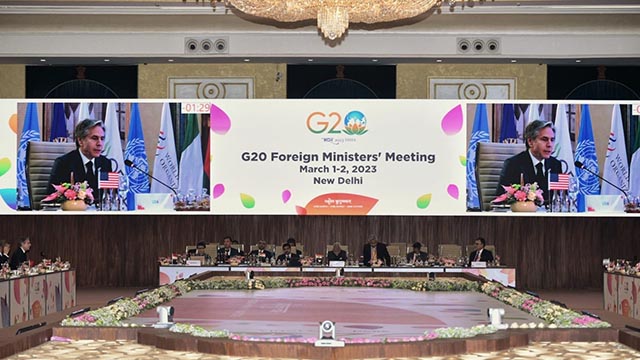
India hosted the G20 Foreign Ministers’ Meeting at New Delhi’s Rashtrapati Bhawan from March 1st to March 2nd. Confrontations between the US-led western bloc and the Russian foreign ministry officials during this meeting exhibited how the shadow of Moscow’s special military operations in Ukraine looms large on global affairs.
The emergence of bitter hostilities between the western bloc under the US’s leadership and the Russian side showed the futility to expect any consensus on global issues, especially those related to economic development.
EAM discloses the problems in the G20 Foreign Ministers’ Meeting
India’s External Affairs Minister S Jaishankar said, “I would say, I don’t want to put a percentage on it because that’s not a fair way of depicting …a collection of issues, but do appreciate that on the bulk of the issues, which concern especially the global South, the developing countries, there was a considerable meeting of minds”.
Jaishankar underscored the importance of moving ahead with other agendas of the G20 Foreign Ministers’ Meeting and said, “…for the Global South, the Russia-Ukraine conflict is a make-or-break issue”.
“If we had a perfect meeting of minds on all issues and captured it fully, then obviously, it would have been a collective statement, but there were issues… I would say, very frankly, concerned the Ukraine conflict on which there were divergences… there were differences on the Ukraine issue, which we could not reconcile between various parties who held differing positions”, the external affairs minister said.
PM speaks of “deep global divisions”
Indian Prime Minister Narendra Modi also urged the foreign ministers to engage with each other, despite their hostile views, in a meaningful way. “You are meeting at a time of deep global divisions”, Modi said.
Modi also said, “As Foreign Ministers, it is but natural that your discussions are affected by the geo-political tensions of the day. We all have our positions and our perspectives on how these tensions should be resolved. However, as the leading economies of the world, we also have a responsibility towards those who are not in this room. The world looks upon the G20 to ease the challenges of growth, development, economic resilience, disaster resilience, financial stability, transnational crime, corruption, terrorism, and food and energy security. In all these areas, the G20 has capacity to build consensus and deliver concrete results. We should not allow issues that we cannot resolve together to come in the way of those we can.”
While, at the same time, Modi accused the West of pushing multilateralism to sheer crisis and causing devastation in developing countries. He said, “We must all acknowledge that multilateralism is in crisis today”.
India’s position on multilateralism has made it a neutral entity in the Ukraine conflict, which has visibly irked the West. However, India has remained consistent with pursuing a relatively ‘independent’ foreign policy.
“Many developing countries are struggling with unsustainable debt while trying to ensure food and energy security for their people. They are also the ones most affected by global warming caused by richer countries”, Modi accused.
He also claimed that India’s G20 presidency has “tried to give a voice to the Global South”. Modi also said that no single country or group can claim global leadership, ignoring the voice of the developing countries. “No group can claim global leadership without listening to those most affected by its decisions”, Modi said, purportedly taking a dig at the West.
Russia vs the West at the G20 Foreign Ministers’ Meeting
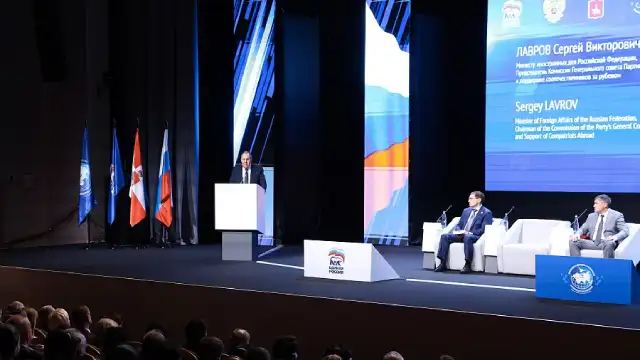
During the G20 Foreign Ministers’ Meeting, Russian Foreign Minister Sergei Lavrov accused the West of blaming Russia for everything going wrong in their countries. Lavrov alleged that the West is blaming Russia’s special military operation in Ukraine for inflation in their countries, while, at the same time, it didn’t allow Russia to take steps to ease the global supply of food grains from Ukraine.
He alleged that the western delegates to the G20 Foreign Ministers’ Meeting have turned the event into a “farce”, by turning it into an occasion to bash Russia for their failures in curbing inflation.
“A number of Western delegations turned the work on the G20 agenda into a farce, wanting to shift the responsibility for their failures in the economy to the Russian Federation,” Lavrov alleged.
Lavrov accused the West of “shamelessly burying” the Black Sea grain export initiative that Moscow took in 2022 to ensure that Ukraine can export its agricultural produce through the southern ports. The grain export could have eased the pressure on Africa and other continents, while also easing the inflationary pressure caused on several geographies due to the supply-chain disruption caused by the Ukraine conflict.
“The West creates obstacles for the export of agricultural products of the Russian Federation, no matter how the representatives of the EU convince the contrary,” Lavrov said.
Lavrov advocated for a reform of the United Nations Security Council (UNSC). He said, “…it’s time to reform the UN Security Council”. Lavrov further claimed, “This invasion (of Ukraine as per the West) reflects the reaction to the war the West was preparing for many years and that is why it was arming the Ukrainian regime.”
The US Foreign Secretary Anthony Blinken accused Russia of waging an “unprovoked and unjustified war” against Ukraine and asked it to immediately cease the special military operation.
Blinken alleged that Russia’s special military operation in Ukraine is the major cause of the economic inflation in the West while remaining mum on the sanctions on Russia imposed by US President Joe Biden’s administration.
“We must continue to call on Russia to end its war of aggression and withdraw from Ukraine for the sake of international peace and economic stability,” Blinken said, drawing a sharp response from Lavrov.
The US allies like France, Germany and the Netherlands supported Blinken in the G20 Foreign Ministers’ Meeting. They raised a chorus demanding an end to Russia’s special military operation in Ukraine.
French Foreign Minister Catherine Colonna, German Foreign Minister Annalena Baerbock, and Dutch Foreign Minister Wopke Hoekstra toed the US line in the G20 Foreign Ministers’ Meeting and blamed Russia for global inflation. Hoekstra even advocated for prolonging the sanctions on Russia by the US-led western lobby.
The US and the West want Russia to resume the New START treaty
These foreign ministers also wanted Russia to resume the New START treaty —a 2011 nuclear arms treaty with the US that Russian President Vladimir Putin decided to scrap lately—to ensure safety from a nuclear war. However, Russia’s Deputy Foreign Minister Sergei Ryabkov rejected any such proposal and claimed that the US may use the information regarding Russia’s nuclear arsenal to help Ukraine attack such facilities.
At a United Nations disarmament conference in Geneva, Ryabkov alleged that the US had attempted “to probe the security of Russian strategic facilities declared under the New START Treaty by assisting the Kiev regime in conducting armed attacks against them.”
Moscow’s withdrawal from the New START treaty has reportedly stirred panic in the West. But Moscow remains non-committal about resuming the dialogue. Outside the G20 Foreign Ministers’ Meeting, Anatoly Antonov, the Russian Ambassador to the US, accused Washington DC of violating New START central provisions for years.
“Washington has launched and dragged its European allies into a large-scale hybrid war against Russia. It openly declares its goal to inflict a strategic defeat on our country. And at the same time, as if nothing has happened, it insists on the inspection of our bases which store strategic nuclear weapons. It is the same bases that have been attacked by Ukraine with the help of the Pentagon. Where is the adherence to the spirit and letter of New START and its key goal of strengthening the security of Treaty parties? There is nothing but a brazen desire to ‘probe’ the protection of our strategic facilities (sic),” Antonov said in a statement released by the Russian embassy in the US.
The unimpressive outcome of the G20 Foreign Ministers’ Meeting
Although the G20 is a group that consists of the seven richest countries of the world, including the US, it has several other members from the East and the “Global South”, who don’t subscribe to the US’s narratives. Australia, Brazil, China, India, Russia, Saudi Arabia, etc, are members of this prestigious group.
Jaishankar claimed that the G20 Foreign Ministers’ Meeting had, “the presence of Foreign Ministers of 27 countries, apart from India, the chair, and two countries – the Republic of Korea and Japan were represented at the Vice Minister, the Minister of State level.”
The G20 Foreign Ministers’ Meeting in New Delhi was also supposed to deal with broader issues like falling economic growth, increasing inflation, lower demands for goods and services as well as increasing prices of food, fuel, and fertilisers.
Although Jaishankar claimed that the G20 Foreign Ministers’ Meeting was successful and there has been consensus on several issues —like economic development, counter-narcotics, food and fertiliser supply chains, sustainable energy supply chains, global health architecture, pandemic funds, and tackling climate change through raising $100bn per year—the fact is it failed to add any remarkable achievements to the final document.
If the West continues the diplomatic rancour, which it did in the G20 Foreign Ministers’ Meeting in New Delhi, at all international level meetings, then it will be causing more problems for the developing world. The West’s arbitrary actions will eventually polarise the world further and intensify new hostilities, rather than ending the existing ones. This can be a risk factor for global peace and security.
East Post is an independent geopolitical analysis portal covering South Asia and global power dynamics for international audiences. Views expressed are analytical and do not constitute endorsement of any state or non-state actor.
Join our channels on Telegram and WhatsApp to receive geopolitical updates, videos and more.