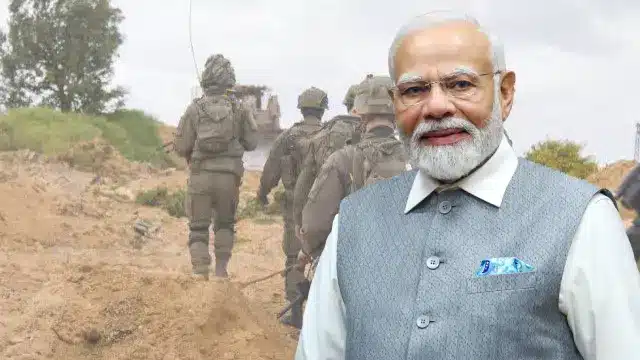
After remaining a mute spectator for nearly ten days, India finally broke its silence on the violence unleashed by the Israeli aggression on the Gaza Strip. The sudden U-turn in India’s stand on the Israel-Palestine conflict has been sharp.
After initially supporting Israel in its aggression on Palestinian people with insouciance, Prime Minister Narendra Modi had to condemn Israel’s bombing of the Al-Ahli Baptist Hospital in Gaza, which killed and wounded over 800 people.
Modi condemns Israeli aggression without naming it
“Deeply shocked at the tragic loss of lives at the Al-Ahli Baptist Hospital in Gaza. Our heartfelt condolences to the families of the victims, and prayers for speedy recovery of those injured. Civilian casualties in the ongoing conflict are a matter of serious and continuing concern. Those involved should be held responsible”, Modi wrote on his X (formerly Twitter) handle.
It was Modi’s first official reaction to the ongoing Israeli aggression on the besieged Gaza Strip. This appears as a frantic attempt to woo the Arab world, which has exhibited deep resentment against the Israeli aggression and condemned the West’s hypocrisy on the ongoing crisis. Then he rang Abbas.
“Spoke to the President of the Palestinian Authority H.E. Mahmoud Abbas. Conveyed my condolences at the loss of civilian lives at the Al Ahli Hospital in Gaza. We will continue to send humanitarian assistance for the Palestinian people. Shared our deep concern at the terrorism, violence and deteriorating security situation in the region. Reiterated India’s long-standing principled position on the Israel-Palestine issue (sic)”, Modi posted on his X handle.
Modi not only avoided mentioning Israel in social media posts or during his conversation with Abbas, but he also didn’t demand an immediate cessation of hostilities from both sides along with a ceasefire, which the Arab countries, supported by China and Russia, have been vocal about.
India’s stand on the Israel-Palestine conflict
Historically, India has been an ally of the Palestinian people and supported their anti-colonial struggle. In principle, India’s stand on the Israel-Palestine conflict conforms to the international agreements on the issue, especially the 1993-Oslo Accords.
New Delhi supports the formation of an independent state of Palestine alongside Israel in a peaceful manner. It supports Israel’s right to exist but believes that long-standing peace in the region can be established through the formation of an independent Palestinian state.
Modi’s tilt towards Israel
However, India’s stand on the Israel-Palestine conflict that flared up following Hamas’s Operation Al-Aqsa Flood on October 7th has been diametrically opposite to its historical position on the issue.
Modi was swift to condemn the Hamas attacks on the occupied territories and following the Rashtriya Swayamsevak Sangh’s (RSS)—the fountainhead of the Hindutva nationalist movement that Modi’s ruling Bharatiya Janata Party (BJP) is a part of—standpoint, he declared support for Israel.
Following Modi’s support for Israel, officials and supporters of his BJP joined the pro-Israel bandwagon on the internet. Driven by sheer Islamophobia, many Indian social media users, allegedly affiliated with the BJP and the RSS, hailed the atrocities committed by the Israeli forces.
The reason behind Modi’s support to Israel, without maintaining a neutral stance and demanding a ceasefire, is rooted in the political mileage that the BJP wants to derive from the Israel-Palestine conflict before the 2024 general elections.
This issue would help the BJP and the RSS polarise the majority Hindu community against the Muslims who support the Palestinian people’s right to exist and right to freedom. Using such a polarisation weapon, Modi can return to power in May 2024 for the third consecutive term.
India’s interests suffer in the Middle East
Though India’s stand on the Israel-Palestine conflict following the October 7th attack remained divided into two parts —the BJP and RSS supporting the Israeli aggression and the MEA reiterating the official principle that calls for the creation of an independent Palestinian state—throughout the Arab world and beyond it appeared that New Delhi has chosen to go along with the Israeli government on the issue. Although it made India a treasure in the Global South for the West, the Arab world and other countries of the Global South weren’t visibly happy.
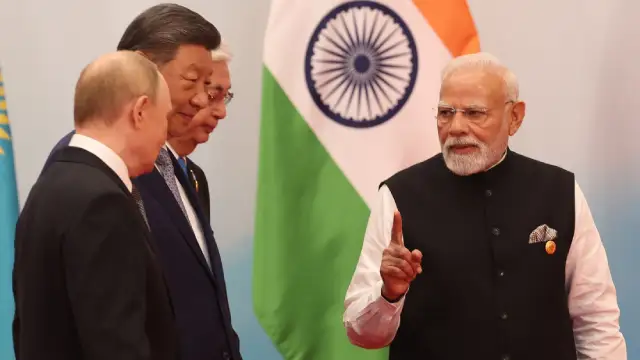
In the meantime, China and Russia, along with their regional allies like Iran, Syria and even countries like Saudi Arabia and Egypt stood against the Israeli aggression. Chinese President Xi Jinping, who met Russian President Vladimir Putin during the celebration of the tenth anniversary of Beijing’s ambitious Belt-Road Initiative (BRI), called for an immediate cessation of hostilities and a ceasefire.
Despite Russia’s close ties with Israel, President Putin has opposed the violence against Palestinians and compared the siege of the Gaza Strip with that of the Nazi siege of Leningrad during the Second World War. Russia has also condemned Israel’s attack on the hospital and blamed the US for the escalation.
Amid the escalating violence, the Palestinians, along with the Iranian and other Arab governments, sought more support from China to end the conflict. US President Joe Biden’s comparison of Russia and Hamas also helped Moscow in consolidating its position in the Arab world, where the resentment against the US is at its peak currently.
In this situation, it became difficult for New Delhi to remain indifferent regarding the changing geopolitical realities in the crucial region. For New Delhi, its unequivocal support for Israel caused severe collateral damage in diplomatic terms.
India has been a stern opponent of China’s BRI. With the help of the US and its European allies, Modi envisioned the India-Middle East-Europe Corridor (IMEC) project to counter the Chinese project in the Middle East.
For the IMEC’s successful completion and to beat the BRI, India needs peace between the Arabs and the Israelis. As India’s stand on the Israel-Palestine conflict following Modi’s support for Israel caused a furore in the Arab world, it became imperative for him to control the damage.
Modi’s reluctance to blame Israel may create problems
Although Modi has condemned the war crime of Israel, his reluctance to name the perpetrator of the violence leaves room for speculation. The Israelis have shifted the blame on the Palestinian Islamic Jihad (PIJ) for the attack on the Al-Ahli Baptist Hospital on Tuesday.
Tel Aviv accused that a misfired PIJ rocket had caused the incident. However, both PIJ and the Arab governments have rejected the claim and blamed Israel for conducting an air raid on a hospital violating all conflict rules and guidelines.
In this scenario, Modi’s silence on the perpetrator of the war crime appears as a tactical move, which would allow India to further blame the PIJ or Hamas for the attack if the Israeli side can bring out evidence to support its claim.
Even though such claims won’t be accepted by the Arabs, New Delhi, at the behest of the US, can use it to blame the “terrorists” for the incident. Modi’s BJP has been viewing the Palestinian resistance as terrorism for a long time.
The MEA’s setback in the Middle East
The MEA has suffered the worst during this conflict due to the BJP-RSS’s ideological support of the Israeli government.
The way India’s television anchors with doubtful credentials have been covering the conflict using an Israeli lens to shape the opinion of the elite and urban middle-class blocs has tarnished India’s image in the Arab world from where New Delhi imports a large volume of fossil fuel.
The MEA’s years of hard work in the Middle East, where it isolated rival Pakistan and deepened its ties with regional power blocs, including Iran and Saudi Arabia, has been pulled down to an abyss and India’s reputation as a neutral, peace-loving country has also got tarnished.
Can Modi’s balancing act undo the damages?
Whether Modi walks the talk, and the MEA could undo the damages done to its efforts in the Middle East by reiterating India’s stand on the Israel-Palestine conflict according to the line that has been hitherto followed is yet to be seen.
However, it’s clear that Modi’s unilateral support to Israel, the Hindutva camp’s cyber war against the pro-Palestinian forces within and outside India, etc, won’t be easy to efface with good public relations campaigning and reaching out to people like Abbas.
East Post is an independent geopolitical analysis portal covering South Asia and global power dynamics for international audiences. Views expressed are analytical and do not constitute endorsement of any state or non-state actor.
Join our channels on Telegram and WhatsApp to receive geopolitical updates, videos and more.