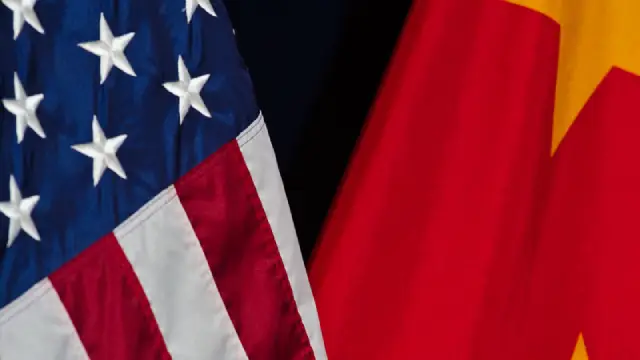
It is with great anticipation that people waited for the meeting between the US and Chinese trade delegations in Sweden from July 27th to July 30th. The meeting takes place at the top level, with Treasury Secretary Scott Bessent leading the US delegation and China’s Vice Premier He Lifeng leading the Chinese delegation. While the meeting could serve as a real stabiliser in the often tense China-US trade relations, there is little optimism about any comprehensive trade deal resulting from it.
Some of the US’s demands are simply matters that China will not consider. For instance, the US calls on China to reduce its trade with Russia on the bogus claim that that trade is somehow “bolstering” Russia’s war efforts. This is unacceptable to China and would constitute a breach of its sovereign rights in determining with whom it chooses to trade. While the US would like to further “isolate” Russia economically, this is a position that is absolutely unacceptable to China, as it is to most of the countries of the world.
Judging from recent comments by Mr Bessent to Fox News journalist Maria Bartiromo, the administration’s view is to somehow transform China into primarily a major “consumer” of US goods. At the same time, the US effectively reasserts itself as the major manufacturing power. Ms Bessent pointed to the tremendous size of the Chinese market in this respect. However, even with the decline in exports during the COVID-19 crisis, China has underscored and strengthened its domestic consumption component, thanks to — and not in contradiction with — its role as a manufacturing powerhouse.
US President Donald Trump, in his nostalgia, seems to want to turn back the clock to the 1970s, or even to the 1950s, when the United States was the primary manufacturing power in the world. It is unlikely to happen. Industries that are thriving in other parts of the world are unlikely to suddenly rush to America, given the uncertain future and the rather lopsided policy decisions of the Trump administration itself.
At that time, the US was undoubtedly in the lead in science and technology, coming out of World War II. Much of that has dissipated under the neglect of science and technology over the last few decades, and most dramatically under Mr Trump’s dismantling of many government-supported science institutions, with major cuts to the budgets of NASA, the National Science Foundation, the National Institutes of Health and others. Mr Trump hopes to “farm out” R&D spending to private industries, which are more focused on their “shareholder value” than on the welfare of the nation.
While there are continual claims from the administration spokespersons about US “industrial might”, the US industry in general and particularly the all-important sci-tech component of that industry, has become something of a Potemkin village, all glossy on the outside but significantly hollowed out on the inside.
What can be expected from the Stockholm meeting, however, is the creation of a “breathing space” from any new trade conflict, which would be absolutely devastating for the US and the world. There is already some agreement with regard to the crucial issue of rare earth minerals. While the US has been foolishly trying to gain control of rare earth minerals in other countries, including Ukraine, by a combination of threats and “carrots”, these finds are negligible in contrast to what China possesses. And trying to get these countries to help build a “tariff fortress” against China is simply not going to succeed.
Looking back on the “glamour” of the days in which the US was effectively the “sole superpower”—and this was a minimal period immediately following the demise of the Soviet Union—the country now finds itself in a situation of great disarray in which the world around it has changed radically, with the countries of the Global South now becoming a major political factor in world politics. In the present situation, the US can only effectively rebuild its industrial and scientific base in close cooperation with China.
There are indications that the Trump administration is beginning to understand this. The raw materials agreement with China is one indication; the other is Mr Trump’s decision to allow Nvidia to sell chips to China again. The Stockholm trip could possibly be a step in building a bridge to a China-US trade relationship that has more than the character of a win-win cooperation than we have seen in recent years.
[Credit: CGTN]
East Post is an independent geopolitical analysis portal covering South Asia and global power dynamics for international audiences. Views expressed are analytical and do not constitute endorsement of any state or non-state actor.
Join our channels on Telegram and WhatsApp to receive geopolitical updates, videos and more.