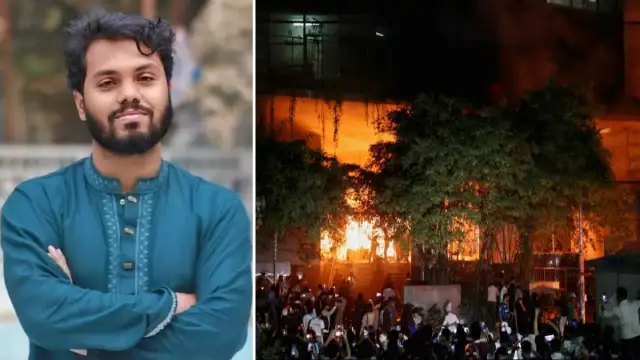
Soon after the news of Sharif Osman Hadi’s death in Singapore reached Bangladesh on Thursday, December 18th, night, nationwide protests erupted, which continued even till late Friday. At several places, the protests over the far-right Islamist activist’s assassination snowballed into mob violence, leading to attacks on newspaper offices, editors and journalists, cultural organisations, etc.
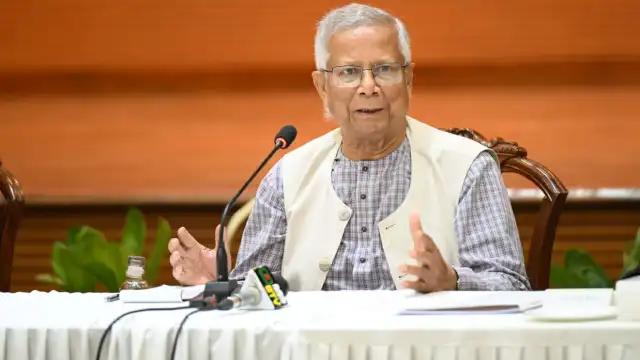
Although the interim government, led by Muhammad Yunus, has condemned the mob violence following Mr Hadi’s death, it did little to stop the carnage, prompting political parties, journalists, activists and others to criticise its nonchalant and meek attitude.
Apart from criticising the mob violence, the interim government has taken no concrete steps to combat the menace.
It’s alleged that Mr Hadi’s assassination is the handiwork of India-backed ousted prime minister Sheikh Hasina’s Awami League, which is a banned outfit in Bangladesh. There have been unverified allegations that Mr Hadi’s killers have entered India’s Assam and are now in Guwahati, sheltered by New Delhi.
These allegations have stoked anti-India protests in Dhaka and other parts of Bangladesh since Mr Hadi was shot on December 12th.
India didn’t directly comment on the developments. However, India’s Ministry of External Affairs (MEA) had summoned the high commissioner of Bangladesh in India, Riaz Hamidullah, to protest the demonstrations outside India’s Mission in Dhaka.
In a statement issued on December 17th, a day before Mr Hadi died, New Delhi said, “India completely rejects the false narrative sought to be created by extremist elements regarding certain recent events in Bangladesh. It is unfortunate that the interim government has neither conducted a thorough investigation nor shared meaningful evidence with India regarding the incidents.”
The “extremists” mentioned in India’s statement are those belonging to the Islamist nationalist movement, which views India as a threat to Bangladesh’s sovereignty.
The mob violence that erupted in Bangladesh following Mr Hadi’s death on Thursday, and continued even on Friday, targeted all institutions, including newspapers like Prothom Alo and Daily Star, which allegedly either supported Ms Hasina’s government until the monsoon uprisings in 2024 or have had links to the Awami League-New Delhi nexus.
However, the mob violence didn’t spare many, including New Age’s editor, Nurul Kabir, who has been a fierce critic of Ms Hasina even during the heydays of her rule. Mr Kabir, who also heads Bangladesh’s Editors’ Council, faced an assault near the Farmgate area, close to the Daily Star office, when he was rushing to the spot, hearing the news of the attack on the newspaper.
While the political parties of Bangladesh, from far-right Jamat-e-Islami (JeI) to nationalist Bangladesh Nationalist Party (BNP), from populist National Citizens’ Party (NCP) to left-wing Communist Party of Bangladesh (CPB), have harshly condemned the mob violence, attack on newspapers and acts of arson and vandalism, experts see a deep conspiracy behind the upheaval.
It appears as if external forces are quietly exploiting Bangladesh’s turbulence at a time when it’s approaching the crucial general elections and mandate on the July Charter.
Who’s behind mob violence that followed Hadi’s death?
Evidence shows that two foreign-based social media influencers, Pinaki Bhattacharya and Elyas Hussain, have been playing the key role behind stoking mob violence in Bangladesh.
The organised violence appeared pre-planned. Mr Hussain has been particularly found guiding the mob through his social media posts on Thursday night. His verified Facebook page has been taken down by Meta.
Mr Bhattacharya also provoked the violence and remained critical of those questioning the carnage.
A former medic-turned-marketing professional based in Paris, Mr Bhattacharya started his political journey as a CPB worker. Later, he quit the CPB in 2016 and then switched over to the far-right before leaving Bangladesh to live in India. He later moved on to France and has been working with Western personal care brand L’Oréal.
For years, Mr Bhattacharya, who came to fame earlier as a left-wing student leader and a prominent face of Bangladesh’s secular, progressive movements, has been using Islamist political rhetoric to provoke his social media followers on American platforms like Meta’s Facebook and Google’s YouTube.
Critics of Mr Bhattacharya allege that he has masked his atheist identity using Islamist garb and has been exploiting the Islamic sentiments of Bangladesh’s majority to promote the extreme far-right in the country. Several critics of his, including prominent intellectuals, accuse him of being an Indian intelligence resource working towards creating a rift within the country and leading it towards fragmentation.
Mr Hussain is based in New York. He identifies himself as a journalist but works as a pro-Pakistan rabble-rouser on social media and has been involved in provoking mob violence across the country since the 2024 monsoon uprisings.
Mr Bhattacharya and Mr Hussain promote historical revisionism that whitewashes Pakistan’s documented crimes against the Bengali people in the erstwhile East Pakistan, promote the idea of Pakistan’s reunification, provoke mob violence throughout the country and also incite violence against military and government officials.
Commanding the allegiance of millions of vulnerable Bangladeshis, the duo have been instrumental in creating chaos in the country.
Recently, the BNP’s national leader, AKM Wahiduzzaman, has accused the duo, without naming them, for the mob lynching of a Hindu man in the Mymensingh district in the aftermath of Mr Hadi’s death.
Mr Wahiduzzaman has also alleged that Mr Bhattacharya’s provocation has led to an incident of arson, resulting in the murder of a girl child.
While allegations against the duo have mounted, the interim government has so far ignored their activities.
Although their political rhetoric apparently looks anti-India, it’s alleged that they have been helping New Delhi.
India’s ruling far-right Bharatiya Janata Party’s (BJP) Islamophobic narrative regarding Bangladesh and its magnification of persecution of Hindus in that country are validated by the mob violence that these influencers, sheltered by the West, incite, critics in the BNP, CPB and NCP allege.
How New Delhi, BJP benefit from mob violence following Hadi’s death?
For the BJP, and its parental body, Rashtriya Swayamsevak Sangh (RSS), Bangladesh has always been a concern. The birth of Bangladesh in 1971, following a prolonged liberation struggle by Bengali peasants and soldiers against Pakistan, shattered the two-nation theory first proposed by Hindutva icons like VD Savarkar and later usurped by the Muslim League’s MA Jinnah.
The Bangladesh struggle, which was later supported by Indira Gandhi-led India, backed by the Soviet Union, proved that nationhood formed based on religion can’t survive for long, overlooking the unique characteristics of diverse people who join such a nation.
In India, the RSS, which has the world’s largest private paramilitary force and runs a global Hindutva movement, overtly and covertly, has been involved in designing a nationhood based on Hindu identity. It allegedly aims to obliterate the diversity that exists in India to build a unitary, monochrome state based on Hindu identity, Hindi language and sheer apartheid.
In their attempt to polarise the masses, the BJP and the RSS have been using different techniques to promote bigotry. Using Bangladesh as a subterfuge has always paid rich dividends to India’s far-right Hindutva camp.
Even Indian Prime Minister Narendra Modi, who shared bonhomie with Ms Hasina, had used the Bangladeshi infiltration bogey to stoke communal sentiments and polarise the Hindus.
Since the 2024 July uprisings, the RSS-led universe and India’s mainstream media have been alleging that Bangladesh is succumbing to Islamist mob violence. There is a concerted propaganda, which allegedly originates from India, targeting Bangladesh and accusing the interim government of patronising attacks on minority Hindus.
India’s BJP and the RSS benefit from the optics of Islamist mob violence in Bangladesh, which targets the Indian Embassy, the opponents of the far-right forces and attacks on minority communities. Such optics help the RSS-led Hindutva camp’s Islamophobic narratives and help consolidate Hindu votes before the crucial 2026 Assam and West Bengal elections.
Mr Modi’s BJP, despite promising citizenship to those Bengali Hindus who migrated from Bangladesh to India due to religious persecution, has not done anything substantial in this regard.
As the special intensive revision exercise of electoral rolls is going on in West Bengal, the Bengali Hindu migrants, especially those belonging to the ostracised Namasudra caste, have been living under a persistent threat of getting disenfranchised.
Their discontent with the BJP, which they have supported hitherto, driven by the hope of getting Indian citizenship, has been on the rise. In this scenario, the optics of Bangladesh’s mob violence following Mr Hadi’s death help the BJP to override the anti-incumbency wave among this crucial section.
Moreover, globally, India has been projecting Bangladesh as a failed state following Ms Hasina’s downfall, despite recognising Mr Yunus’s government.
India has been hosting Ms Hasina and has so far maintained an ambiguity over the issue of handing her over to Bangladesh even after the International Crime Tribunal of the country sentenced her to death for her role in the massacre of protesters during the monsoon uprisings in 2024.
India’s MEA has been expecting to open dialogue with a new government following the February 2026 elections, in which the BNP has the scope of forming a government. It’s expected by the experts that India will create a scope for Awami League’s restoration in the country, something that the BNP leaders have also indicated their interest in.
India has been allegedly hosting hundreds of absconding Awami League operatives with an aim to restore them in the neighbouring country at an opportune moment.
This is done deliberately by India for two reasons.
Firstly, by hosting Awami League operatives and Ms Hasina, India can trigger the Islamist forces, backed by Pakistan and Türkiye, to carry out mob violence and rampage.
Secondly, citing the mob violence and deteriorated law and order situation in Bangladesh, India can build international opinion in favour of Ms Hasina’s restoration in the post-poll situation.
Interim government’s role under scanner
Meanwhile, critics have raised concerns over the interim government’s role in Mr Hadi’s murder and the mob violence that followed it. According to several critics, especially those from the left, without the state machinery’s support, such professional killers couldn’t have fired at Mr Hadi and easily escape to India.
The role of the interim government, the Directorate General of Foreign Intelligence (DGFI), the South Asian country’s intelligence wing, and Border Guard Bangladesh are under the scanner, as it appears impossible for the suspects to escape the security forces and flee to India, when an eerie alarm was raised after Mr Hadi was shot.
Moreover, while Mr Hadi’s killing exemplifies Bangladesh’s deteriorating law and order situation, the interim government’s failure to nab the perpetrators, the mob violence didn’t target government or security agencies. Rather, they attacked the remnants of Bangladesh’s first president, the slain Mujibur Rahman’s demolished residence, followed by attacks on newspaper offices and cultural organisations.
This shows that the mob isn’t merely an organic one, but a carefully orchestrated one, which worked as a subterfuge and helped deflect the people’s attention.
While the deposed Awami League is blamed for the murder, questions aren’t raised on its influence on the state machinery, which continues to function under the interim government, without any shake-up.
Hadi’s death and Bangladesh’s fall
Mr Hadi was an Islamist, a staunch opponent of Ms Hasina, and also an opponent of the mainstream parties, including JeI. Rather than joining the JeI or other Islamist forces, he preferred to file nomination as an independent candidate for the forthcoming general elections.
While circumstantial evidence shows that Mr Hadi’s assassins were professionals and not rookie political activists wielding guns, the bigger question is who benefits from his murder.
For the Awami League, which is already suffering a major erosion in public support and has been on the backfoot due to the ban imposed on it, killing Mr Hadi is a risky proposition. However, for India and those who oppose Ms Hasina’s party, Mr Hadi’s death serves diverse purposes. For New Delhi, the mob violence helps its narrative regarding the aggrandisement of Islamist forces in Bangladesh. For anti-Hasina Islamist forces, Mr Hadi’s death helps in polarising the nation after 16 months of instability and uncertainty following the Awami League’s ouster.
Bangladesh is traversing through a very treacherous political trajectory. It remains to be seen how the country emerges from this crisis.
East Post is an independent geopolitical analysis portal covering South Asia and global power dynamics for international audiences. Views expressed are analytical and do not constitute endorsement of any state or non-state actor.
Join our channels on Telegram and WhatsApp to receive geopolitical updates, videos and more.