As Iran manages to keep the Strait of Hormuz choked, disrupting the global fuel supply chain, after the US and Israeli strikes started in February, oil markets wobbled, and navies stirred. A former Indian air marshal, like many others, analysed the situation. Yet, the analysis shows that in New Delhi, the episode has prompted a different response.
A Facebook post, allegedly written by R Nambiar, a former Indian air marshal, has been doing the rounds on the social media platform for days. Although there are no direct links between the writer and the post, several influencers are sharing the post and crediting him.
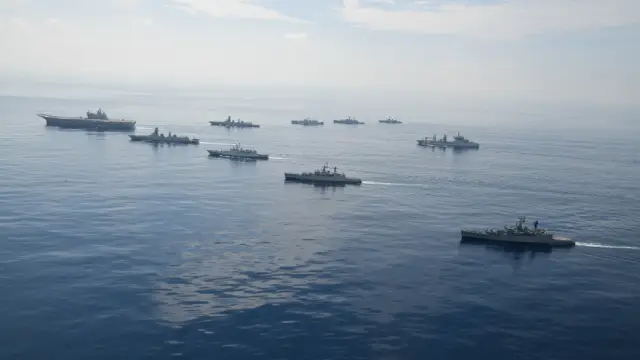
The analysis credited to Mr Nambiar argues that India must learn a lesson from Iran choking the 33km-long Strait of Hormuz, which has forced three US aircraft carriers to refuse global oil corporations’ escort through the narrow strait.
The retired Indian Air Force officer asserts that India should abandon dreams of a large surface fleet and instead master choke points—above all, the Malacca Strait—to counter China. It is a neat argument. It may also be the wrong one.
Sinophobia: Driving India’s defence
India’s former air marshal reflects how New Delhi’s military thought leaders remain focused only on China and ignore the elephant in the room.
The US, not China, has been the power most willing to disrupt flows in West Asian waters, intrude into India’s proximity and use sanctions and pressure that directly affect New Delhi’s interests.
The risk for New Delhi is not merely misreading Beijing. It is aligning its strategy to a contest defined in Washington in ways that cut across India’s own interests.
Strait of Hormuz to Malacca: Strategic miscalculations
At the Strait of Hormuz, Iran’s ability to harass or impede traffic through the narrow waterway is well established; the episode has been a reminder of how vulnerable global energy trade remains. It also underlines the limits of naval power against an asymmetric actor operating close to home. That point strengthens the case for resilience—diversified supply, stockpiles, convoying—more than it does for reorienting India’s naval forces towards distant choke points aimed at a single rival.
This also isn’t new for India. During Israel’s attacks on the Gaza Strip, the Ansar Allah forces of Yemen had blocked the Red Sea for ships linked to either Israel or its allies. For months, despite American and Israeli attacks on Yemen, the global supply chain remained choked.
As a country that has managed to retain a friendly relationship with the US, Israel and Iran, India has seen how Washington and Tel Aviv have violated international rules to attack Tehran. Indian experts know that for decades, the US has been attacking countries that don’t toe its line.
Yet China is increasingly cast as that rival.
India’s planners note the expansion of the People’s Liberation Army Navy, its forays into the Indian Ocean and its commercial presence in ports from Gwadar to Djibouti. They also recall unresolved border tensions.
From this perspective, a strategy built around sea denial at key straits appears prudent.
There is, however, another reading.
China treads own water
Much of China’s naval modernisation has focused on deterring American intervention in its near seas, particularly around Taiwan, and on protecting sea lanes that carry its own trade and energy.
Whether Beijing intends to project coercive power deep into the Indian Ocean remains contested.
Its deployments there have so far been episodic and often linked to anti-piracy or escort missions.
Treating China as the central maritime antagonist risks turning a conditional problem into a fixed one.
The Strait of Hormuz episode also throws the US’s role into sharper relief.
The US retains unmatched reach across the region, with a network of bases and partners stretching from the Gulf to East Asia. It is also prepared to use economic statecraft at scale.
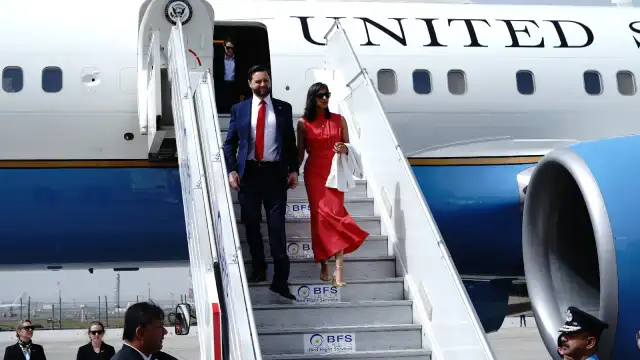
Sanctions regimes have repeatedly constrained India’s room for manoeuvre—most notably over Iranian oil imports—while recent threats under Donald Trump’s revived trade and security agenda have again signalled Washington’s willingness to pressure partners as well as rivals.
For a country that imports a large share of its energy from West Asia, that leverage matters.
Despite this, India’s defence conversation often treats the US as a benign “partner” and China as the principal “rival”.
The asymmetry is striking when seen in the context of recent US-Israeli attacks on Iran and the latter’s retaliation.
There is little public debate about how to hedge against any future American coercion in the Indian Ocean, even as Indian defence policies increasingly mesh with US priorities in the Indo-Pacific.
Joint exercises, logistics agreements and interoperability all have their uses. They also create path dependence.
That matters when strategy meets geography. India’s island territories—especially the Andaman and Nicobar chain—offer a vantage over the Malacca Strait. Strengthening them is sensible. But capabilities are not neutral.
In a crisis, assets designed for sea denial could be folded into a wider coalition effort to interdict Chinese shipping. That would tie India’s hand in a confrontation not of its choosing, and risk retaliation against its own trade.
The economic stakes are large.
Hitting partners: India’s faux passe
China is among India’s biggest trading partners, and the Indian industry depends on Chinese inputs in sectors from pharmaceuticals to electronics and clean energy.
A doctrine that assumes sustained disruption of those flows carries costs that extend well beyond defence planning.
Since the May 2020 Galwan skirmish that killed 20 Indian soldiers, New Delhi had tried to look away from China, but realised that it’s not feasible in the current world.
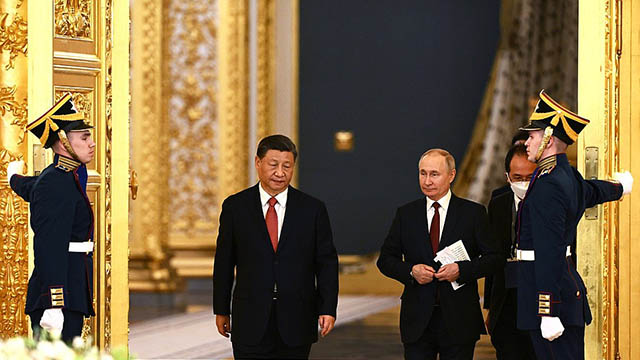
In the post-COVID period, India saw its trade with China soar. Last year, Prime Minister Narendra Modi’s visit to China and bilateral meeting with President Xi Jinping opened new doors of cooperation.
For New Delhi, losing the scope in its bid to appease the US can become a fatal mistake.
Strategic autonomy in choosing friends or obeying orders
India has long practised a form of “multi-alignment”, balancing relationships to preserve autonomy.
A strategy overly centred on countering China at sea sits awkwardly with that tradition.
None of this argues for complacency.
China’s capabilities are growing; its intentions are not fully transparent. Prudence requires preparing for worst cases as well as most likely ones. But prudence also requires discriminating between theatres and actors.
The lesson of the Strait of Hormuz is not that India should pivot its navy towards distant choke points against a single adversary. It is that energy security, proximity and asymmetric tactics can upend even superior fleets—and that the sources of risk in West Asia are plural.
For New Delhi, the sharper question is how to avoid importing another country’s hierarchy of threats. A strategy that emphasises resilience at home, flexibility abroad and a clear-eyed view of both China and the US would better serve India’s interests. Alignment may sometimes be useful. Alignment by default, built on a simplified picture of who threatens whom, is not.
East Post is an independent geopolitical analysis portal covering South Asia and global power dynamics for international audiences. Views expressed are analytical and do not constitute endorsement of any state or non-state actor.
Join our channels on Telegram and WhatsApp to receive geopolitical updates, videos and more.