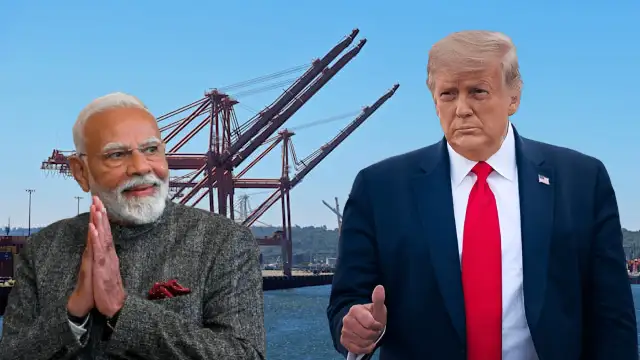
Donald Trump’s second administration has wasted little time in fulfilling his campaign promise to wage a trade war against the world. On what he bombastically dubbed “Liberation Day”—April 2nd 2025—the president announced steep tariffs affecting more than 180 countries, combining a 10% baseline tariff with additional “reciprocal” charges supposedly set at half the rate that other countries levy on American products. And Mr Trump’s tariffs shook the world, including India.
"I, DONALD J. TRUMP, President of the United States of America, find that underlying conditions, including a lack of reciprocity in our bilateral trade relationships, disparate tariff rates and non-tariff barriers, and U.S. trading partners’ economic policies that suppress domestic wages and consumption, as indicated by large and persistent annual U.S. goods trade deficits, constitute an unusual and extraordinary threat to the national security and economy of the United States. That threat has its source in whole or substantial part outside the United States in the domestic economic policies of key trading partners and structural imbalances in the global trading system. I hereby declare a national emergency with respect to this threat. (sic)" (Presidential Declaration)
For India, the result of Mr Trump’s tariffs was devastating: a 26% tariff on its exports to America, higher than those imposed on the European Union (20%), Japan (24%) and South Korea (25%), though not as punitive as the 54% slapped on China. The tariffs represent a significant setback for India’s trade relations with the United States and raise uncomfortable questions about Prime Minister Narendra Modi‘s strategy of personal diplomacy with Mr Trump.
Strangely, while world leaders rushed to condemn Mr Trump’s tariffs and announce countermeasures, Mr Modi’s government has maintained a conspicuous silence—an approach shared only by Israel’s Benjamin Netanyahu and, to a lesser extent, Italy’s Giorgia Meloni.
Market meltdown, sectoral shock follow Trump’s tariffs
The immediate reaction to Mr Trump’s tariffs announcement was predictably negative. In the first trading session after the news broke, the BSE Sensex dropped over 500 points, while the Nifty50 declined below 23,200 within 15 minutes. Gift Nifty fell by 1.5%, and the rupee weakened against the dollar, hovering around 85.69 amid the market volatility.
The impact across sectors has been uneven. The pharmaceutical industry, which contributes about $12.2bn to Indian exports to the US, has temporarily escaped tariffs—a reprieve for companies like Syngene, Gland Pharma and Dr Reddy’s, which derive 68%, 54% and 43% of their revenues from the American market respectively. The Nifty Pharma index increased by 2.73% after the announcement, reflecting this temporary relief.
“Except as otherwise provided in this order, all articles imported into the customs territory of the United States shall be, consistent with law, subject to an additional ad valorem rate of duty of 10 percent. (sic)”
Donald Trump
Less fortunate is the automotive industry, which contributes around 3% of India’s overall exports to the US. “A blanket tariff of 26% is expected to impact demand and also the competitiveness of Indian automobile exports in the American market, which can have a cascading effect in terms of higher production costs, lay offs and supply chain challenges,” Macquarie reported. The Nifty Auto index consequently dropped by 0.64%.
The information technology sector fared worse still, with the Nifty IT index tumbling by over 3% as fears of an American recession and cutbacks in discretionary spending loomed large. Analysts have downgraded the sector to equal-weight based on increasing US recession risks.
Other major export categories likely to be affected include machinery (15.6% of exports to America), gems and jewellery (11.5%), machinery for nuclear reactors (8.1%) and refined petroleum products (5.5%). Macquarie estimates that the combined effect could shave 50 basis points off India’s GDP growth.
Strange bedfellows: Netanyahu, Modi and silence
While most world leaders were quick to condemn Mr Trump’s tariffs and announce retaliatory measures, Mr Modi has maintained a conspicuous silence—even as his commerce minister, Piyush Goyal, returned empty-handed from Washington following the prime minister’s much-hyped February tour.
The Israeli prime minister, by contrast, moved quickly to exempt American imports from tariffs. “Today we cancelled all of the customs duties levied on products from the US, Israel’s largest trading partner,” Mr Netanyahu wrote on X (formerly Twitter). “In addition to the advantages to the market and to citizens of Israel, the current effort will allow us to further strengthen the alliance and ties between Israel and the US.”
Today we cancelled all of the customs duties levied on products from the US, Israel's largest trading partner.
— Benjamin Netanyahu – בנימין נתניהו (@netanyahu) April 1, 2025
Cancelling the customs duties on American goods is an additional step in the policy that my governments have led for a decade in opening up the market to competition,…
This eager compliance is perhaps less surprising given that Israel receives billions of dollars in American aid annually. India enjoys no such largesse, making Mr Modi’s acquiescence all the more puzzling.
The contrast with other world leaders could hardly be starker. European Commission President Ursula von der Leyen announced that the EU was “already finalising a first package of countermeasures” and “preparing for further” action.
China’s Commerce Ministry “firmly opposes” the tariffs and “will resolutely adopt countermeasures”.
Japanese Prime Minister Shigeru Ishiba questioned whether it “makes sense to apply uniform tariffs to all countries” and put “all options on the table”.
Canadian Prime Minister Mark Carney vowed to “protect our workers” with a 25% tariff on American vehicles.
Even Ms Meloni, a stalwart Trump ally, called the tariffs “a wrong approach” and pledged to “do everything we can… to prevent a trade war that would inevitably weaken the West.”
Asian alliance against Trump’s tariffs without India
Perhaps most tellingly, India’s absence was conspicuous at a recent economic dialogue between South Korea, China and Japan—their first in five years. The three export powerhouses met on March 30th, just days before Trump’s announcement, to “closely cooperate for a comprehensive and high-level” free trade agreement to promote “regional and global trade”.
This Asian alliance, formed specifically to counter American protectionism, might once have seemed a natural fit for India. Yet Mr Modi appears more interested in placating Mr Trump than in joining forces with regional partners.
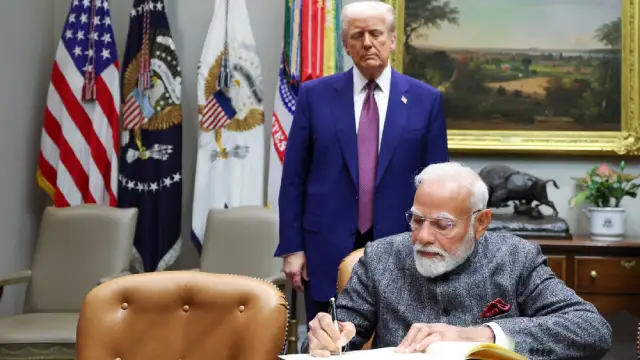
During his February visit to Washington, the Indian prime minister went so far as to plagiarise Mr Trump’s “Make America Great Again” slogan, proposing a “Make India Great Again” initiative while promising greater Indian purchases of American goods and services, as well as more Indian investments to create jobs in the United States—peculiar priorities given India’s high unemployment rate.
Path not taken
As Mr Trump’s tariffs begin to bite, India’s options for response appear limited by Mr Modi’s reluctance to challenge his American counterpart. While the impact might not be catastrophic—India’s exports in the most vulnerable sectors amount to only 1.1% of its GDP—the tariffs will certainly hit high-export sectors, reduce India’s foreign exchange earnings and potentially create problems for its balance of payments, especially for oil imports.
This vulnerability is exacerbated by Mr Modi’s refusal to support the BRICS nations’ push for trading in local currencies, which would be a significant step towards de-dollarisation. His reluctance forces Indian businesses to pay a heavy price amid high economic stagnation.
Unlike Mr Netanyahu, whose strategic embrace of Mr Trump brings tangible benefits in the form of American aid and diplomatic cover, Mr Modi’s silence appears to secure nothing but the most ephemeral of rewards: photo opportunities and fleeting praise from a notoriously fickle American president.
As global leaders from London to Beijing formulate their responses to Trump’s trade war, the Indian prime minister’s unusual acquiescence raises uncomfortable questions about the price of his personal diplomacy—and whether India’s economic sovereignty is being traded away for a pat on the back.
In the court of global public opinion, Mr Modi now finds himself in the peculiar company of Mr Netanyahu—celebrating Mr Trump’s tariffs while everyone else condemns them. The difference, of course, is that, unlike Mr Netanyahu, Mr Modi receives no American largesse to offset the economic pain. Mr Modi’s silence on Mr Trump’s tariffs speaks volumes about his priorities, as India’s businesses and consumers prepare to pay the price.
East Post is an independent geopolitical analysis portal covering South Asia and global power dynamics for international audiences. Views expressed are analytical and do not constitute endorsement of any state or non-state actor.
Join our channels on Telegram and WhatsApp to receive geopolitical updates, videos and more.