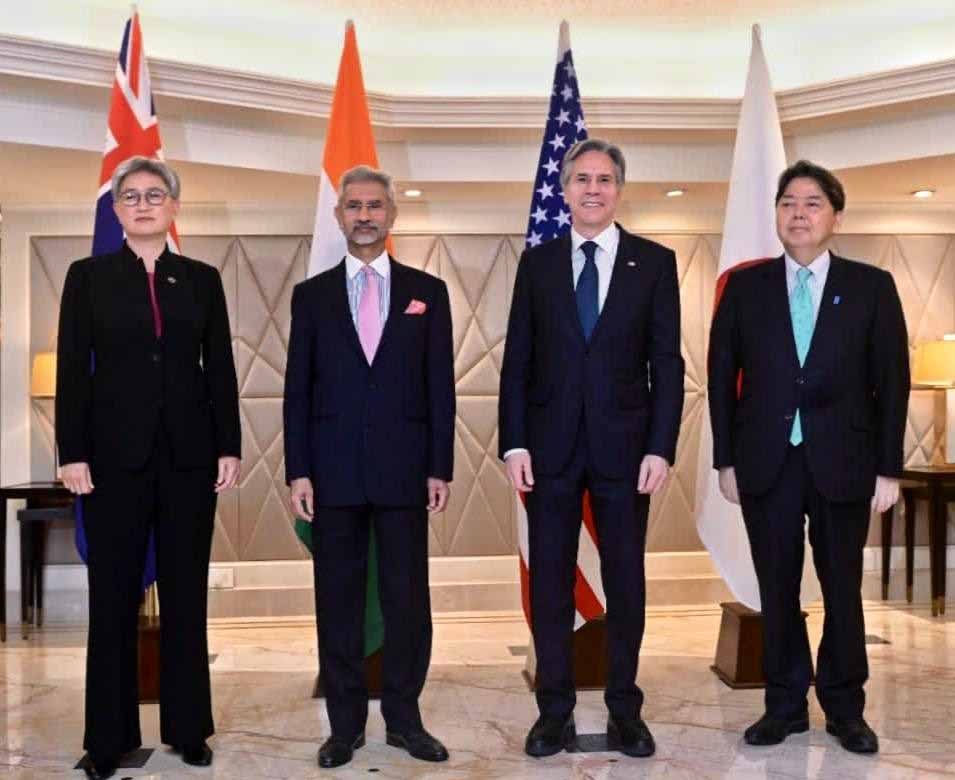
India hosted the foreign ministers’ meet of the Quad, an anti-China military entente in the US-designated ‘Indo-Pacific’ war theatre, on Friday, March 3rd 2023. India’s External Affairs Minister S Jaishankar, the US Secretary of State Anthony Blinken, Japanese Foreign Minister Yoshimasa Hayashi, and Australian Foreign Minister Penny Wong attended the Quad foreign ministers’ meeting.
A joint declaration was issued after the Quad foreign ministers’ meeting. The joint statement underscored the importance of maritime security in the ‘Indo-Pacific’ region and stressed ‘ASEAN centrality and unity’. The declaration claimed that the Quad would remain committed to supporting the implementation of the ASEAN Outlook on the Indo-Pacific (AOIP) implementation.
What is there in the joint statement of the Quad foreign ministers’ meeting?
The Quad welcomed “Indonesia’s 2023 ASEAN Chairmanship”. The Quad foreign ministers’ meeting promised to support its Chair theme, “ASEAN Matters: Epicentrum of Growth”.
The joint statement of the Quad foreign ministers’ meeting pointed out the possibility of expanding the entente’s influence in the region. It said that it can “identify tangible areas for the Quad to support the work of ASEAN. In addition, we are committed to further strengthening our respective relationships with ASEAN, thus creating a platform for greater Quad collaboration in support of the AOIP (ASEAN Outlook on the Indo-Pacific).”
Without naming China in the statement of the Quad foreign ministers’ meeting, the entente said, “We reiterate the importance of adherence to international law, as reflected in the UN Convention on the Law of the Sea (UNCLOS), to meet challenges to the maritime rules-based order, including in the South and East China Seas. We strongly oppose any unilateral actions that seek to change the status quo or increase tensions in the area. We express serious concern at the militarization of disputed features, the dangerous use of coast guard vessels and maritime militia, and efforts to disrupt other countries’ offshore resource exploitation activities.”
The Quad has been alleging, under the US’s insistence, that China has been encroaching on the South and East China Seas. However, China has defended its rights on its territorial waters and opposed the US’s intervention in the region. India has historically pursued an anti-China military policy following a dispute over the borders drawn by the British colonial rulers, which the Chinese have refused to accept.
The statement of the Quad foreign ministers’ meeting said that the entente will “deepen engagement with regional partners, including through information-sharing, capacity-building and technical assistance, to strengthen maritime domain awareness; counter illegal, unreported and unregulated fishing; enhance their capability to protect and develop offshore resources, consistent with UNCLOS; ensure freedom of navigation and overflight; and promote the safety and security of sea lines of communication.”
Apart from condemning terrorism, especially the past terror incidents, the Quad foreign ministers criticised China, which is accused of blocking some of the names that India proposes as ‘terrorist’ in the UN Security Council 1267 Sanctions Committee. The Quad foreign ministers’ joint statement said, “we express our concern at attempts to politicise the working of the UNSC Sanctions Regimes and call on all states to maintain the transparent, objective and evidence-based working methods of UNSC Sanctions Committees (sic).”
The Quad foreign ministers’ statement also announced the “establishment of the Quad Working Group on Counter-Terrorism, which will explore cooperation amongst the Quad, and with Indo-Pacific partners, to counter new and emerging forms of terrorism, radicalization to violence and violent extremism (sic).”
Although there will be further meetings on the Quad Working Group on Counter-Terrorism in the US, later in 2023, there has been no information on how this Working Group will detect, detain and counter “new and emerging forms of terrorism”. There have been several complaints regarding witch-hunting in the name of “counter-terrorism” in India and the US. Moreover, it’s majorly the minority Muslim community in both countries that suffer the most due to such opaque operations. Many are acquitted by courts after they are found innocent following decades-long trials.
The Quad foreign ministers’ meeting condemned the Democratic People’s Republic of Korea (DPRK) for ballistic missile launches. However, it remained quiet on the accusations levelled by Russia and China that the US and the West are provoking tensions worldwide to retain its waning global hegemony.
Finally, the Quad condemned the violence in Ukraine. “We continued to discuss our responses to the conflict in Ukraine and the immense human suffering it is causing and concurred that the use or threat of use of nuclear weapons is inadmissible. We underscored the need for a comprehensive, just and lasting peace in Ukraine in accordance with international law, including the UN Charter. We emphasised that the rules-based international order must respect the sovereignty, territorial integrity, transparency and peaceful resolution of disputes (sic).” – the statement said.
Although India’s insistence has prevented the US, Japan and Australia from naming Russia in the document, it attempted to accuse Russia of threatening to use “nuclear weapons”. The Russian government has withdrawn from a 2011 nuclear treaty with the US called the New START treaty. Russia’s Deputy Foreign Minister Sergei Ryabkov recently told the UN Conference on Disarmament in Geneva that the US may resume nuclear testing.
“The situation involving the CTBT (Comprehensive Nuclear-Test-Ban Treaty) is causing increasing concern. The responsibility for the situation in which the treaty has not entered into force over more than a quarter of a century of its existence lies squarely with the United States, which defiantly refused to ratify it and is now demonstrating its clear intention to resume testing,” Ryabkov had accused in Geneva.
The Quad foreign minister’s meeting avoided discussing the probabilities regarding the US violating nuclear testing norms and muscle-flexing. However, its focus on DPRK and Ukraine showed that the pro-western affiliation of the military entente is overwhelming.
How can the Quad foreign ministers’ meeting affect the India-China relationship?
During the G20 Foreign Ministers’ Meeting in New Delhi, China’s new foreign minister, Qin Gang, made his maiden trip to India, which is also his first foreign trip. Qin met Jaishankar during the sidelines of the G20 Foreign Ministers’ Summit. However, there was no breakthrough.
India and China had a border skirmish in mid-2020 since then their bilateral relationship has suffered a lot. Although the Indian Army and the Chinese People’s Liberation Army are engaging with each other to de-escalate tensions in the Himalayan region, it’s unlikely that both sides will find any breakthrough.
While meeting Qin, Jaishankar said that India’s bilateral relationship with China is “abnormal” at present and only de-escalation of tension at the border can help in developing the relationship.
Jaishankar told the press, “I met Minister Qin Gang on the sidelines of the conference (G20 Foreign Ministers’ Meeting) this afternoon. It’s our first meeting after he took over as Foreign Minister. So we spent…maybe about 45 minutes talking to each other and the bulk of our conversation understandably was about the current state of our relationship, which many of you have heard me describe as abnormal, and I think those were among the adjectives that I used in that meeting. We have, you know, there are real problems in that relationship that need to be looked at, that need to be discussed very openly and candidly between us. That’s what we sought to do today.”
The minister added, “We also had a brief discussion on what was happening in the G20 framework, but the thrust of the meeting was really on our bilateral relationship and the challenges in the bilateral relationship, especially that of peace and tranquillity in the border areas.”
However, Jaishankar told a journalist, who asked whether the Quad foreign ministers’ meeting discussed the issue of the Taiwan Strait, that they didn’t discuss that issue. The Chinese side has already accused the US of violating the ‘One China Policy’ by fuelling tensions in Taiwan. India has stood by the ‘One China Policy’, and has opposed any tension in the Taiwan Strait.
Although India’s bilateral relations with China are in an ‘abnormal’ state, New Delhi doesn’t allow the Quad platform to utter anti-Chinese statements explicitly in its declarations. This has helped New Delhi to balance its geopolitical position vis-à-vis the West, which wants it to get involved in a military conflict with China.
Moreover, as the western hegemonistic world order has been crumbling, especially after Russia’s special military operations in Ukraine, India has been advocating for a multilateral world order too, which echoes the same demand raised by China and Russia. It’s not wise for India to pin its hopes on the West for a resolution of its seven-decade-old border conflict with China. Rather, a stronger tie with Russia can help India use Moscow as an influential arbitrator to negotiate peace with China, the way it happened after the Galwan valley clash in mid-2020.
At present, India’s bilateral trade with China has increased manifold and reached its peak in 2022. India’s oil imports from Russia have increased immensely since 2022, and it has been working on a rupee-rouble payment system to bypass the dollar-based western payment system controlled by the US.
In this scenario, and considering India’s long-term geopolitical interests, the Quad foreign ministers’ meeting was bound to produce an ambiguous document. The US’s initiatives to build alternative ententes against China, especially with Australia and the UK, shows that it’s doubtful about India’s long-term collaboration and the future of Quad. Although Australia and Japan would continue their anti-China tirade, it’s to be seen how long they can persist in a rapidly-changing world, transitioning towards a multi-lateral order.
East Post is an independent geopolitical analysis portal covering South Asia and global power dynamics for international audiences. Views expressed are analytical and do not constitute endorsement of any state or non-state actor.
Join our channels on Telegram and WhatsApp to receive geopolitical updates, videos and more.