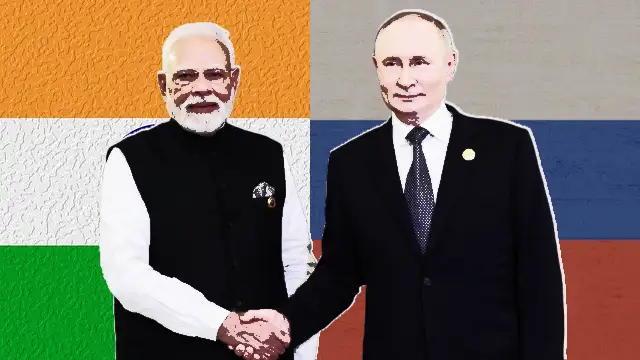
Russian President Vladimir Putin‘s visit to India, scheduled for December 4th-5th, has been causing considerable unease for Prime Minister Narendra Modi. The Modi government is anxious to ensure that the Russian president’s trip does not heighten geopolitical tensions or damage India’s relations with the West. Although Mr Putin is arriving for the annual bilateral summit between Indian and Russian leaders—a routine diplomatic exercise—the visit poses a problem for Mr Modi’s administration.
The reason is straightforward. American President Donald Trump‘s administration has imposed an additional 25% punitive tariff on Indian exports to the US, ostensibly as punishment for India’s continued purchase of cheap Russian oil. This surcharge brings total duties on Indian goods to 50%, placing severe strain on Indian exporters.
To ease this tariff burden, India is pressing for a trade agreement with the US while deploying diplomatic efforts to protect its exporters, particularly large corporations. Simultaneously, New Delhi has accelerated negotiations on a free-trade agreement with the European Union, which diplomats expect could be concluded within weeks.
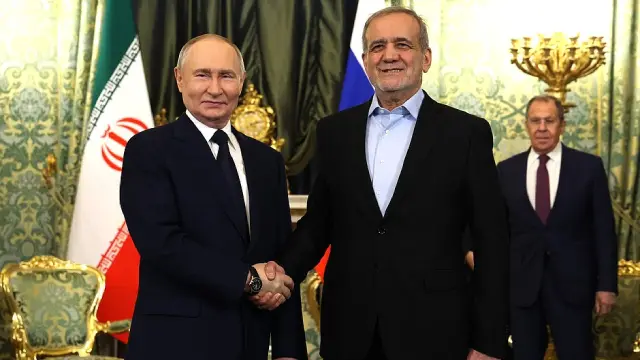
Against this backdrop, images of Mr Putin and Mr Modi shaking hands and displaying camaraderie could adversely affect these delicate processes.
Yet India’s dependence on Russian oil and military equipment, combined with its reluctance to rely entirely on a crisis-ridden West, makes Putin’s forthcoming India visit important for New Delhi as well. Nevertheless, alleviating the US’s tariff burden has become more urgent for India than deepening ties with Russia.
Can Putin’s pre-India visit assurances deliver?
Russia understands India’s predicament. Moscow knows that New Delhi will ultimately be compelled to yield to the West’s pressure, particularly from the US.
India is not China. It lacks the industrial base and technological prowess that enable Beijing to keep western powers in check. Mr Putin also recognises that, despite India’s rhetoric about a multipolar world and multilateral relationships, New Delhi actually aspires to become South Asia’s Israel with western backing. This explains Mr Modi’s repeated efforts to improve relations with the US and the West.
Consequently, Mr Putin’s administration is working persistently to keep India in its orbit.
Ahead of Putin’s India visit, the Russian president announced he would compensate India for financial losses caused by US tariffs. Such diplomatic assurances are rare, yet Mr Putin’s claim is deeply unrealistic.
The Russian economy’s current state offers Moscow no such capacity.
Bilateral trade: the numbers tell a different story
India-Russia bilateral trade in 2024 totalled $68.7bn. Of this, Indian exports to Russia amounted to $4.88bn, while India imported $63.84bn worth of goods—predominantly Russian oil. India ran a trade deficit with Russia of $63.82bn in 2024.
By contrast, India-US bilateral trade in the same year reached $129.2bn. India imported $41.8bn worth of American goods and exported $87.4bn to the US, yielding a trade surplus of $45.7bn in India’s favour.
If one accepts Mr Putin’s assurances at face value, Russia would need to provide India with approximately $45.7bn in additional trade opportunities. But where might such opportunities exist?
First, western sanctions prevent India from accessing Russia’s arms market, despite surging demand for military equipment owing to the Ukraine conflict.
Second, those same sanctions preclude India-Russia cooperation in advanced technology, chip manufacturing or sophisticated computing. Promising new industries are therefore off-limits for close collaboration with Moscow.
Third, despite talk of improving relations, tensions between India and China persist. Since Russia and China are strategic partners opposing western dominance, the Modi government—dependent on western powers—will never pursue extensive cooperation with Moscow in India’s most important emerging industries.
Beyond these constraints, Russia’s own economy is simply not positioned to support India meaningfully.
Can the Russian economy rescue India?
Confounding western analysts’ predictions, Russia’s economy grew by 4.1% in 2024 despite the war. Yet this economic performance cannot generate profitable opportunities for India in the manner Mr Putin suggests.
India-Russia bilateral trade is half that of India-US trade. Moreover, the trade surplus sits in Russia’s ledger. Were India to cease purchasing Russian oil, bilateral trade would collapse dramatically. Before the pandemic, India-Russia trade stood at merely $10.01bn.
In December 2021, when Mr Modi and Mr Putin initiated their annual bilateral summit process, they set a target of $50bn in bilateral trade by 2025. The Ukraine war facilitated this through increased Russian oil imports.
The two leaders also agreed to raise bilateral trade to $100bn by 2030. Even if achieved, India-Russia trade would remain well below current India-US trade levels.
When Mr Putin assures India he will compensate for Mr Trump’s tariff-related losses, no clear mechanism underpins this promise. Economic arithmetic demonstrates that Russia simply cannot deliver.
Indian exports to Russia have increased in pharmaceuticals, fertilisers and similar products as western corporations have withdrawn from Russia following the Ukraine war. Yet beyond armaments, Mr Putin has no sector where India could secure a market worth $45bn or more.
Furthermore, Russia’s federal budget deficit in 2024 stood at 1.7% of GDP—approximately $34.5bn. If Mr Putin were to borrow from markets to compensate India, he would need to raise more than his country’s annual budget deficit. No nation at war undertakes such borrowing under normal circumstances.
Putin’s India visit: Moscow’s limitations exposed
Despite his assurances, Mr Putin can offer India neither new markets nor compensation capacity. Mr Modi may shake his hand, embrace him and speak of building a multipolar world, yet he will ultimately tilt towards western powers and seek to appease Mr Trump. Mr Putin knows this perfectly well. Nevertheless, swimming against the current, his government and media will continue efforts to maintain Russian influence over India.
Without a robust economic foundation or viable alternatives, however, such endeavours will prove futile—and signs of this are already visible. Putin’s India visit is therefore unlikely to deliver much beyond diplomatic formalities. Moreover, Moscow’s excessive dependence on Mr Modi could sour Russia’s relations with other South Asian nations, potentially damaging its long-term geopolitical interests in this volatile region.
East Post is an independent geopolitical analysis portal covering South Asia and global power dynamics for international audiences. Views expressed are analytical and do not constitute endorsement of any state or non-state actor.
Join our channels on Telegram and WhatsApp to receive geopolitical updates, videos and more.