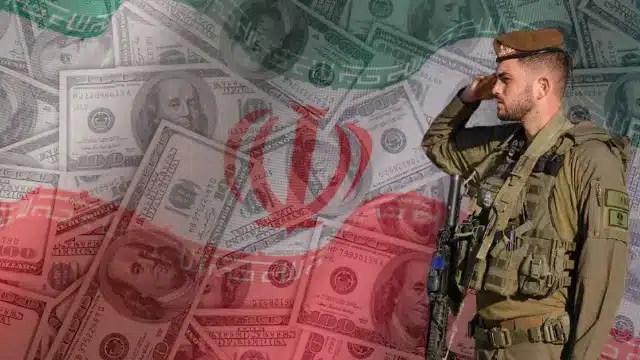
Last October, Israeli-linked lobby groups faced criticism over the so-called “Esther Project”, under which influencers in the US were reportedly paid up to $7,000 to produce pro-Israel content amid the Gaza genocide. Months later, a separate case suggests that sensitive military information may have been compromised for far less. Iran has managed to buy spies in Israel, IDF soldiers, and acquire Iron Dome’s information for as little as $1,000.
After Israel and the US launched an aggression targeting Iran on February 28th, the latter has shown the world how it can bleed the duo both militarily and economically by fighting an asymmetric war.
While the world now acknowledges that Iran has successfully managed to inflict heavy losses on American and Israeli military ledgers by using cheap drones and missiles to overwhelm the expensive air defence systems, from THAAD to the Iron Dome, a battle fought at another level, below the surface, remains concealed from the world.
Iran has not only inflicted heavy losses on Israel and the US by using cheaper drones against expensive air defence missiles, but also spent an extremely modest amount to acquire crucial military intel regarding the Iron Dome air defence system.
Arrest highlights alleged breach inside Iron Dome system
Raz Cohen (26), an Israel Defense Force (IDF) reservist from Jerusalem, has been arrested by Shin Bet, Israel’s internal security agency, last week.
On Friday, March 20th, Israeli police and Shin Bet said Mr Cohen had been indicted on charges of spying for Iran. According to the indictment, he served in the Iron Dome air defence system and allegedly passed sensitive operational information to an Iranian contact.
The arrest itself forms part of a broader pattern of internal security investigations. The more significant finding, according to the indictment, is the scale and cost of the alleged breach. Authorities claim Mr Cohen transmitted information about Iron Dome batteries to an Iranian handler in exchange for cryptocurrency worth approximately $1,000.
The case highlights a potential vulnerability in Israel’s security system, particularly given the strategic importance of Iron Dome in intercepting incoming threats.
With Israel sitting on a large cache of American hard cash, it’s a matter of embarrassment when Iran gets confidential military information for a negligible amount of cash from IDF soldiers.
Crucial information transfer under IDF’s nose
The allegations against Mr Cohen include passing details about how Iron Dome operates, the locations of Israeli Air Force (IAF) bases, and the positioning of specific batteries. Prosecutors state that the information was transferred in December 2025.
Mr Cohen remained in contact with his Iranian handler, who had recruited the reservist over the social media app Telegram, before the war started in February. By then, he had passed on significant information to the handler, which then went to the Islamic Revolutionary Guards Corps (IRGC).
According to Israeli media reports, the indictment was submitted to the Jerusalem District Court on March 18th. Authorities have charged Mr Cohen with assisting the enemy during wartime, transmitting information with the intent to harm state security, and providing intelligence likely to aid an adversary.
The indictment states that Mr Cohen ceased contact in February 2026.
“The defendant explained to the Iranian handler how the Iron Dome battery is constructed, the components of the battery, and also explained that there are other components connected to the battery spread out around the area, as well as launch sites that are not located with the Iron Dome [system] but are deployed in the periphery (sic),” the indictment alleges.
Israeli officials allege that Mr Cohen also shared technical details about the system’s armaments and operational procedures.
On December 9th, he reportedly sent 27 images and videos via Telegram showing firing processes, rates of fire, the presence of a backup launcher, and arming procedures.
At the request of his handler, Mr Cohen also provided the locations of seven IAF bases and two Iron Dome batteries — one at Hatzerim and another at Palmachim, according to the indictment.
Authorities further allege that he shared contact details of other individuals who could potentially be recruited.
Case reflects broader pattern of arrests
Israeli media reports indicate that Mr Cohen’s case is part of a wider series of alleged espionage incidents.
By January 2026, prosecutors had filed 35 indictments involving 54 individuals accused of links to Iranian intelligence networks.
Some suspects were allegedly tasked with surveillance or targeting senior officials, although authorities say arrests were made before plans were carried out.
The pattern shows Iran has been recruiting IDF soldiers, their partners and even random civilians to access high-value intelligence.
Recent cases cited in Israeli reporting include:
- Lekacho Demsash, arrested in January in Rishon LeZion for allegedly photographing the residence of former prime minister Naftali Bennett
- Vadim Kupriyanov (40), detained in December on similar allegations
- Amir Malka (37), accused of transferring information for $4,200
- Shimon Azarzar, a resident of Kiryat Yam, was arrested in November for passing an IAF base’s photos and videos to Iran, exploiting his girlfriend, an IDF reservist
- An IDF soldier was arrested in September 2025 on suspicion of passing military intelligence
Amid these developments, Israeli media also reported the arrest of two Haredi Jewish brothers on suspicion of spying for Iran.
“The Israel Police and the Shin Bet once again warn citizens and residents of the State of Israel against having contact with foreign agents from enemy countries, or unknown officials. All the more so, performing missions for them in exchange for payment or for any other reason,” the two services said in a statement issued after Mr Cohen’s arrest.
Officials say the pattern—Iran recruiting IDF soldiers—reflects growing concern within Israel’s security establishment.
Recruitments point to low-cost intelligence strategy
Investigations suggest that Iranian-linked agent recruitment efforts have relied less on complex networks and more on direct digital outreach.
According to the indictment and related reports, initial contact in Mr Cohen’s case was made on December 6th 2025 via Telegram, where the individual identified himself as an Iranian agent and offered payment in exchange for information.
Unlike traditional intelligence agency recruitment, which requires a long period of trust-building and networking, the Iranian approach has been swift, direct, and very rudimentary. Take cash, share information and have no baggage to carry.
The Shin Bet alleges that Mr Cohen agreed to provide details related to his role in the Iron Dome system, including work in the battery’s control centre. This conversion of an IDF soldier took a few messages and a promise of $1,000 only.
In several cases, authorities say similar outreach methods were used, involving broadcast-style messaging and financial incentives. The success of this method in Israel shows that the entire military apparatus of the occupation regime remains susceptible to cash incentives.
“These officials, including intelligence and terrorist agents from enemy countries, continue their efforts to recruit and use Israelis for security, espionage and terrorist missions in Israel including during the current war (sic),” the joint statement said.
While such methods may expose operations to detection, they require limited resources and infrastructure.
Economic pressures and internal discontent
Analysts and studies cited in Israeli media point to underlying socioeconomic factors that may result in Iran’s success in intelligence warfare, using as little as $1,000 to buy IDF soldiers.
Despite relatively low unemployment, estimated at around 3%, and comparatively high per capita income, research from the Shoresh Institution indicates widening income inequality and rising living costs.
With youths frustrated with rising costs and the wealth gap, Israel offers a way to vent out frustration—serving in the IDF.
This environment helps to create openings for recruitment, particularly where financial incentives are involved. IDF soldiers, driven by an urge to enhance their living standards, succumb to Iran’s luring in most cases.
The indictment also states that Mr Cohen had expressed frustration linked to mandatory military service. He completed compulsory service between 2019 and 2022 in the IAF’s Aerial Defense Array and continued in reserve duty, including service following the October 7th 2023 Hamas attack and during the June 2025 conflict with Iran.
Iran’s cheap, $1,000 IDF spies challenge Tel Aviv’s security
Israeli authorities inform that the increasing number of Iranian spy cases has prompted institutional responses, including the creation of a dedicated wing at Damon prison in Haifa for individuals charged with espionage-related offences.
Most cases remain ongoing, with only one conviction reported so far. This gives more options to Iran’s intelligence networks to exploit vulnerable IDF soldiers or their near ones.
As Israel lacks a cohesive and workable plan to defeat Iran, it’s unlikely that the latter would stop hiring $1,000 IDF spies to breach Iron Dome’s security.
The Cohen case, if proven, suggests that the challenge facing Israel’s security system may not be limited to external threats. The challenge isn’t Iran’s low-cost Shahed drones, which are overwhelming Israel’s air defence systems, but the use of cheap spies like Mr Cohen to acquire crucial data that can be a game-changer in the long run. Can Iran beat Israel in the spy game using low-cost, highly efficient IDF human resources that it can buy for $1,000? The damage inflicted by Iran on Israel’s Iron Dome air defence system has proved that it’s actually ahead of its enemy in this race.
East Post is an independent geopolitical analysis portal covering South Asia and global power dynamics for international audiences. Views expressed are analytical and do not constitute endorsement of any state or non-state actor.
Join our channels on Telegram and WhatsApp to receive geopolitical updates, videos and more.