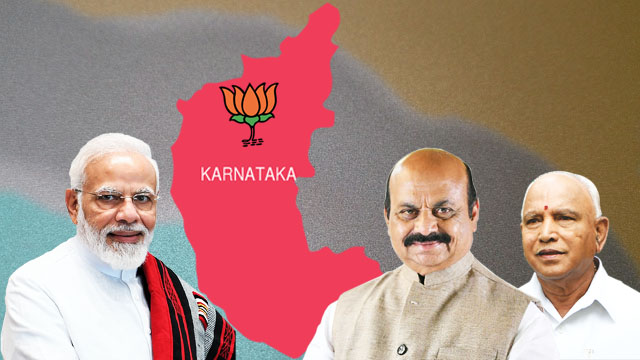
While critics of Prime Minister Narendra Modi’s Bharatiya Janata Party (BJP) are cheering the Indian National Congress’s (INC) victory in the Karnataka Assembly elections, terming it as a semi-final to the Lok Sabha elections scheduled in 2024, there are several underlying factors behind the mandate that needs a close look. The BJP’s defeat in Karnataka, the only southern state it was ruling, didn’t happen merely due to anti-incumbency factors, rather, there are several underlying reasons behind it.
Behind the BJP’s defeat in Karnataka, one can’t deny the role of a well-oiled and hyper-motivated INC poll machinery. The INC, which ruled the state singlehandedly between 2013 and 2018, failed to cross the magic figure of 113 seats in the 224-member legislative assembly required to form a government in the state in the last assembly election.
It managed to stitch an alliance with the Janata Dal (Secular) [JD(S)], offering the party’s chief HD Kumaraswamy the chief minister’s position. However, the INC and JD(S) coalition could rule with a thin majority only for 14 months, as soon after the 2019 Lok Sabha elections, the BJP managed to wean away several members of the legislative assembly (MLAs) and topple the government.
For the INC, it was a challenge to regain the power back from the BJP. Under former chief minister Siddaramaiah and state party chief DK Shivakumar, the party fought a strenuous pitch battle with the BJP, becoming the major challenge to the government, while the JD(S) slid into oblivion. However, apart from the INC’s fight, there have been other factors that contributed to the BJP’s defeat in Karnataka.
Reasons behind the BJP’s defeat in Karnataka
1. The BJP’s internal strife and erosion in the Lingayat vote bank
Even though the BJP’s veteran Lingayat leader BS Yeddyurappa played a pivotal role in toppling the INC-JD(S) coalition government and became the chief minister with the support of the turncoat MLAs, the BJP side-lined him eventually. Yeddyurappa was replaced by Basavaraj Bommai by the BJP, which irked the veteran leader.
Yeddyurappa’s marginalisation angered the powerful Lingayat community that he had weaned away from the INC’s fold in 1989. The result was visible in the major splitting of the Lingayat votes during the 2023 Karnataka Assembly elections between the INC and the BJP. Moreover, his lobby within the state’s ruling BJP got irked by the marginalisation of the veteran leader.
While Modi criticised the INC during the canvassing of the election, accusing it of suffering “instability” due to internal strife, several BJP leaders, including heavyweight Jagadish Shettar, who was the chief minister of the state from 2012 to 2013, quit the party and joined the INC before the assembly elections after he was denied a ticket. As a powerful Lingayat face of the BJP, Shettar’s marginalisation also angered the community, although he didn’t win the election.
Although the BJP thought that it will retain the support of the Lingayat voters by placing Bommai as the chief minister, the plan backfired. Bommai didn’t have the charisma and hold on the community, unlike Yeddyurappa.
2. The failure of Hindutva
Behind the BJP’s defeat in Karnataka lies the failure of its signature Hindutva-driven communal polarisation exercise before the elections. Since toppling the INC-JD(S) government in 2019, the BJP depended heavily on communal polarisation in the state, especially after Bommai became the chief minister.
Hijab ban, Halal meat, religious conversion and anti-Christian vitriol, the party heavily relied on such dichotomy to stoke communal passions and on extremist forces like the Bajrang Dal, the youth wing of the Vishwa Hindu Parishad (VHP), to keep the communal tempo high. The communal propaganda intensified along with unemployment and lack of development.
However, beyond its coastal region, communal polarisation didn’t spread much. Even though Modi criticised the INC’s poll promise of banning Bajrang Dal, which an INC leader denied, to stoke communal passions during the election campaigning, it didn’t help him achieve any breakthrough.
3. The INC’s social engineering
The INC’s renewed social engineering, despite the party’s softcore Hindutva approach, played a key part in the BJP’s defeat in Karnataka. Though the BJP had a major hold on the Lingayat community, which eroded following Yeddyurappa’s marginalisation, the INC managed to get a hold of a section of the community.
The INC placed a unique array of leaders who represent the major communities in Karnataka. Former chief minister Siddaramaiah, a member of the other backward community (OBC), state INC chief Shivakumar, a member of the significant Vokkaligga community, and the INC chief Mallikarjun Kharge, a Dalit, became a unique combo.
Apart from eroding the BJP’s Lingayat and Dalit support bases, the INC also affected the Vokkaligga vote bank of the JD(S). The fall in the JD(S) tally shows that a significant number of voters have shifted from Kumaraswamy’s party to the INC.
The INC also managed to polarise the Muslim and Christian vote banks in the state. It especially managed to wean away the Muslim voters from the JD(S) fold. The Christians, who have faced severe attacks during the BJP’s rule, also reportedly supported the INC.
The implications of the BJP’s defeat in Karnataka
The BJP’s defeat in Karnataka may have caused a setback to its juggernaut and Modi’s halo of invincibility, it will be too early to conclude that the trend will continue on a pan-India basis up to the 2024 Lok Sabha elections or the assembly elections scheduled later this year.
Historically, the BJP’s influence in the southern part of the Vindhya range has been negligible. Except for the communally-volatile coastal Karnataka, the intense polarisation drive initiated by the likes of VHP and Bajrang Dal, with their cow vigilante, anti-conversion and other campaigns, didn’t pay a rich dividend in Karnataka, but they may be game changers in major states like Bihar, Haryana, Madhya Pradesh, Rajasthan and Uttar Pradesh.
Apart from tightening its grip over the Hindi belt in northern and central India, the BJP has also expanded manifold in the northeast, including the states like Manipur, Meghalaya, Mizoram and Nagaland with a sizeable Christian population. The BJP’s social engineering has helped the party build a strong base in West Bengal, a state where it used to be a non-entity a decade ago.
The INC and the BJP will have to contest elections in Chhattisgarh, Madhya Pradesh and Rajasthan later this year, where the equations are quite different from that of Karnataka. These are places where the BJP’s Hindutva-driven politics has many subscribers, and it has ruled these states for years.
Among these, as the INC rules Chhattisgarh and Rajasthan, therefore, it will have to face strong anti-incumbency waves there. In Madhya Pradesh, although the INC has the advantage of being the principal Opposition, the BJP’s stronger organisational presence can outmanoeuvre the grand old party.
Moreover, even the assembly elections in these states won’t provide any concrete evidence that the Opposition can defeat the BJP in the 2024 Lok Sabha elections. The BJP lost the assembly elections in each of these states in December 2018, however, within a span of six months, it won a landslide victory in the Lok Sabha elections held in 2019. This shows how the results of the assembly elections don’t impact the general elections.
The BJP’s defeat in Karnataka also gave the party a chance to retrospect on its failures. By the time the INC will face the BJP again later this year, the latter may be a tough contender. Moreover, an ebullient INC may pose a stronger challenge to the BJP in these three states. In the long run, the party that manages to garner strength and support using a fool-proof strategy can taste victory in the 2024 Lok Sabha elections. Expecting too much out of a state’s assembly election is unrealistic.
East Post is an independent geopolitical analysis portal covering South Asia and global power dynamics for international audiences. Views expressed are analytical and do not constitute endorsement of any state or non-state actor.
Join our channels on Telegram and WhatsApp to receive geopolitical updates, videos and more.