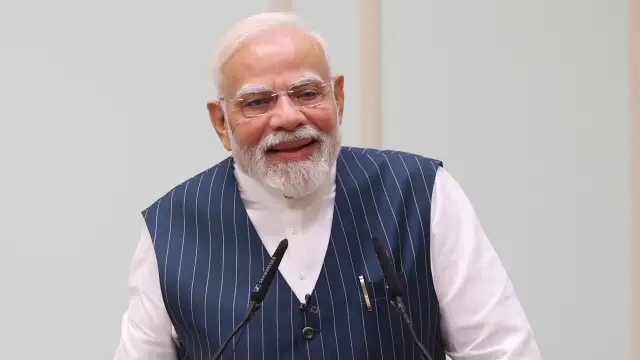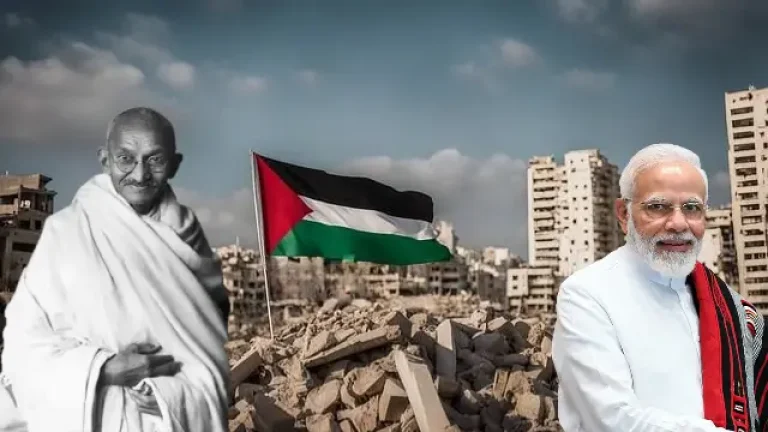
A day before Indian Prime Minister Narendra Modi paid homage to Mohandas Karamchand Gandhi, popular as Mahatma Gandhi, on his birth anniversary today, he tweeted about his discussion with Israeli Prime Minister Benjamin Netanyahu and how India stands against “terrorism”. Before Mahatma Gandhi’s birthday, Mr Modi highlighted India’s solidarity with Israel in a subtle way. This move betrays Mr Gandhi’s stance on Palestine and his staunch opposition to the creation of Israel, a fact that not many Indian foreign policymakers talk about in the present day and something that even Gandhists try to avoid.
Mr Modi has shown no support or any empathy for the people of Lebanon who are incessantly bombed by Israel, which has been violating its northern neighbour’s sovereignty with sheer impunity. While its Gaza attacks have killed over 41,000 people in a year, thousands have been killed in Lebanon, with which India has good bilateral ties.
Condoning violence against Lebanon or the entrapped people of Gaza by Mr Modi’s far-right Bharatiya Janata Party (BJP), which is the parliamentary wing of the Hindutva-driven Rashtriya Swayamsevak Sangh (RSS), an organisation that was complicit in the assassination of Mr Gandhi, shows the metamorphosis of Mr Gandhi’s India into its nemesis within eight decades.
Understanding Gandhi’s stance on Palestine
Mr Gandhi was a unique character in not just the history of the country but the world. He’s often criticised for having a duality, supporting something and at the very next stage opposing it bitterly.
Criticising Mr Gandhi during his interview to the BBC, Bhimrao Ambedkar, one of the key architects of the Indian Constitution, alleged the Mahatma had a different political persona when he preached in Gujarati to his captive audience in his home state of Gujarat—the home state of Mr Modi as well—which smacked of reactionary thoughts that supported the caste system, while he had a different persona, a liberal and progressive one, when he reached out a larger audience in English.
This dialectics of Mr Gandhi may have been a reason for his often contradictory positions on the same issue.
However, it was Mr Gandhi’s stance on Palestine that he never contradicted and it founded the basis of independent India’s Palestine policy.
Mr Gandhi opposed the idea of a “Jewish homeland”, which was imposed on the Arabs after the Second World War according to the Balfour Declaration of 1917.
Criticising the “Jewish homeland” question before the war, which also highlights his opposition to nationhood based on religion, Mr Gandhi wrote in 1938, “My sympathy for the Jews does not blind me to the requirements of Justice. It is wrong and inhuman to impose the Jews on the Arabs… The nobler course would be to insist on a just treatment of the Jews wherever they were born and bred. The Jews born and bred in France are French precisely in the same sense as the Christians born in France are French. Every country is their home, including Palestine, not by aggression but by loving service.”
Highlighting the flaw of the Jewish homeland, which was advocated by those powers that remained indifferent to Nazi Germany’s barbaric genocide of Jews, Mr Gandhi showed the hypocrisy of the West on the issue.
Mr Gandhi’s stand on Palestine was shaped by the fact that most European countries and the US didn’t want to provide a safe space to their Jews but offload them on the Arabs who were still colonised and lacked an agency and the military prowess to defend themselves.
When he was criticised for his views on the question of the “Jewish homeland” and when he could see the way the state of Israel was in the making with the help of Anglo-Saxon weapons and money, he opposed it once more in the Harijan in 1946.
“But, in my opinion, they have erred grievously in seeking to impose themselves on Palestine with the aid of America and Britain and now with the aid of naked terrorism. Their citizenship of the world should have and would have made them honoured guests of any country.”
Combating the myth that he’s “anti-Semitist” Mr Gandhi said, “No wonder that my sympathy goes out to the Jews in their unenviably sad plight. But one would have thought adversity would teach them lessons of peace. Why should they depend upon American money or British arms for forcing themselves on an unwelcome land? Why should they resort to terrorism to make good their forcible landing in Palestine?”
Hindutva’s opposition to Gandhi’s stance on Palestine
Mr Gandhi’s stance on Palestine was strongly opposed by not just the Zionists but the Hindutva camp as well. Apart from the RSS, the main supporter of the Israeli cause was Vinayak Damodar Savarkar, who coined the term “Hindutva” in the 1920s and gave the ideology an organisational direction.
Though Mr Savarkar, a leader of the Hindu Mahasabha, and the RSS leader MS Golwalkar supported the Nazi treatment of Jews in Europe, and the latter even considered it a lesson for the Hindutva camp to apply in India, against its minorities, they became staunch supporters of Israel as it coincided with Hindutva camp’s theory of nationhood based on religion.
Mr Savarkar believed that one’s holy land and fatherland should be the same and, therefore, Indian Muslims won’t be loyal to India, according to him, as their holy land is in Arab. Thus, Mr Savarkar, following his own chain of thoughts, supported the founding of Israel as the homeland of the Jewish people in a land they considered holy.
The terror inflicted by the Zionist forces on indigenous Palestinians didn’t bother the Hindutva camp. There was no objection to the terrorism of the Zionists in any of Mr Savarkar’s or Mr Golwalkar’s writings.
And when it comes to terrorism, both were accused in Mr Gandhi’s assassination in 1948, which was the first terrorist attack in independent India.
Mr Modi and his colleagues have been praising Mr Savarkar as a revolutionary throughout the tenure of his 10-year rule and the government and the RSS are allegedly involved in an image makeover role for the controversial figure.
Modi’s India vs Gandhi’s
Mr Gandhi’s stance on Palestine, his support for the Arab people, which became a key that opened the doors of strong ties with Middle Eastern countries for the newly-independent India and which grew stronger over a period of time, has been obliterated by another fellow Gujarati—Mr Modi.
While India recognised Israel following the Oslo Accords, based on the creation of an independent Palestinian state, which Mr Modi pays lip service to, never before did any government, including BJP’s Atal Bihari Vajpayee-led coalition government that ruled the country from 1998 to 2004, took as much of an unapologetic pro-Israel stance like the present dispensation.
While economic realities like India’s membership in the India-Israel-UAE-US (I2U2) grouping and its pivotal role in the India-Middle East-Europe Economic Corridor (IMEC) are crucial for New Delhi due to its proximity with the US, the indifference shown by India towards the Gaza genocide, its repeated tactical absence from the United Nations whenever there has been a resolution against Israel, and its absolute silence on Lebanon show its keen to be seen as an Israeli ally like the US, which also supports the two-state policy.
In doing so, Mr Modi’s government, which has started a cleanliness campaign on Mr Gandhi’s birthday, has betrayed the Mahatma by going against Mr Gandhi’s stance on Palestine.
In the long run, with the changing dynamics of West Asian geopolitics, India’s plans in the region and its long-term strategic interests can suffer severe setbacks if it fails to realise the pulse of the people. India’s reluctance to go against Israel’s war crimes also betrays Mr Gandhi’s non-violent principles that New Delhi advocates on a world stage.
For Mr Modi, toxic hyper-nationalism and chest thumping may be a vote generator in the domestic space, but on an international scale he may be throwing India into troubled waters by refusing to follow Mahatma Gandhi’s stance on Palestine. If India’s global identity is rooted in Gandhian principles, then its rescue from a carcinogenic and catastrophic foreign policy is also rooted in his thoughts, especially on Palestine.
East Post is an independent geopolitical analysis portal covering South Asia and global power dynamics for international audiences. Views expressed are analytical and do not constitute endorsement of any state or non-state actor.
Join our channels on Telegram and WhatsApp to receive geopolitical updates, videos and more.