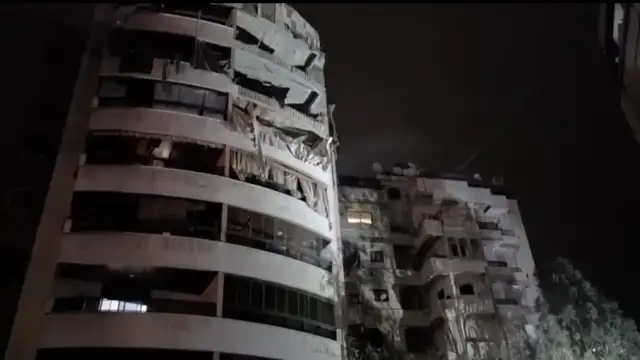
The Israeli airstrike hit the top three floors of a residential building in Beirut’s southern suburb of Al-Duwayr in the early hours of April 1st. Lebanon’s Ministry of Health reported four dead, including a woman, and seven injured, with two in critical condition. Israel’s airstrike on southern Beirut has stirred an upheaval as it violates the fragile ceasefire deal signed with Hezbollah last year.
Among those killed in the Israeli airstrike on southern Beirut were Hezbollah commander Hassan Bdeir and his son Ali, who were killed in their sleep. Their neighbours, siblings Ahmed Muhammad Mahmoud and his sister Hiam Muhammad Mahmoud, also perished in the attack. Their mother, Iman, was rushed to surgery with severe injuries, according to Lebanon’s National News Agency.
Lebanese sources suggest Mr Bdeir likely served as Hezbollah’s liaison with Palestinian resistance movements—a role that apparently sealed his fate.
“Criminal aggression”: Palestinian factions united in condemnation
In an unusual display of unity, Palestinian resistance organisations across the ideological spectrum—from right-wing Islamists to left-wing Marxist-Leninists—denounced the Israeli airstrike on southern Beirut.
The Palestinian Islamic Jihad issued a blistering statement characterising the attack as “a flagrant violation of the ceasefire agreement” designed to “destabilize Lebanon and shuffle the cards to serve its aggressive agenda.”
“This aggression, which enjoys clear support from the US administration, is part of a broader plan to redraw the map of the region to serve the interests of the Zionist entity and the United States, at the expense of the security and stability of our peoples,” the statement continued. “It is an extension of a series of ongoing attacks against Palestine, Syria, and Yemen, as well as the ongoing threats to the Islamic Republic of Iran.”
The left-wing Popular Front for the Liberation of Palestine (PFLP) echoed these sentiments, condemning what it called “the cowardly Zionist aggression” and placing blame squarely on “war criminal Netanyahu, who is pushing the region toward further escalation in an attempt to salvage his crumbling political future.”
“The occupier and its agents are mistaken if they believe that the resistance is weak,” the PFLP statement warned. “It will continue to work by all legitimate means to protect its people and confront the aggression,” the PFLP claimed on behalf of the resistance.
Lebanon’s muted response to Israel’s airstrike on southern Beirut
While Palestinian factions responded with vehemence, the official Lebanese reaction to Israel’s airstrike on southern Beirut has been notably restrained. President Joseph Aoun offered what many observers characterise as a tepid condemnation, while the Ministry of Foreign Affairs maintained a conspicuous silence.
“Israel’s persistence in its aggression requires more effort from us in addressing Lebanon’s friends around the world and rallying them in support of our right to full sovereignty over our land,” Mr Aoun said in a carefully worded statement. “This attack on the outskirts of Beirut, for the second time since the November 26th agreement, constitutes a serious warning of the hostile intentions against Lebanon,” the former general added.
The former general’s appeal to Lebanon’s “friends” rings particularly hollow given the country’s precarious diplomatic situation. Of Lebanon’s three major allies—France, Saudi Arabia and the United States—none seems inclined to offer meaningful support. France maintains a policy of studied detachment, Saudi Arabia has shown little interest in confronting Israeli aggression, and the US continues to provide unwavering support to Israel despite its repeated violations of international law.
Hezbollah’s restrained fury
Ibrahim al-Mousawi, a member of parliament from Hezbollah’s Loyalty to the Resistance Bloc, condemned the attack as “a major act of aggression” and called for more robust governmental action.
“Mere condemnations from the President and Prime Minister are not enough,” Mr al-Mousawi told Lebanese broadcaster Al-Manar. “The government must summon the ambassadors of major powers. The situation has become intolerable—civilians are being targeted in their sleep with no justification,” he added.
Despite his outrage, Mr al-Mousawi emphasised that Hezbollah was not seeking war. “We remain committed to restraint,” he said, “but the Lebanese government must engage in the highest levels of diplomacy when the state acknowledges the enemy’s breaches.”
Hezbollah Secretary-General Sheikh Naim Qassem had warned just days before the attack that “Lebanon remains on Israel’s annexation list,” adding that “Israel aims to establish a lasting foothold in Lebanon.”
In what now seems a prescient statement, Mr Qassem cautioned that if Israel continued to violate the ceasefire, “we will have no choice but to consider other options.”
Calculating the costs of escalation
Israel’s airstrike on southern Beirut represents the second major violation of the November 26th ceasefire, raising serious questions about the agreement’s viability. For residents of the affected areas, the constant threat of Israeli strikes has become a nightmarish reality.
International humanitarian organisations have expressed alarm at the potential for renewed conflict. The Lebanese infrastructure and civilian population—still reeling from years of economic crisis and political instability—would face catastrophic consequences if full-scale hostilities resumed.
As funeral processions wound through the narrow streets of Beirut’s southern suburbs in the festive period, the question on everyone’s lips was not if but when and how retaliation would come.
For now, an uneasy calm prevails—one that feels more like the gathering of a storm than the settling of peace.
East Post is an independent geopolitical analysis portal covering South Asia and global power dynamics for international audiences. Views expressed are analytical and do not constitute endorsement of any state or non-state actor.
Join our channels on Telegram and WhatsApp to receive geopolitical updates, videos and more.