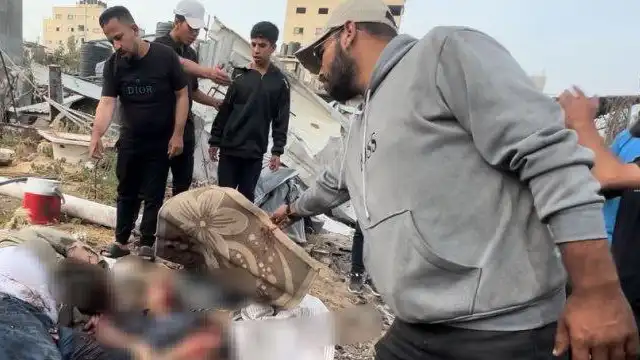
As Arab leaders concluded their summit in Baghdad on May 18th 2025, Israeli attacks on Gaza reached new heights of brutality. In a day marked by devastating airstrikes, hospital sieges and the targeted killing of journalists, Israeli forces killed at least 150 Palestinians while simultaneously announcing a plan to allow limited humanitarian aid—a stark illustration of how aid has become weaponised in this protracted conflict.
The deadly toll of Israeli attacks on Gaza
The Palestinian Ministry of Health reported that Israel killed 96 people and more than 140 have been injured in just the morning hours of May 18th.
This brings the death toll since March 18th to 3,193, with 8,993 injuries.
Since October 7th 2023, the total has reached a staggering 53,339 killed and 121,034 wounded.
Among Sunday’s victims were five journalists killed in separate Israeli strikes, along with several of their family members.
Abdul Rahman Al-Abadleh was killed in an airstrike on Al-Qarara in southern Gaza. Aziz Al-Hijjar was killed alongside his wife and children in Be’er Al-Na’ja, northern Gaza.
Nour Qandeel, her husband Khaled Abu Saif and their young daughter died when their home in Deir Al-Balah was hit.
Ahmad Al-Zeinati, his wife Nour Al-Madhoun and their two sons were killed when an Israeli airstrike struck their tent in Sanabel camp.
According to the Palestinian Journalists Protection Centre, this brings the number of journalists killed by Israel since October 7th 2023 to 222.
“What is happening in Gaza represents one of the deadliest waves of mass killings of journalists in modern history, amid suspicious international silence,” the centre noted in a statement.
In another significant strike, Zakaria Sinwar, an academic and professor of modern history at the Islamic University of Gaza, was seriously injured while three of his children were killed when Israeli forces bombed his tent in Al-Nuseirat Camp. Sinwar is the brother of Yahya Sinwar, the Hamas leader killed earlier in the conflict.
Hospitals under siege amid intensifying Israeli attacks on Gaza
The systematic targeting of medical facilities has emerged as a hallmark of Israel’s campaign. By day’s end on May 18th, not a single hospital in northern Gaza remained operational.
The Indonesian Hospital in Beit Lahia came under intense siege, with Israeli forces destroying the facility’s gate and yard, cutting off electricity and trapping 55 people inside—including four doctors, eight nurses and dozens of immobile patients. According to the Director-General of the Ministry of Health, Israeli forces opened fire on the hospital’s intensive care unit and bombed one of the patients.
“A state of panic and confusion has spread among patients, the wounded, and medical staff, severely hindering the delivery of emergency medical care,” the Ministry of Health said. “Two patients were injured while attempting to leave the hospital.”
Meanwhile, Al-Awda Hospital in northern Gaza suffered extensive damage after Israeli warplanes conducted ten airstrikes near the facility. “Large parts of the hospital were destroyed,” said Mohammed Salha, the hospital’s director. “The situation near the hospital is extremely dangerous. Some surgeries have been halted due to medical teams being unable to reach the location.”
These attacks came just hours after the destruction of the Kuwaiti Field Hospital in Khan Younis and days after the shutdown of the European Hospital. The pattern appears deliberate: “The occupation is intensifying its systematic campaign to target hospitals and force them out of service,” noted the Ministry of Health.
Civil defence collapses as casualties mount
The ability to respond to emergencies has nearly vanished. Gaza’s Civil Defence announced that 75% of their vehicles have ceased operations due to fuel shortages.
“The pace of Israeli bombing and targeting of residential homes continues to escalate, leaving us unable to respond to citizens’ emergency calls due to a severe shortage of essential resources—most critically fuel, heavy rescue equipment, spare parts, and vehicle repair supplies,” the Civil Defence stated.
They warned that within 72 hours, all vehicle services may come to a complete halt if they do not receive at least minimal fuel supplies. This collapse means victims remain trapped under rubble for hours or days, with no hope of rescue.
The weaponisation of aid
In a calculated move that underscores how humanitarian assistance has become a political tool, Israeli Prime Minister Benjamin Netanyahu‘s cabinet approved the entry of limited aid into Gaza—after blocking it for 80 days.
The decision came after Hamas released Edan Alexander, an Israeli-American soldier held captive since October 7th. For the past two months, no food or supplies had entered Gaza, forcing all bakeries to close and leaving the territory with less than two weeks of food stocks.
According to Israeli sources, the aid delivery is a temporary measure expected to last just one week, until the Israeli military establishes formal distribution centres near the “Morag” axis between Khan Younis and Rafah. The Israeli military will directly control aid distribution, effectively turning humanitarian assistance into an extension of military operations.
Netanyahu himself framed the decision not as a humanitarian gesture but as a tactical move to prevent famine that might “disrupt the progress” of Israel’s military campaign. Throughout the war, Israeli forces have bombed 68 aid distribution centres and charity kitchens, resulting in dozens of Palestinians killed.
Hamas rejects partial deals as Arab League falls silent
Hamas officials rejected rumours of an agreement to release nine Israeli captives in exchange for a two-month truce. “We initiated the handover of soldier Edan Alexander to create an atmosphere for reaching an agreement, but the American administration did not appreciate our step,” said Sami Abu Zuhri, head of Hamas’s Political Bureau Abroad.
He added: “We will not hand over the occupation’s captives as long as it insists on endlessly continuing its aggression against Gaza. We are ready to release the captives all at once, on the condition that the occupation commits to stopping the war with international guarantees.”
Taher Al-Nono, media advisor for Hamas, claimed that Israel deliberately escalates casualties during negotiations to gain leverage. “With every round of negotiations, the occupation deliberately raises the number of [those] killed to pressure and gain leverage,” he told Al-Mayadeen.
Meanwhile, Arab leaders meeting in Baghdad offered little beyond rhetoric. Their summit concluded the same day that Israeli attacks on Gaza killed at least 150 people, including 69 in the north, highlighting the profound gap between pan-Arab declarations and meaningful action.
The devastating events of May 18th 2025 represent in microcosm Israel’s broader strategy in Gaza: inflict maximum damage on civilian infrastructure while maintaining just enough humanitarian provision to deflect international condemnation.
As the aggression enters its 20th month, the Israeli government appears to be calculating exactly how much suffering Gaza’s population can endure before the world is moved to meaningful intervention—a calculation that, so far, has worked in Israel’s favour.
East Post is an independent geopolitical analysis portal covering South Asia and global power dynamics for international audiences. Views expressed are analytical and do not constitute endorsement of any state or non-state actor.
Join our channels on Telegram and WhatsApp to receive geopolitical updates, videos and more.