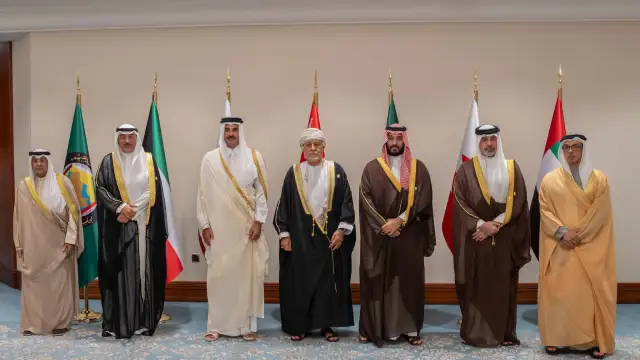
Despite the hullabaloo, the emergency Arab League Summit in Doha, called by Qatar, couldn’t find a resolution to counter the threat posed by Israel to West Asia. The emergency summit of the Arab League and the Organisation of Islamic Cooperation (OIC) was called by Qatari Amir Sheikh Tamim bin Hamad Al Thani at the Sheraton Doha hotel on Monday, September 15th, following the Israeli attack on the country last week.
While all Arab countries condemned the Israeli attack on Qatar, a country playing the mediator’s role in the Gaza ceasefire negotiation between Hamas and the Zionist entity, they didn’t show any interest in taking concrete punitive steps against Tel Aviv.
Therefore, although the Doha Declaration has issued 25 points, none of them deal with a solution to the threat posed by Israel.
It’s not merely a possibility that Israel will launch another attack on Qatar or any other Arab country, especially the Gulf monarchies that hitherto considered themselves immune from Israeli aggression due to their strong ties with the US.
Israeli Prime Minister Benjamin Netanyahu has announced that Israel, under the banner of its “right to protect itself”, can launch an attack on the “terrorists”, wherever they are.
As Qatar and Egypt play the role of mediators in the ceasefire negotiations, under the US’s supervision, it’s quite likely that Mr Netanyahu may decide to hit either of these two countries, targeting the senior Hamas officials there.
In such a scenario, while tensions in West Asia will escalate, the Gulf monarchies will provide no support to the victim in military terms, as the vaguely worded Doha Declaration has spared them any obligation towards each other.
What did the Arab League’s Summit in Doha achieve?
The Arab League’s Summit and the OIC’s meeting in Doha aimed at condemning and isolating Israel for its September 9th attack on Qatar. It also aimed to project unity among Arab and Islamic nations against Israel. However, on the eve of the meeting, a closed-door meeting of foreign ministers of Arab League members took place.
During the meeting, it was speculated that the Arab countries would form a military alliance, like the North Atlantic Treaty Organization (NATO), to bolster their collective security.
Pakistani Foreign Minister Mohammad Ishaq Dar had told Al Jazeera in an interview that the Arab countries are considering building a combined security force. He claimed that as the sole Islamic nuclear power, Pakistan will support the Arab countries.
Although the Pakistani minister had the compulsion to show excessive enthusiasm due to his country’s economic reliance on the Arab monarchies, the latter treaded carefully.
Therefore, the Doha Declaration didn’t mention any specific measures to bolster the Arab countries’ security to ensure it doesn’t irk US President Donald Trump.
The ninth point in the Arab League and OIC summit’s Doha Declaration vaguely mentions the need for collective security, without providing much detail in the adopted resolution.
“Welcome the adoption by the Council of the Arab League at ministerial level of the resolution entitled ‘Shared Vision for Security and Cooperation in the Region,’ and, in this context, to reaffirm the concept of collective security and shared destiny of Arab and Islamic States, the necessity of unity in facing common challenges and threats, and the importance of beginning to put in place the required implementation mechanisms,” the Doha Declaration stated.
It further stated in the tenth point the need to confront Israel’s aggression, however, again in vague terms.
“Reaffirm the necessity of confronting Israel’s schemes to impose a new fait accompli in the region, which pose a direct threat to regional and international stability and security, and the necessity of resisting them,” the tenth point said.
Apart from these two, the Arab states and OIC countries didn’t mention any concrete steps to isolate Israel. There is no call to punish Israel for the transgression.
The Iranian president, Dr Massoud Pezeshkian, has proposed that the Muslim countries cut ties with Israel. However, in the current geopolitical and economic scenario, it’s not feasible for countries like Egypt, Jordan, Saudi Arabia and the UAE to cut ties with Israel.
One of the examples of this is Türkiye.
Even though Turkish President Recep Tayyip Erdoğan has claimed that his government has foregone revenue of $9.5bn by cutting trade ties with Israel, shipping data shows movement of cargo between Türkiye and Israel.
Thus, the NATO member state remains complicit, yet claims not to be involved in any bilateral trade with Israel.
Why did the Arab League Summit in Doha disappoint many?
Several across the Global South, especially the Muslim-majority countries, expected a tougher response from the members attending the Arab League Summit in Doha.
While the Arab League and the OIC have been mute spectators throughout Israel’s 23-month-long Gaza aggression and attacks on Iran, Lebanon and Syria, limiting their role to only issuing vague statements, it was expected that an attack on one of the crucial monarchies would create an uproar.
Yet, the outcome of the Arab League and OIC summits in Doha disappointed those expecting a tough response.
To understand the reason behind the tepid response of the Arab League and OIC members, one needs to see the intent behind the emergency meeting.
The emergency Arab League Summit was convened by the Amir in Doha to demonstrate regional support for Qatar ahead of US Secretary of State Marco Rubio’s visit.
It was nothing more than a bargaining tool for Doha, as it wants to ensure that the US guarantees its security.
A few months ago, during his West Asia tour, Mr Trump managed to sell more weapons to the Gulf monarchies.
Qatar has not merely bought American weapons but also houses the largest US military base in the region.
It’s alleged that the US authorities knew about the Israeli air strikes in advance, and they didn’t alert the Qatari officials.
Moreover, it’s also alleged that the US military’s CENTCOM had deactivated Qatar’s American air defence system to safeguard the Israeli planes.
These incidents show that the US doesn’t treat Qatar on par with Israel. Yet, Qatar has to agree to American terms.
These monarchies have so far acted as American pawns, and under Mr Trump’s Abraham Accords, they have mostly agreed to cooperate with Israel.
It’s only because of the ongoing aggression in Gaza that Saudi Arabia isn’t in a position to implement projects with Israel, like the pending India-Middle East-Europe Economic Corridor.
However, countries like the UAE and Jordan aren’t merely cooperating with Israel but are also ensuring its protection.
In these circumstances, it’s not feasible for the monarchies, unlike Iran, to take a tough stance regarding Israel. To secure their territories, they have to rely more on the US than on their collective strength.
As US Secretary of State Marco Rubio has stated in Israel on Monday that Washington will steadfastly support Tel Aviv in its military expeditions, it sent a message to the Arab League and OIC countries.
With Mr Netanyahu reiterating that Israel will violate the sovereignty of any country in the region in the future, it remains to be seen how the Arab monarchies will protect themselves.
East Post is an independent geopolitical analysis portal covering South Asia and global power dynamics for international audiences. Views expressed are analytical and do not constitute endorsement of any state or non-state actor.
Join our channels on Telegram and WhatsApp to receive geopolitical updates, videos and more.