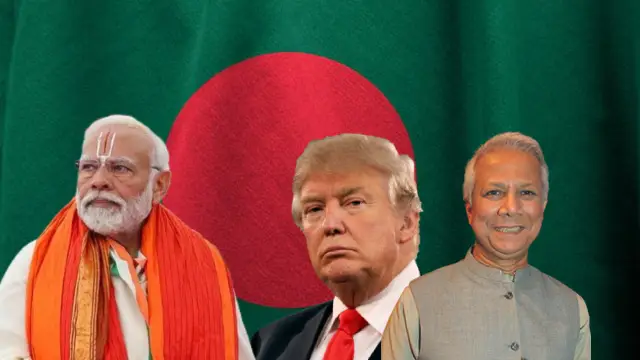
US President Donald Trump’s administration recently announced a freeze on foreign aid distributed through the United States Agency for International Development (USAID). While this move aims to curb destabilisation caused by US interventions worldwide, India’s ruling Bharatiya Janata Party (BJP) and its affiliated media outlets have framed the USAID freeze impact as targeted sanctions against Bangladesh. Pro-BJP channels like Republic TV, India TV, and newspapers like Hindustan Times, The New Indian Express, etc, claim that the US is punishing Bangladesh for persecuting Hindus—a narrative propagated by Prime Minister Narendra Modi-controlled BJP’s IT Cell and its leaders.
This campaign has led to speculation about whether the Trump administration has specifically targeted Bangladesh’s interim caretaker government, led by Mohammad Yunus, a Nobel laureate and vocal Democrat. Yunus, known for his microfinance initiatives, has long been at odds with Mr Trump’s policies.
In reality, Mr Trump has halted all USAID activities and foreign funding globally, with exceptions only for Egypt and Israel. The USAID freeze impact on Bangladesh is, therefore, a part of a global policy. However, India’s Hindutva-aligned groups have seized on this decision, portraying it as targeted sanctions against Bangladesh. This misinterpretation reveals a troubling lack of geopolitical foresight. It also has the potential to cause damage to India’s long-term strategic interests in South Asia and the Bay of Bengal region.
Misleading narrative on USAID freeze impact on Bangladesh
Hindustan Times, one of India’s largest mainstream newspapers, claimed on X (formerly Twitter) that Mr Trump’s decision to halt USAID support to Bangladesh was a response to reports of anti-Hindu violence in the country. However, no official US statement links the aid freeze to such incidents.
Pro-BJP outlets like WION and Republic World have amplified the narrative, framing the USAID freeze impact on Bangladesh as a “setback” for Yunus’s interim government.
“#BREAKING | President Donald Trump suspends all US Aid projects in Bangladesh, in a setback to Muhammad Yunus-led interim government (sic),” WION posted on X.
“In a significant shift in U.S. foreign policy, the United States Agency for International Development (USAID) has suspended all funding to the interim government of Bangladesh led by Muhammad Yunus (sic),” Republic World published on its website.
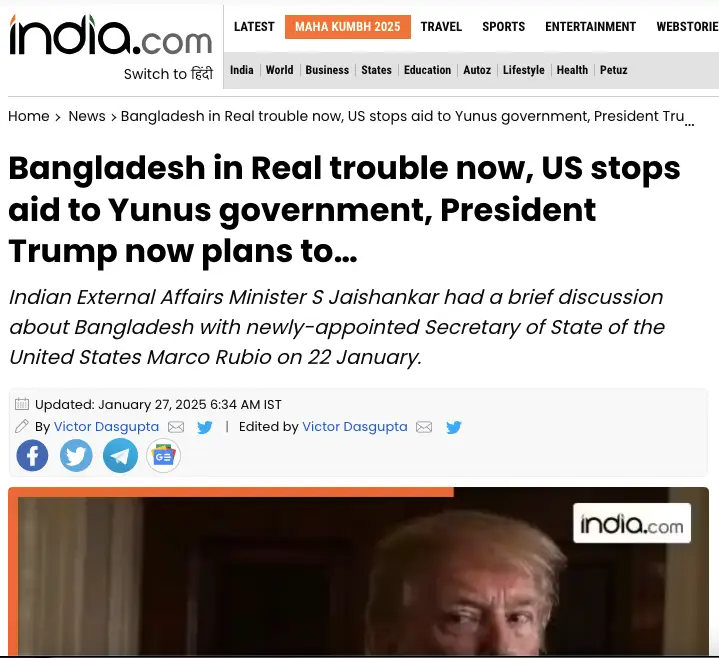
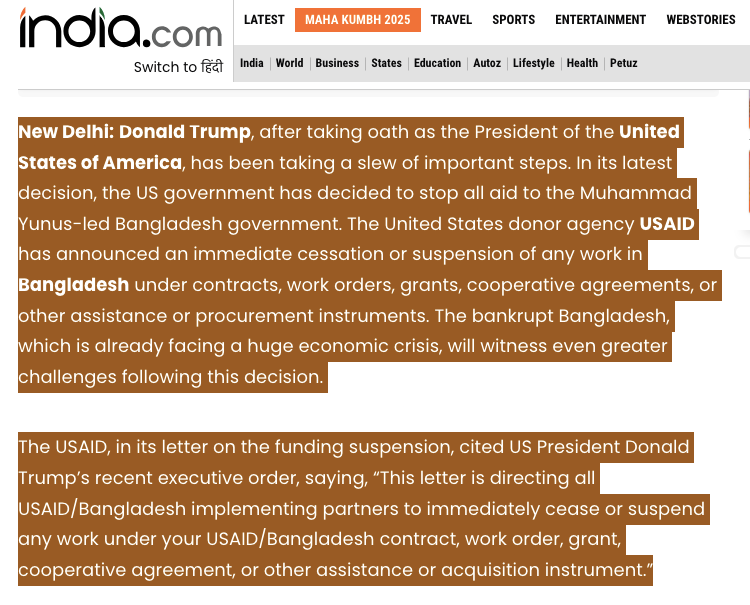
India.com, part of the same pro-Hindutva media universe, went further, claiming that “bankrupt Bangladesh” would face even greater economic challenges.
“The bankrupt Bangladesh, which is already facing a huge economic crisis, will witness even greater challenges following this decision,” the website, which had 188.8m views in December 2024, published.
IndiaTV, a channel controlled by a pro-Hindutva editor, Rajat Sharma, shared the same story. It claimed that the decision follows India’s External Affairs Minister S Jaishankar’s meeting with Secretary of State Marco Rubio.

“Donald Trump halts US aid to Yunus Interim govt in Bangladesh (sic)” the Financial Express, a subsidiary of The Indian Express, one of India’s leading dailies, wrote in the heading of its digital coverage.
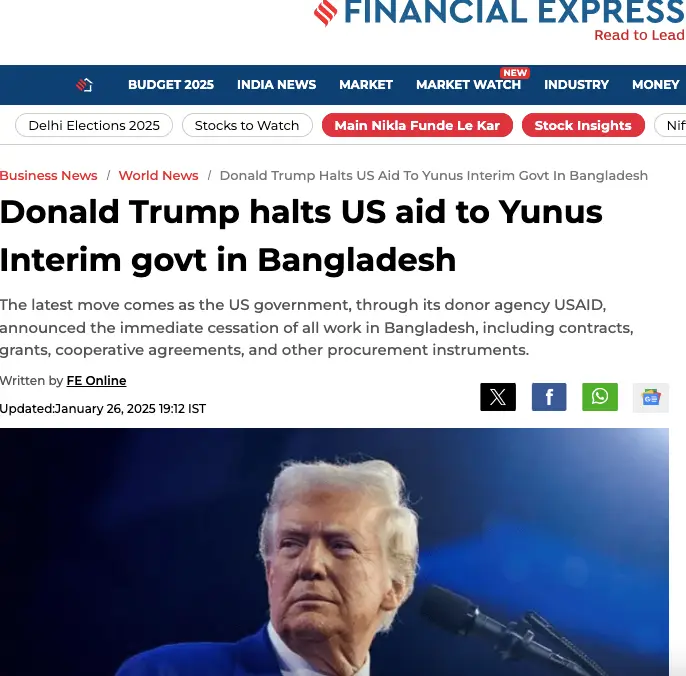
Notably, these mainstream reports often bury the fact that Mr Trump’s USAID freeze is a global policy, not specific to Bangladesh. This selective reporting underscores the Hindutva camp’s broader agenda: to isolate Bangladesh and bolster the saffron camp’s influence in the region.
The source of the Indian mainstream, pro-Hindutva lobby’s coverage was a post on X by Kanchan Gupta, a pro-Hindutva media advisor to Mr Modi’s government.
Mr Gupta tweeted “US halts aid to Yunus Regime-led Bangladesh, notifies Dhaka,” without specifying that the decision to stop USAID is not specific to Bangladesh but a worldwide decision.
Apart from the mainstream media, fringe Hindutva campaigners have been also spreading the same narrative.
Hindutva-incensed blog Hindu Post has claimed the freezing of USAID as the “endgame” for Mr Yunus and Bangladesh in its post.
Why Trump’s USAID freeze might benefit Bangladesh?
According to an executive order by the US president, Mr Trump’s administration has decided to review all foreign aid provided through USAID. Mr Rubio confirmed in a memo that the Trump 2.0 administration will take 85 days to review all the existing foreign aid distributed through the USAID channel.
Except for Egypt and Israel, the US will not provide foreign aid in the next 90 days until the administration decides on whether to continue the assistance provided under the programmes. This isn’t a sanction specifically on Bangladesh, as many in the Hindutva camp would claim, but a worldwide phenomenon.
The US government provided Bangladesh with about $490m in 2023, during the tenure of ousted prime minister Sheikh Hasina, for the development sector. In September 2024, the USAID committed to provide $202.25m in aid as part of the Development Objective Grant Agreement (DOAG).
The USAID freeze will impact Bangladesh’s DOAG projects, although the programme doesn’t provide for the government’s expenses.
Although the freezing of USAID to countries like Bangladesh will impact its healthcare and other programmes, however, much to the dismay of India’s Hindutva camp, Mr Yunus’s government will continue to receive money from the US for life-saving food and nutrition supplies for the Rohingya refugees sheltered in the country.
The USAID freeze impact on Bangladesh will disrupt development projects, but exemptions for Rohingya refugee aid remain in place, for which Mr Yunus has thanked the US president.
“Officials of the US Embassy in Dhaka visited High Representative Dr Khalilur Rahman this afternoon and informed him about this exemption,” Mr Yunus’s press secretary announced on Sunday.
India’s Hindutva camp has been demonising the Rohingyas, accusing them of entering India and changing its demography in an apparent bid to stoke Islamophobia among the majority Hindus. As Mr Trump, whom the Hindutva camp hails, continues to provide for Rohingya refugees from Myanmar, it’s a setback for India’s far-right.
But this isn’t the only bad thing for India.
India’s misinformation campaign: A strategic blunder?
India’s mainstream media and Hindutva-aligned groups have jointly propagated misinformation about Bangladesh, from claims of Hindu persecution to framing the USAID freeze as targeted sanctions. This narrative, however, overlooks the broader implications for India’s long-term strategic interests in South Asia.
One of the key drivers of anti-Hasina sentiment in Bangladesh has been her government’s perceived subservience to New Delhi. Many Bangladeshis aspire to a bilateral relationship based on equality—a concept fundamentally at odds with the hierarchical worldview of Hindutva ideology. By celebrating the USAID freeze as a victory, India’s Hindutva camp risks alienating Bangladesh further, jeopardising any chance of rebuilding trust with future governments in Dhaka.
The Indo-Pacific chessboard
India’s role as a junior partner in the US-led Indo-Pacific strategy complicates its relationship with Bangladesh. Washington and its allies, including Australia and Japan, aim to counter China’s influence in the region. However, New Delhi has historically sought to maintain control over Bangladesh’s geopolitical alignment.
Subsequent Indian governments have ensured that foreign powers maintain their relations with Bangladesh through New Delhi, a formula only Russia has accepted so far.
Like China, the US has also taken a different approach. By separating its India desk from the South Asia desk, Washington has signalled its intent to engage with Bangladesh independently. This shift became evident during the 2023 Bangladeshi elections when the US sanctioned individuals accused of electoral malpractices—a move opposed by both Ms Hasina and New Delhi. Ms Hasina later alleged that the US sought control over St Martin’s Island to gain leverage in the Bay of Bengal, a claim echoed by India’s Hindutva camp, which blamed the CIA for the anti-Hasina rebellion in July-August 2024.
Trump’s rise and India’s growing influence in Washington
The collapse of the Biden administration and the resurgence of Mr Trump have bolstered India’s influence in Washington. Several outspoken Hindutva supporters have been appointed to key positions in the US national security apparatus, reflecting a deepening alignment between the two far-right entities in global politics.
However, this alignment has not translated into favourable outcomes for India’s regional ambitions. Mr Yunus, Bangladesh’s interim leader and a vocal critic of Mr Trump, has long anticipated a cooling of US-Bangladesh relations. Since last year, Mr Yunus’s caretaker government has actively courted China and Pakistan, two of India’s staunchest rivals, to secure its long-term defence and economic interests. While Bangladesh’s ties with Pakistan remain limited to military and intelligence cooperation, its relationship with China has grown significantly.
India’s misinformation campaign overlooks the broader USAID freeze impact on Bangladesh, which will be pushing Dhaka closer to China, much to India’s disadvantage.
China’s strategic gains in Bangladesh
China’s cordial relationship with Sheikh Hasina’s government soured due to her perceived favouritism toward India. Ms Hasina went to China in July 2024, her last foreign tour as the prime minister, where she signed a strategic cooperative partnership agreement with China. However, when Ms Hasina sought a US$7bn loan from Beijing during her visit in July 2024—$5bn for trade assistance and $2bn to cover budget deficits—China refused. Since Ms Hasina’s ouster, Beijing has actively wooed Mr Yunus’s interim government, offering economic and strategic partnerships.
On August 25th 2024, Chinese Vice Foreign Minister Sun Weidong met with the outgoing Bangladeshi ambassador to China Md Jashim Uddin, a Hasina-era appointee. The Chinse hailed Sino-Bangladesh relations during this meeting.
“China welcomes the establishment and full operation of the interim government of Bangladesh, wishes Bangladesh political stability and economic development, and is ready to work with Bangladesh to strengthen exchanges and cooperation in various fields, pursue high-quality Belt and Road cooperation, and promote greater development of China-Bangladesh relations,” the Chinese Ministry of Foreign Affairs (MFA) said in a statement.
On December 24th 2024, Director-General of the Department of Asian Affairs of the Foreign Ministry Liu Jinsong met with the new Bangladeshi Ambassador to China Nazmul Islam. Mr Islam has been appointed by Mr Yunus’s government anticipating major changes in the US administration.
“China is ready to maintain high-level exchanges with Bangladesh, strengthen the exchange of governance experience, and take the 50th anniversary of the establishment of China-Bangladesh diplomatic relations and the ‘China-Bangladesh Year of People-to-People Exchanges’ next year as an opportunity to enhance communication and cooperation, advance high-quality Belt and Road cooperation, and continuously enrich the comprehensive strategic cooperative partnership between China and Bangladesh,” the Chinese MFA said.
China can’t leave Bangladesh despite Mr Yunus’s close ties with Democrats and the country’s economic reliance on the US. Bangladesh is a key member of China’s Belt and Road Initiative (BRI).
Bangladesh’s participation in BRI has already yielded significant investments. According to the American Enterprise Institute (AEI), China has invested $7.07bn in Bangladesh under BRI, with additional construction contracts worth $22.94bn.
As the USAID freeze impact on Bangladesh deepens in the days to come, China can seize the opportunity to expand its influence through the BRI. China’s growing influence in Bangladesh could thwart Indian and American efforts to isolate Beijing in the Bay of Bengal—a long-term strategic gain for China and a loss for India.
The economic fallout: Bangladesh’s dilemma
Bangladesh’s economy relies heavily on exports to the US and the West, particularly its garments industry, which accounts for a significant portion of its GDP. China, a major garment producer itself, cannot replace this market. India’s calls for US intervention, reiterated by Mr Jaishankar during his meeting with Mr Rubio, could further strain Bangladesh’s economy if the US, driven by Mr Trump’s protectionism, restricts imports. This compels Dhaka to share cordial relations with Washington DC.
Moreover, Mr Trump’s protectionist policies cast doubt on Bangladesh’s ability to rely on the US market in the long term. By aligning itself with India’s agenda, the US risks pushing Bangladesh closer to China—a scenario that undermines both nations’ strategic interests in the Indo-Pacific region.
A neo-colonial approach: India’s self-inflicted wounds
The propaganda centred around the USAID freeze impact on Bangladesh highlights the risks of India’s neo-colonial approach in South Asia.
The constant propaganda about US sanctions and Hindu persecution has widened the rift between the two nations. Bangladesh’s interim government, led by Mr Yunus, has made it clear that it will not accept India’s hegemony.
As India isolates itself in South Asia, with Bhutan as its only remaining ally, its reliance on misinformation campaigns exposes its insecurities. This approach not only damages India’s credibility but also paves the way for geopolitical catastrophes in the region.
What lies ahead?
The fallout from India’s misinformation campaign targeting Bangladesh over Mr Trump’s USAID freeze will have far-reaching consequences. Rather than peddling the usual propaganda around the perceived USAID freeze impact on Bangladesh, there is a need for India to rethink its strategy in the region
Bangladesh’s growing reliance on China, coupled with its economic dependence on the West, places it in a precarious position.
Yet, India’s inability to foster equitable relationships in South Asia could lead to its further isolation, while China consolidates its influence in the Bay of Bengal.
In the long term, Indian propaganda around the USAID freeze impact on Bangladesh could reshape the geopolitical dynamics of the Bay of Bengal.
Moreover, in the end, India’s propaganda-driven diplomacy may prove to be its own undoing. As Bangladesh charts its course in a rapidly changing geopolitical landscape, New Delhi must rethink its strategy—or risk becoming a bystander in its own backyard.
East Post is an independent geopolitical analysis portal covering South Asia and global power dynamics for international audiences. Views expressed are analytical and do not constitute endorsement of any state or non-state actor.
Join our channels on Telegram and WhatsApp to receive geopolitical updates, videos and more.