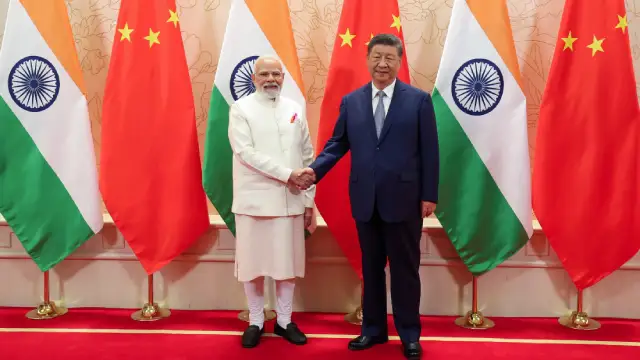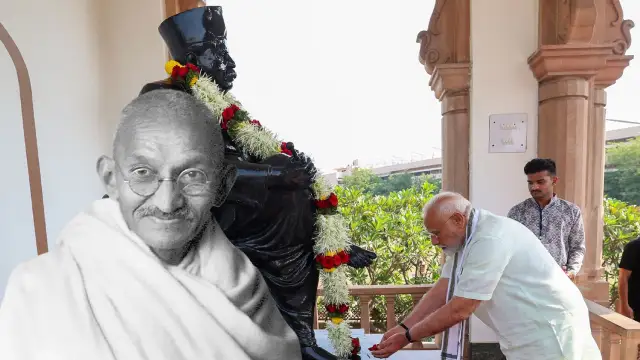
October 2nd 2025 marks an uncomfortable convergence. India celebrates Mahatma Gandhi‘s 156th birth anniversary. The same day, the Rashtriya Swayamsevak Sangh (RSS) celebrates its centenary. This organisation is considered the wellspring of Hindutva nationalism, which drove Mr Gandhi’s assassin. It now controls nearly every lever of Indian power. Prime Minister Narendra Modi, a lifelong RSS member, presided over commemorations in New Delhi. He released a 100-rupee coin bearing RSS iconography. Meanwhile, India’s support for Israel in Gaza intensifies. The nation abandons Mr Gandhi’s vision for Palestine. Instead, it embraces the ideology of those who killed him.
The timing is ironic, but no accident.
The RSS was founded on September 27th 1925. But it celebrates its founding on Vijayadashami, a Hindu festival. In 2025, that festival falls on October 2nd, Mr Gandhi’s birthday.
Mr Gandhi opposed Zionist colonisation of Palestine. He championed secular, inclusive nationalism. The RSS architects admired Nazi Germany. They supported Zionist claims to Palestine. Today, their worldview drives policy for 1.4bn people. Under the RSS, India has become Israel’s largest weapons customer.
RSS and Gandhi’s murder
Mr Gandhi was shot three times at point-blank range on January 30th 1948. His assassin, 37-year-old Nathuram Godse, belonged to both the Hindu Mahasabha and the RSS. The RSS claims Mr Godse left in the mid-1930s. But his brother Gopal Godse, who served 15 years as a co-conspirator, told a different story, years later. “All the brothers were in the RSS,” he said.
The government banned the RSS on February 4th 1948, five days after the assassination. Home Minister Sardar Vallabhbhai Patel noted that RSS men expressed joy and distributed sweets after Mr Gandhi’s death.
Vinayak Damodar Savarkar, the ideological architect of Hindutva, faced more explosive charges. He coined the “fatherland-holy land” theory that defines Hindu nationalism.
The ideological chasm between Mr Gandhi and the RSS extended far beyond tactics.
RSS and Gandhi differ on Palestine
Mr Gandhi published his clearest statement on Zionism in his newspaper, Harijan, on November 26th 1938.
At that point, Nazi persecution of Jews was intensifying. Still, Mr Gandhi clarified his stance on Palestine.
“Palestine belongs to the Arabs in the same sense that England belongs to the English or France to the French,” Mr Gandhi wrote. “It is wrong and inhuman to impose the Jews on the Arabs. What is going on in Palestine today cannot be justified by any moral code of conduct,” he added.
He continued: “Surely it would be a crime against humanity to reduce the proud Arabs so that Palestine can be restored to the Jews partly or wholly as their national home.”
Mr Gandhi opposed political Zionism while expressing deep sympathy for Jewish suffering.
He argued Jews should resist Nazi persecution through non-violence. They should not create a colonial state under British military protection.
In 1946, he wrote: “Why should they depend upon American money or British arms for forcing themselves on an unwelcome land? Why should they resort to terrorism to make good their forcible landing in Palestine?”
Savarkar promotes Israel, Golwalkar hails Nazis
Mr Savarkar took the opposite position. In his foundational 1923 text “Essentials of Hindutva”, he wrote: “If the Zionists’ dreams are ever realised – if Palestine becomes a Jewish state – it will gladden us almost as much as our Jewish friends.”
He believed a Jewish state would serve to checkmate the aggressive tendencies of Muslim fanaticism in general.
After Israel’s creation in 1948, Mr Savarkar celebrated the establishment of the independent Jewish state in Palestine on moral and political grounds.
He criticised India’s 1947 United Nations (UN) vote against partition as Muslim appeasement.
RSS’s second chief, MS Golwalkar, went further. In his 1939 book “We or Our Nationhood Defined”, written after Kristallnacht, he praised Nazi Germany. “To keep up the purity of the Race and its culture, Germany shocked the world by her purging the country of the Semitic Races – the Jews,” Mr Golwalkar wrote.
“Race pride at its highest has been manifested here. Germany has also shown how well-nigh impossible it is for Races and cultures, having differences going to the root, to be assimilated into one united whole, a good lesson for us in Hindusthan to learn and profit by.”
From Palestine champion to Israel’s silent partner
For decades after independence, India positioned itself as a champion of Palestinian rights. India was the first non-Arab nation to recognise the Palestine Liberation Organization (PLO) in 1974.
It was among the first to recognise Palestinian statehood in 1988. This came before establishing full diplomatic relations with Israel in 1992. India consistently voted pro-Palestine at the UN.
It supported PLO membership in international organisations. It maintained a balanced approach that linked progress with Israel to progress on Palestinian rights.
Mr Modi’s 2014 election marked a dramatic shift.
His government announced a de-hyphenation policy. Israel and Palestine would be treated as entirely separate, independent relationships.
In July 2017, Mr Modi became the first Indian prime minister to visit Israel. More significantly, he did not visit Palestine or Ramallah during this trip.
He broke every previous Indian leader’s practice of visiting both. All prior ministerial visits had included stops in both locations. The omission signalled a fundamental reorientation.
Weapons join I-I axis
The defence relationship drove much of this shift. India became Israel’s largest arms customer globally. It purchases weapons worth over $2bn annually. By 2024, it received 42% of all Israeli arms exports. Deals included Spike missiles, Hermes 900 drones, and advanced air defence systems.
The Adani Group, closely associated with Mr Modi, partnered with Israel’s Elbit Systems to manufacture drones in Hyderabad. Over 20 Hermes 900 drones were delivered to Israel by early 2024.
Modi’s unapologetic support for genocide
When Hamas launched Operation Al-Aqsa Flood against Israeli occupation on October 7th 2023, Mr Modi’s response abandoned all pretence of balance.
“We stand in solidarity with Israel at this difficult hour,” he tweeted. “Our thoughts and prayers are with the innocent victims and their families. India strongly and unequivocally condemns terrorism in all its forms and manifestations,” he added.
Sensing trouble, he had to take a U-turn in a few days, but has never criticised Israel’s aggression in these two years..
India’s UN voting record became incoherent.
On October 27th 2023, India abstained on a resolution calling for a humanitarian truce. By December 12th 2023, after 18,000 Palestinian deaths, India voted for an immediate ceasefire.
Yet by June 2025, with Palestinian deaths exceeding 66,000, India again abstained on a ceasefire resolution. It became one of only two Asian nations to abstain, along with Timor-Leste.
All other Quad members except the United States voted for the ceasefire. India became an outlier even among strategic partners.
Diplomacy turns appeasement tool
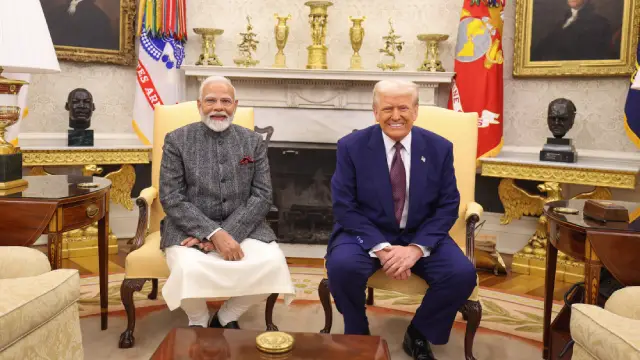
On September 30th 2025, Mr Modi fully endorsed Donald Trump’s Gaza peace plan hours after its announcement. “We welcome President Donald J Trump’s announcement of a comprehensive plan to end the Gaza conflict,” he posted. “It provides a viable pathway to long term and sustainable peace,” he added.
Israeli Ambassador to India Reuven Azar responded immediately. “We welcome the statement of PM Modi, it is a great sign that we have India with us,” Mr Azar said.
India’s opposition Indian National Congress (INC) condemned Mr Modi’s silence on the Gaza genocide and moral cowardice.
Senior INC leader Sonia Gandhi wrote that the government’s response appears to be driven primarily by personal friendship between Mr Modi and Benjamin Netanyahu rather than India’s constitutional values.
The transformation is complete. The nation that Mr Gandhi wanted to stand against colonial projects now provides rhetorical cover for Israel. The nation that pioneered recognition of Palestinian statehood now offers material support while 66,000 Palestinians lie dead.
RSS controls India, its foreign policy
Mr Modi is not simply influenced by the RSS. He is the RSS. Mr Modi spent years as an apparatchik. In 1985, the RSS assigned him to the Bharatiya Janata Party (BJP), its political wing. He rose from organiser to chief minister of Gujarat to prime minister in 2014. A 2019 study found 71% of Mr Modi’s ministers had RSS backgrounds. This created unprecedented ideological homogeneity in Indian governance.
The structural relationship runs deeper than personnel. Mr Modi and senior ministers attend the three-day RSS coordination meetings. They present policy positions on education, foreign policy, and economic policy. The prime minister and senior ministers report on their policies. They receive the RSS’s views on policy. This is not merely lobbying. It is hierarchical guidance from ideological command to political implementation.
The RSS views Israel as the template for Hindu Rashtra. Both are parliamentary democracies with religious majorities. They define national identity through ethnic-religious criteria. These two maintain second-class status for minorities.
Moreover, contrary to Mr Gandhi, both believe in the language of force.
RSS chief Mohan Bhagwat stated recently, “The world listens to the language of love and welfare only when you have power. We need to be powerful and the world has seen our strength.”
The ideological transformation extends to diplomatic practice itself.
RSS activists have been reportedly planted at embassies and high commissions. Hindu religious events proliferate at diplomatic facilities. Sanskrit terms and yoga serve as soft power for India’s outreach. English is marginalised in favour of Hindi. External Affairs Minister Subrahmanyam Jaishankar frames policy through “civilisational language”.
These replace Nehruvian secularism with Hindu nationalist discourse.
Gandhi’s assassins rejoice
The RSS celebrated Nazi Germany’s treatment of Jews as a model. Its member assassinated Mr Gandhi for alleged Muslim appeasement. It spent decades building grassroots networks through 83,000 local branches. It built India’s most powerful political party—BJP. Now it controls virtually every institution in the world’s largest democracy.
The October 2nd coincidence represents historical irony transformed into political triumph.
The secular, inclusive, anti-colonial vision Mr Gandhi died defending has been systematically dismantled.
The very forces that killed him accomplished this. The very force that killed Mr Gandhi now embraces Israel over the dead bodies of 66,000 Palestinians.
The RSS centenary on Mr Gandhi’s birthday marks not ironic timing but ideological victory. It represents the complete inversion of everything Mr Gandhi lived and died for. The movement that pulled the trigger accomplished this inversion.
On October 2nd 2025, as India marked Mr Gandhi’s birth and the RSS centenary, the distance between Mr Gandhi’s vision for Palestine and India’s current policy measured more than geography. It measured the death of a dream.
East Post is an independent geopolitical analysis portal covering South Asia and global power dynamics for international audiences. Views expressed are analytical and do not constitute endorsement of any state or non-state actor.
Join our channels on Telegram and WhatsApp to receive geopolitical updates, videos and more.