India’s Prime Minister Narendra Modi‘s first trip to Israel in nine years has stirred fresh controversy. A faction of India’s opposition — chiefly its communist parties — has lambasted the Modi government’s deepening closeness with the US and Israel, accusing it of betraying India’s long tradition of supporting Palestine. But beyond the domestic squabbling, the visit carries graver international implications.
Mr Modi has chosen to perch India on Israel’s orbit at precisely the moment the US appears to be clearing the way for an assault on Iran. The message is unmistakable: India is drifting away from West Asia just as the region is about to be set alight.
Modi’s Israel visit
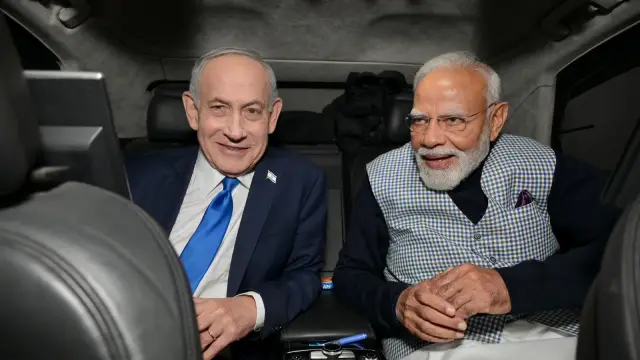
This is Mr Modi’s second trip to Israel — and only the second by any Indian prime minister.
His first, in 2017, was itself mired in controversy. It has recently resurfaced in a more unsavoury context: documents released by the US Department of Justice relating to the late Jeffrey Epstein — convicted of child sexual abuse — contain a reference to that visit. According to an Epstein email, Mr Modi “danced and sang” in Israel at the behest of the then-US president, apparently to please him. That particular US president, as it happens, is the current one.
Although Mr Modi’s Israel trip had long been in the works, India’s Ministry of External Affairs had declined to announce a date. Indian news agencies learnt of the plan through ruling Bharatiya Janata Party (BJP) sources, but the travel dates were revealed not by New Delhi but by Israeli Prime Minister Benjamin Netanyahu — on Monday, February 23rd.
This morning, at the opening of our Cabinet meeting, I spoke about the historic visit of my dear friend, Prime Minister @narendramodi, to Israel this coming Wednesday. 🇮🇱🤝🇮🇳
— Benjamin Netanyahu – בנימין נתניהו (@netanyahu) February 22, 2026
The bond between Israel and India is a powerful alliance between two global leaders. We are partners in… pic.twitter.com/8cW2ltKdzK
India’s ministry scrambled to confirm, one day later, that Mr Modi would make a two-day visit on February 25th and 26th. The spectacle of New Delhi following Tel Aviv’s lead rather than its own prompted raised eyebrows among analysts.
The ministry duly issued its communiqué. “The two leaders will review the significant progress made in India – Israel Strategic Partnership, and discuss further opportunities in various areas of cooperation, including science and technology, innovation, defence and security, agriculture, water management, trade and economy, and people to people exchanges (sic),” it said.
“The leaders are also expected to exchange perspectives on regional and global issues of mutual interest,” the MEA mentioned without particularly referring to any West Asian tension.
“This visit will reaffirm the deep and long-standing strategic partnership between the two countries and will present an opportunity to review the common challenges as well as realign efforts towards achieving their shared vision for a robust partnership between two resilient democracies (sic),” the MEA statement said.
Mr Modi was no less effusive on social media.
Before leaving for Israel, the prime minister wrote, “Our nations share a robust and multifaceted Strategic Partnership. Ties have significantly strengthened in the last few years. I will be holding talks with PM Netanyahu, in which we will discuss ways to strengthen cooperation across diverse fields (sic).”
I will be undertaking a State Visit to Israel today and tomorrow. Our nations share a robust and multifaceted Strategic Partnership. Ties have significantly strengthened in the last few years. I will be holding talks with PM Netanyahu, in which we will discuss ways to strengthen…
— Narendra Modi (@narendramodi) February 25, 2026
Under Mr Modi, India and Israel have not merely upgraded their bilateral relationship to a strategic partnership — they have moved into the same orbit.
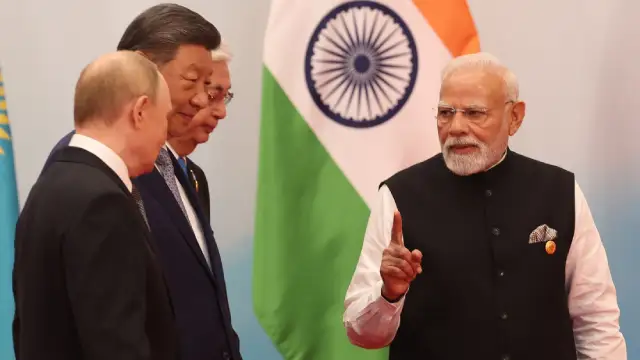
There is a conspicuous thread running through all of this. India, despite being a member of both BRICS and the Shanghai Cooperation Organisation (SCO), has declined to join its partners in opposing Israel’s military campaign in Gaza, termed as genocide by the United Nations.
Mr Modi expressed direct support for Mr Netanyahu in October 2023, immediately after Israel launched its Gaza offensive. He subsequently reverted to India’s traditional call for a two-state solution, but said almost nothing specific about Gaza — he reportedly used the word only twice in two years.
India’s representative office in Ramallah told East Post that New Delhi dispatched humanitarian aid to Gaza on just two occasions in that period.
At the SCO summit in China in August 2025, Mr Modi signed a joint declaration condemning the Gaza genocide and Israeli and US strikes on Iran.
Yet it is reported that it was at India’s insistence that Russia and China agreed to excise the word “genocide” from the passages specifically addressing Gaza.
Over those two years, meanwhile, Israeli weapons manufacturers have been producing drones and other lethal equipment through joint ventures with Indian firms — most notably those belonging to Gautam Adani, one of Asia’s richest men, widely perceived as close to Mr Modi and notorious for a string of controversies — and these weapons have reportedly been exported for use in the Gaza campaign.
India has, on certain issues at the United Nations, voted against Israel — on West Bank settlements and humanitarian access to Gaza. But on the fundamental question of the Gaza conflict, New Delhi has stood squarely with Tel Aviv.
Behind this alignment lie clear economic and military ambitions — ones that Mr Netanyahu, remarkably, chose to reveal before Mr Modi had even landed.
Joining Israel’s axis, leaving allies like Iran behind
When Mr Netanyahu announced Mr Modi’s visit on February 23rd, he simultaneously disclosed that India would be joining a six-nation strategic hexagonal axis alongside Israel. He described the regional landscape in stark terms: beyond the “Shia extremist axis” — widely understood as Iran’s anti-Zionist resistance bloc, encompassing Lebanon’s Hezbollah, Yemen’s Houthi rebels, Palestinian resistance groups and Iraq’s Kataib Hezbollah — a “Sunni extremist axis” was also taking shape.
An Israeli-led hexagonal alliance, comprising India, Greece, Cyprus and certain Arab and African states, would counter both.
Israel’s confrontation with Iran has reached an acute pitch.
Under Israeli pressure, US President Donald Trump has deployed troops, warships and combat aircraft to West Asia on a scale not seen since the 2003 invasion of Iraq.
Analysts suggest Mr Trump is keeping Iran pinned down in drawn-out bilateral negotiations — brokered by Oman, which is close to Washington — while quietly giving Mr Netanyahu room to strike Tehran.
To foreclose an Iranian counter-strike, the US Navy’s largest aircraft carriers — the USS Gerald R. Ford and the nuclear-powered USS Abraham Lincoln — are being manoeuvred through the Mediterranean and Arabian Sea toward the Strait of Hormuz.
Geopolitical analysts broadly regard Iran’s civilian nuclear programme as a pretext. The real objective, they argue, is the removal of Iran’s Shia clerical establishment, which has sustained the regional resistance axis arrayed against Israel.
Tel Aviv knows it cannot defeat Iran unaided; it needs the US. Washington, in turn, sees an opportunity to seize control of Iran’s oil and gas reserves and install Reza Pahlavi — the self-styled crown prince of the long-exiled monarchy — in Tehran.
In serving these two powers’ interests, India is steadily wrecking a relationship with Iran that served it well for decades. At Washington’s and Tel Aviv’s prompting, it has distanced itself from its strategic partnership with Tehran — and has even begun pulling back from the Chabahar port, into which it had sunk considerable investment.
Eliminating the Shia axis, however, would not resolve Israel’s strategic dilemmas. A more awkward threat is brewing among states that are nominally US allies. The most significant of these is Saudi Arabia.
Sunni Axis rises
After decades of alignment with Washington and quiet backing of Israel, Riyadh has been charting a new course under Crown Prince Mohammed bin Salman (MbS).
When Israel struck Qatar last year — a country with close ties to Washington — Saudi Arabia drew the obvious conclusion: proximity to the US would not serve as insurance against Israeli aggression.
Riyadh swiftly utilised emergency sessions of the Organisation of Islamic Cooperation and the Arab League, then concluded a mutual defence pact with Pakistan.
Under the agreement, an attack on either country would be treated as an attack on both. Saudi Arabia thus secured the backing of the Muslim world’s only nuclear-armed state; Pakistan, in return, gained an economic lifeline and Saudi leverage should tensions with India escalate.
Separately, the UAE’s role in Sudan’s war and in Yemen, coupled with Abu Dhabi’s deepening ties with Tel Aviv, has opened a widening rift between Saudi Arabia and the Emirates. Riyadh has also been declining to participate in, or circumventing, economic initiatives that would benefit Israel.
Consider the India-Middle East-Europe Economic Corridor (IMEC) proposed at the G20 summit in India in September 2023.
The scheme envisages goods flowing by sea from Indian ports — including the Adani-owned Mundra — to the UAE, then overland through Saudi Arabia and Jordan to Israel’s Adani-owned Haifa port, before crossing to Europe via Italy. Trade would flow in both directions. India, the US, Israel and the UAE have been enthusiastic backers, marketing IMEC as a rival to China’s Belt and Road Initiative, with ambitions to carry gas and data alongside goods. India has also entered into a free trade agreement with the European Union in connection with this corridor.
But since Israel launched its Gaza campaign, Saudi Arabia has stepped back. MbS has been blunt, stating that Riyadh will engage with IMEC only when Israel accepts a two-state solution and recognises an independent Palestinian state.
Leveraging its regional weight — and its shared interest with the West in containing Iran — Saudi Arabia has managed to extract conditional recognition of a Palestinian state from France, the United Kingdom and Germany. Conditional and constrained it may be, but the diplomatic achievement has put both Israel and the US on the back foot, and the UAE likewise.
Saudi Arabia and Türkiye have also cooperated in backing extremist factions to topple Syria’s progressive Ba’athist government. When Ahmad al-Sharaa — formerly known as Abu Mohammad al-Jolani, an ex-al-Qaeda operative — overthrew President Bashar al-Assad, both Ankara and Riyadh moved to extend their influence in the new Syrian administration.
Israel saw its opportunity: it launched repeated strikes on Syria and seized additional territory from the Islamist forces now in control. Tel Aviv has made no secret of viewing a partitioned Syria as serving its strategic interests. Both Saudi Arabia and Türkiye are furious. Israel has made plain, repeatedly, that Syria’s partition suits it fine.
Egypt, too, is anxious about the prospect of Israeli military action on its doorstep. The result is a nascent three-way alignment — Türkiye, Saudi Arabia and Egypt — connected to the Saudi-Pakistan defence pact, that presents a genuine geopolitical challenge to Israel.
Egypt’s Muslim Brotherhood, meanwhile, is being pushed to construct a Sunni alternative to Palestinian and anti-Zionist resistance movements that have increasingly fallen under Tehran’s influence. Hamas, which draws its inspiration from the Brotherhood, is now largely within Iran’s orbit. The potential convergence between the Brotherhood and the Saudi-Türkiye axis adds another layer of complication.
What makes all this particularly awkward for Israel is that every state in this emerging coalition is nominally a US ally, and Qatar covertly supports them too. Unlike with Iran, Israel cannot call on the US to confront this particular axis. Hence the construction of the hexagonal counter-alliance.
Alarmed by the Saudi-Pakistan pact, New Delhi rushed to sign a defence agreement with the UAE, sending Riyadh a pointed message. The pre-existing US-UAE-India-Israel (I2U2) framework had already made clear that India and Israel would stand together with Abu Dhabi in the newly sharpened Saudi-UAE rivalry, and the I2U2 alignment made the India-UAE military partnership a natural progression.
India is thus entering the hexagonal axis. Mr Netanyahu has not named the Arab and African members, but analysts believe the UAE and Morocco, among others, are likely candidates. Greece and Cyprus, meanwhile, have been easy recruits — Israel has exploited their long-running dispute with Türkiye to pull them in.
What does Modi’s Israel visit signal?
Addressing Israel’s parliament, the Knesset, Mr Modi called his speech “a tribute to the strong parliamentary and democratic bonds that connect us.” The remark has not gone unremarked in India, where opposition leaders are routinely prevented from speaking in parliament, where the Speaker faces persistent accusations of bias, and where India’s ranking on international democracy indices has been falling for years. Extolling the parliamentary credentials of an occupying power, in those circumstances, was always going to generate controversy.
Through this visit, India is signalling that its foreign policy will be shaped not by the principles that guided it in the 20th century but by the pragmatic opportunism of the 21st. Palestinian statehood may remain inscribed in India’s stated positions; in practice, New Delhi intends to stand with Israel.
The calculation is clear: alignment with Israel strengthens India’s capacity — backed by US support — to outmanoeuvre China, while simultaneously benefiting BJP-linked corporate conglomerates such as the Adani Group. There is also an ideological dimension: the Modi government’s broader project of reengineering India’s state apparatus appears to draw inspiration from Israel’s racially discriminatory, Islamophobic and ultra-majoritarian model of governance.
The question of what ordinary Indians actually gain from all this will not, however, go away.
An assault on Iran will destabilise West Asia’s energy markets and drive oil prices sharply higher. The Modi government, already compelled under US pressure to stop buying Russian oil, will be forced to drain India’s foreign-exchange reserves to purchase costlier supplies elsewhere. Millions of Indian migrant workers live in the Gulf; a broader war involving Iran would rapidly disrupt both trade and remittances.
In an atmosphere of impending conflict with Iran — when even India’s long-standing Arab partners are refusing to permit the use of bases on their soil for fear of being seen as Israeli accomplices — is India not sawing off the branch on which it sits by drawing West Asia’s most controversial state into its embrace, and doing so in the service of US strategic interests?
Mr Modi’s Israel visit rests on a gamble: that proximity to the dominant power in a unipolar world will shield India from any grim consequences, and keep the BJP in power indefinitely. It also rests on a comfortable assumption that moral ambiguity carries little diplomatic cost.
History, however, is rarely so accommodating.
Join our channels on Telegram and WhatsApp to receive geopolitical updates, videos and more.