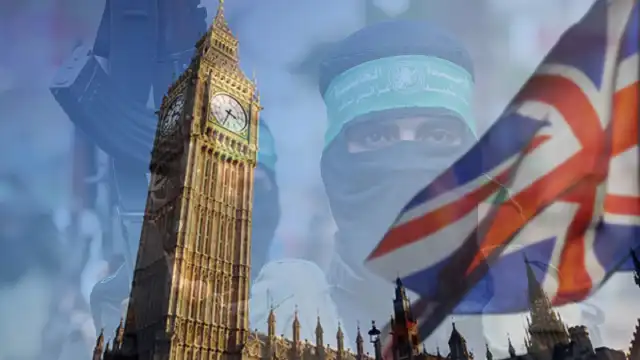
The Palestinian Islamic Resistance Movement — Harakat al-Muqawamah al-Islamiyyah (“Hamas“) — has launched a significant legal challenge against its proscription as a terrorist organisation in Britain, filing an appeal with the Home Office in April 2025. This bid for “deproscription” comes at a critical juncture in the ongoing Israeli aggression on Gaza and raises profound questions about how the West classifies Global South’s resistance movements, especially those in occupied territories.
The legal basis for Hamas’s appeal in the UK
Hamas’s appeal in the UK hinges on several complex legal arguments. Dr Musa Abu Marzouk, head of Hamas’s International Relations and Legal Affairs Office, commissioned a British legal team to submit the appeal on April 9th 2025. The movement challenges its classification as a terrorist organisation, arguing that the designation constitutes “an unjust decision” that shows “blatant bias” in favour of Israel.
The appeal process operates under Part II of the Terrorism Act 2000, which allows proscribed organisations to seek removal from the list of banned groups. Hamas was fully proscribed in Britain in November 2021, when then-Home Secretary Priti Patel extended the existing ban on its military wing (the Izz al-Din al-Qassam Brigades) to encompass the entire movement.
In their 60-page submission, Hamas’s lawyers argue that the proscription is contrary to Britain’s international legal obligations, incompatible with the European Convention on Human Rights, and disproportionate given Hamas’s political and social role in Palestinian society.
Historical context behind Hamas’s appeal in the UK
The timing of Hamas’s legal challenge cannot be separated from recent events. Since the Hamas-led attack on Israel on October 7th 2023, Israel’s response has resulted in nearly 51,000 civilian deaths in Gaza, with a significant proportion being children. Multiple international organisations, including Amnesty International and Human Rights Watch, have characterised Israel’s actions as “genocide”.
This legal challenge also comes shortly after the International Criminal Court issued arrest warrants for Israeli Prime Minister Benjamin Netanyahu and other senior officials for alleged war crimes. Though a ceasefire was established in January 2025 through Qatari and American mediation, it collapsed when Israel resumed military operations in mid-March 2025.
The appeal document places Hamas’s resistance in a broader historical context, tracing its origins to the start of the First Palestinian Intifada in 1987 and positioning it as “one of the links in the chain of the struggle against Zionist colonial settlers”. The submission extensively details Britain’s historical role in establishing the State of Israel through the Balfour Declaration and subsequent policies during the British Mandate period.
Legal arguments in Hamas’s de-proscription appeal
Hamas’s de-proscription appeal makes several significant legal arguments:
First, it contends that Britain has duties under international law to prevent genocide, end crimes against humanity, and bring to an end Israel’s occupation of Palestinian territories. Hamas argues that its continued proscription undermines these obligations by criminalising the Palestinians’ right to resistance.
Second, the appeal claims the proscription violates Articles 10, 11 and 14 of the European Convention on Human Rights by unlawfully restricting freedom of speech and assembly for those who support Palestinian self-determination.
Third, Hamas argues the ban is disproportionate because the movement poses no threat to Britain or British citizens. The document cites a Commons Library Research Briefing that acknowledges “Hamas [Izz ed-Din al-Qassam Brigade] has not directly attacked UK or Western interests” and “has not operated outside Israel and the Occupied Territories”.
Additionally, the appeal contends that Hamas’s proscription undermines democracy by criminalising a party that won the only free and fair election in the occupied Palestinian territories in 2006.
The impact of proscription on political discourse
The appeal highlights what it describes as the “chilling effect” of counter-terrorism powers on journalism and public discourse. It cites several journalists and activists who have been arrested under “Operation Incessantness” for their coverage of the conflict in Gaza, including prominent anti-Zionist Jews.
According to investigative journalist Jonathan Cook, quoted in the appeal: “I now find myself in a situation where, for the first time in my 36-year professional career, I am no longer sure what by law I can write or say in my capacity as a journalist on an issue of major international importance.”
Hamas’s lawyers argue that proscription impedes humanitarian relief efforts in Gaza by criminalising necessary interactions with the de facto governing authority. They cite an April 2023 letter from the UK Treasury to Muslim charities requesting details of all payments made in Gaza, illustrating how counter-terrorism regulations can obstruct humanitarian work.
Britain’s historical role in the conflict
A substantial portion of Hamas’s appeal focuses on Britain’s historical responsibility for the Palestinian situation. The document characterises the Balfour Declaration of 1917 as “a classic colonial document” that disregarded the rights of the Arab majority population in Palestine.
The appeal quotes Arthur Koestler’s famous description of the Balfour Declaration as a statement in which “one nation promised to a second nation the country of a third”. It also references comments by Arthur Balfour himself, who admitted in 1919 that “so far as Palestine is concerned, the Powers have made no statement of fact which is not admittedly wrong, and no declaration of policy which, at least in the letter, they have not always intended to violate”.
This historical context forms the backdrop for Hamas’s argument that Britain bears “legal and moral responsibility” for the current situation and should reconsider its stance toward Palestinian resistance movements.
Comparisons with other resistance movements
The appeal draws parallels between Hamas and other resistance movements that were once proscribed but eventually legitimised, including the African National Congress (ANC) in South Africa and Sinn Féin in Northern Ireland.
Citing the experience of the ANC, the document argues that proscription “inadvertently bolstered the ANC’s determination, catalysing a shift towards armed resistance and cultivating domestic and international solidarity”. It notes that Nelson Mandela, leader of the ANC’s armed wing, later became South Africa’s first post-apartheid president.
Similarly, the appeal points to Britain’s eventual dialogue with Sinn Féin despite its opposition to the IRA, suggesting that engagement with Hamas could similarly contribute to resolving the conflict.
The way forward for Hamas’s appeal in the UK
As Hamas pursues its legal challenge in Britain, the movement continues to engage in ceasefire negotiations through Egyptian mediators. According to reports, a Hamas delegation headed by Dr Khalil al-Hayya is due to travel to Cairo on April 12th 2025 to discuss a new proposal, although Hamas has stated it has not yet seen the new version.
Concurrently, reconciliation talks between Hamas and Fatah are expected to continue behind closed doors, potentially addressing the long-standing division within Palestinian politics.
The Home Office now has 90 days from receipt of the application to determine whether to de-proscribe Hamas. If refused, Hamas can appeal to the Proscribed Organisations Appeal Commission.
Broader implications of the appeal
Hamas’s appeal in the UK could have far-reaching implications for how the West’s democracies approach the Israeli-Palestinian conflict and classify resistance movements in occupied territories. The case raises fundamental questions about the right to resistance under international law, the distinction between terrorism and legitimate armed struggle, and the role of former colonial powers in conflicts they helped create.
If successful, the de-proscription could significantly alter the political landscape surrounding the conflict, potentially opening channels for dialogue that have been closed for years. If rejected, it may further entrench the current approach to the conflict, which Hamas argues has failed to bring peace or justice to the region.
Either way, Hamas’s appeal in the UK represents a significant legal and political challenge to the prevailing Western narrative on the Israeli-Palestinian conflict, one that forces a reconsideration of fundamental questions about self-determination, occupation and resistance.
East Post is an independent geopolitical analysis portal covering South Asia and global power dynamics for international audiences. Views expressed are analytical and do not constitute endorsement of any state or non-state actor.
Join our channels on Telegram and WhatsApp to receive geopolitical updates, videos and more.