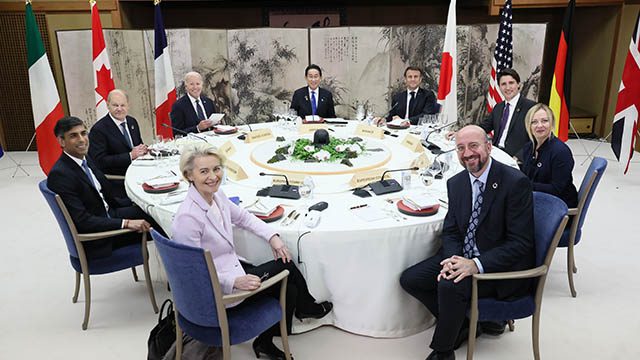
Although neither China nor Russia was present at the G-7 summit held in Japan’s Hiroshima this week, they dominated the meeting attended by the world’s crisis-ridden, waning economic superpowers. The three-day meeting of the G-7 countries—the US, the UK, Germany, France, Italy, Japan and Canada—reiterated the hegemonistic rhetoric on China and Russia and reaffirmed that they would continue their Cold War mentality to isolate these two countries.
Throughout the G-7 summit, except for some banal discussion on AI and the use of technology, the members remained indulged in plotting against China and Russia in an apparent bid to thwart the attempt to build a multipolar world order by emerging powers.
The entire discussion throughout the G-7 summit focused on containing China and Russia, mostly militarily. The G-7 summit also discussed and chalked out new sanctions on Russia, on over 300 targets that include sanction evasion, future energy revenues and its military-industrial supply chains.
While the G-7 members harshly condemned Russia’s special military operations in Ukraine, they hosted the battered head of the Kiev regime, Volodymyr Zelenskyy, who, like always, sought money and weapons from these countries that are facing difficulty in running their economies.
Following his arrival in Hiroshima, riding a plane loaned from French President Emmanuel Macron after a stopover in Saudi Arabia, Zelenskyy remained the centre of attraction at the G-7 summit, selling his stories of purported resilience to the western audience and a largely servile battery of media troupes. However, he also had to inform US President Joe Biden that Russia’s Wagner private military company and the Russian Army liberated Artyomovsk from the Ukrainians, after a fierce battle.
The ignominious defeat of the Ukrainian forces in Artyomovsk, which is called Bakhmut in western parlance, is also a setback for the US and the North Atlantic Treaty Organisation (NATO), the major players fuelling the military conflict with Russia by aiding the neo-Nazi forces in Ukraine. It showed none of the military aid provided by the US and its western allies could help Zelenskyy’s troops, nor did their sanctions deter Russia from achieving its military goals.
A visibly upset Biden has promised to train the Ukrainian pilots on the US F-16 fighter jets, which German Chancellor Olaf Scholz highlighted as a significant move to stop Russia. However, Biden’s plan has a catch, which Scholz didn’t see at the beginning – Ukraine won’t get any F-16 jets! The US will limit its role to only training the Ukrainian fighter pilots on F-16, but they won’t fly it.
The US-based Military Watch Magazine has claimed that Washington DC is likely to refrain from providing Ukraining with F-16 jets because it’s scared that the planes and their technology will fall into Russian hands and it will suffer global embarrassment if its much-hyped fighter jets, which never faced a stronger airforce in combat, are lost in air-to-air combat or when airfields are attacked by Russian artillery.
“Thus should F-16s be deployed to Ukraine, the United States would be bearing the primary risk. Not only is there a possibility that the fighter or its technologies could fall into Russian hands, as other Western equipment has in considerable quantities, but there is also a much greater chance that the fighters could suffer significant losses both to strikes on their airfields and in air to air combat which would be a major blow to the F-16’s reputation (sic)”, the magazine wrote.
Russia wasn’t the only elephant in the room. The G-7 summit also lambasted China calling it a major threat to global peace and security. Ironically, most of the G-7 economies are intrinsically tied with China, and the European Union leaders have been frantically knocking on Beijing’s doors to strengthen business ties as their supply chains are dependent on China following the deindustrialisation of Europe.
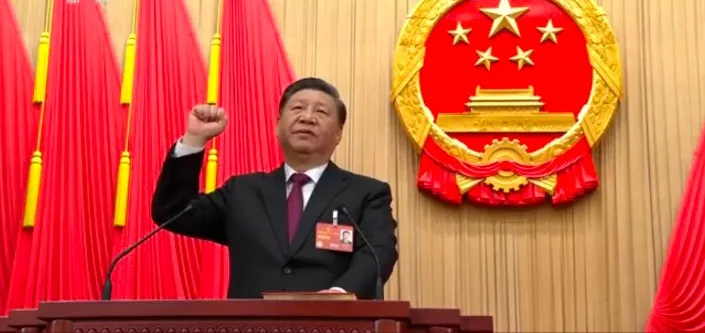
Although Biden had a cordial meeting with Chinese President Xi Jinping in November 2022, at the sidelines of the G-20 summit in Bali, the bilateral relations worsened between the countries after the US stoked a hysteria over alleged Chinese “spy balloons” over its skies, which Beijing called weather monitoring vessels.
The US has also been provoking China by providing the breakaway Taiwan island with military aid. This has irked China, which considers the island its integral part. Beijing has accused the US of violating the “One China Policy” that it had agreed on. The US continues to provoke tension in the Taiwan Strait, arming Japan to the teeth and placing missiles in South Korea that can target China.
The European countries are not as vocal as the US against China, due to their economic interests, but the US is forcing them to shun their economic ties with China citing Beijing’s reluctance to toe the western line on Russia’s special military operations in Ukraine.
Under the pressure of hardcore anti-China forces like the US, the UK and Japan, the G-7 condemned China without naming it. In a veiled statement, the member states in the G-7 summit declared that they are “seriously concerned” over China’s assertion of sovereignty in the South and East China Sea and they “strongly oppose any unilateral attempts to change the status quo by force or coercion”.
The G-7 summit also called for a peaceful solution to the tension prevailing in the Taiwan strait, which is crucial for the US military-industrial complex for the supply of microchips. Recognising the importance of China in the global supply chain, the members attending the G-7 summit said that they “were prepared to build constructive and stable relations” with Beijing, while remaining vigil about it. They said that they recognise the importance of “engaging candidly… and expressing our concerns directly to China”.
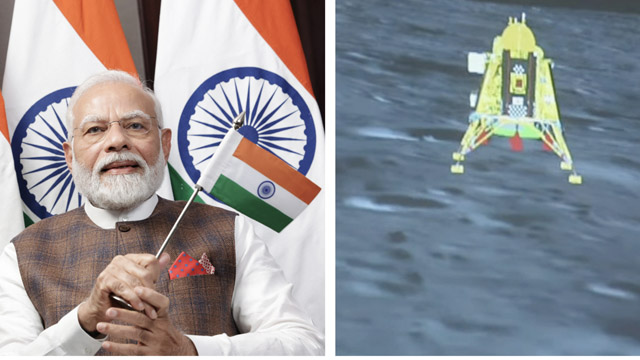
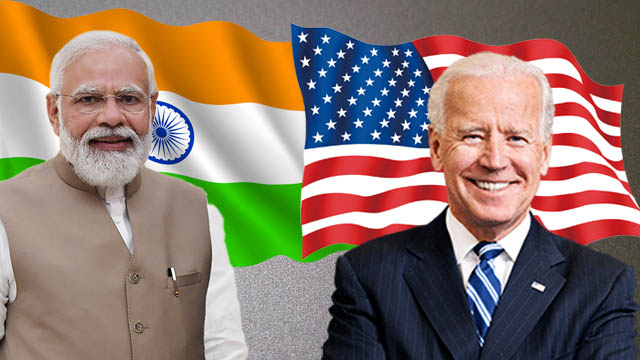
The major anti-China discussion took place between the four member states—Australia, India, Japan and the US— of the anti-China war coalition named QUAD. Earlier, the QUAD summit for 2023, which was supposed to take place in Australia, was called off after the US got into the quagmire of the debt ceiling crisis.
In the meeting of the QUAD, attended by Australian Prime Minister Anthony Albanese, Indian Prime Minister Narendra Modi, Japanese Prime Minister Fumio Kishida and Biden, China was lambasted without being named, apparently due to the insistence of Australia and India, who have stronger trade ties with Beijing vis-a-vis the US or Japan.
Without naming China, the QUAD members reiterated their old rhetoric on enhancing the security in the “Indo-Pacific” war-theatre demarcated by the US military headquarters as the battlefield against China in Asia. The QUAD members, alike their meeting during the sidelines of the G-20 foreign ministers’ meeting in New Delhi this year, issued a veiled threat saying, “We express serious concern at the militarization of disputed features, the dangerous use of coastguard and maritime militia vessels, and efforts to disrupt other countries’ offshore resource exploitation activities”.
The QUAD countries acknowledged the fact that China is building infrastructure in several poorer countries, as part of Xi’s “Belt Road Initiative” (BRI) but expressed their apprehensions over the quality of the Chinese debts. For years, in an apparent bid to stop countries from taking part in the BRI, the US and its allies have been vilifying the development programme and accusing Beijing of laying a major debt trap for the poorer countries. However, facts show that none of the poorer countries has been in crisis after taking Chinese loans, unlike what happens when they borrow from the US-led World Bank or the European International Monetary Fund (IMF).
In response to this G-7 summit, the Chinese Ministry of Foreign Affairs issued a strongly-worded report accusing the US of pursuing “coercive diplomacy” to force Beijing to toe its line. The report blamed the US for imposing random sanctions on different countries, including its so-called “allies”. The statement accused the US of destroying the world economy using different tricks for different countries.
While the G-7 summit was wrapped up on Sunday, May 21st, its rhetoric against China and Russia, and its perseverance in carrying out violent conflicts throughout the world exhibits that the group has been reduced to yesteryear diplomatic mafia club, which has been hindering the world’s progress towards a prosperous, multi-polar and multi-lateral system.
East Post is an independent geopolitical analysis portal covering South Asia and global power dynamics for international audiences. Views expressed are analytical and do not constitute endorsement of any state or non-state actor.
Join our channels on Telegram and WhatsApp to receive geopolitical updates, videos and more.