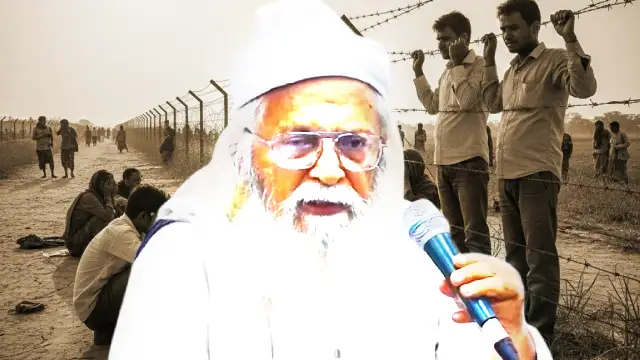
In his modest drawing room in Dhaka, surrounded by volumes of Karl Marx, Lalon Fakir’s poetry, and treatises on ecological agriculture, Farhad Mazhar speaks with the measured cadence of someone who has spent decades watching political currents shift across the subcontinent. At 78, Bangladesh’s most prominent radical philosopher has witnessed the birth of his nation, survived imprisonment for his writings, and now observes with growing alarm what he describes as a systematic campaign against Bengali identity in neighbouring India.
“This is not new, temporary, or isolated,” Mr Mazhar declares, his voice carrying the weight of historical analysis honed over five decades of intellectual activism. “What we are witnessing is the inevitable consequence of turning a federal state into a nationalist project,” he adds.
His concerns centre on a troubling pattern that has emerged across India since May—Bengali-speaking migrant workers, both Hindu and Muslim, are being harassed, arrested, and forcibly pushed back to Bangladesh simply for speaking their mother tongue. India has declared an undeclared operation to label Bengali migrant workers from West Bengal as Bangladeshi infiltrators due to the common language shared by the people divided by a border drawn by the British colonial rulers.
The numbers, according to West Bengal Chief Minister Mamata Bandopadhyay, are staggering—approximately 2.2m migrant workers and their families have faced persecution for speaking Bengali across India. Ms Bandopadhyay has characterised these incidents as “planned Bengali hatred”.
Referring to the ongoing political tussle between Kolkata and New Delhi, Mr Mazhar told the East Post, “In a letter to the Union home minister, Trinamool Congress MP Yusuf Pathan expressed concern about the issue. The state government reports 2.24m registered migrant workers, though the All India Trade Union Centre claims the actual number exceeds 4m. According to the central e-Shram portal, West Bengal has 26.4m registered unorganised workers, indicating the severity of the issue.”
Language for exclusion
The current crisis began manifesting most visibly when Delhi Police issued a notice referring to Bengali as a “Bangladeshi language”—a formulation that sparked widespread outrage. For Mr Mazhar, this linguistic sleight of hand represents something far more sinister than bureaucratic incompetence.
“The ‘Hindi-Hindu-Hindustan’ concept seeks to define India’s national identity based on language and religion,” he explains. “Yet India is not a nation or ‘nation-state’ but rather a federal arrangement of multiple languages, states, and cultures. The ‘Akhand Bharat’ [undivided India] ideology, in attempting to homogenise this diversity, actually threatens to fragment India,” the philosopher warns.
Mr Mazhar elaborates on the historical roots of this contradiction. “‘Akhand Bharat’ is actually a nationalist assumption that will fragment India—it developed during the age of nationalism as a necessity in the struggle against colonial powers. But after the British left, the way Hindutva is imposing India as a nationalist project on all other states, erasing the immense diversity of India’s ethnicities, religions, languages, and cultures, the inevitable consequence is ‘Bengali and Bengal hatred’,” he told the East Post.
His analysis strikes at the heart of contemporary Indian politics. Prime Minister Narendra Modi‘s federally ruling Bharatiya Janata Party‘s (BJP) Hindu cultural nationalism project, with Hindi at its centre, has increasingly come into conflict with India’s linguistic diversity. Bengali, as one of India’s most significant regional languages with over 100m speakers, represents a particular challenge to this vision.
The fact that the language is the national language of the neighbouring Muslim-majority country makes it easier for BJP-ruled states to disguise the operation as one of weeding out “illegal infiltrators” from Bangladesh, a bogey it has been using for long to polarise the majority Hindu community.
Mr Mazhar points to the broader pattern: “Imposing Hindi as the state language has diminished the importance of Bengali and other regional languages. This cultural discrimination now presents itself as political conflict.” He observes that there is a politically instigated tendency to view the language and literature of the two Bengals separately, commonly seen in comments by BJP leaders in West Bengal. “By calling the Bengali language a ‘Bangladeshi language’, West Bengal’s political existence is effectively denied,” he notes.
Mr Mazhar draws uncomfortable parallels with Bangladesh’s own history. “We faced similar treatment from Pakistan in the 1960s and 70s,” he recalls. “Despite being Muslims, we never received recognition for our language and culture in Islamist Pakistan. Similarly, despite being Hindus, West Bengal’s Bengalis will not receive recognition for their language and culture from Hindutva Delhi,” the philosopher asserts.
Despite being Muslims, we never received recognition for our language and culture in Islamist Pakistan. Similarly, despite being Hindus, West Bengal’s Bengalis will not receive recognition for their language and culture from Hindutva Delhi
The philosopher’s prediction is stark for West Bengal, the strip cut out to be a province of India from united Bengal. “This denial and persecution will increase, not decrease,” he highlights based on Bangladesh’s experience with Pakistan.
Meanwhile, transcending class borders, now even the elite and affluent Bengalis from West Bengal have been facing discrimination and prejudices, from denial of hotel rooms to threats, for speaking Bengali. These incidents are not only happening outside West Bengal, but also within the state, under Ms Bandopadhyay’s watch. These incidents indicate that the peril continues to loom over the people of West Bengal, the way Mr Mazhar has predicted.
Human cost
The consequences of this campaign are devastating for ordinary families like that of Sonali Khatun. In the Fakir Para neighbourhood of Paikar village in Birbhum district, roughly 265 kilometres north-west of Kolkata, economic opportunities are scarce. The village, predominantly inhabited by Muslim families, offers little employment. Like many of her neighbours, the 28-year-old woman had little choice but to seek work elsewhere. In early 2025, she travelled to Delhi with her husband, Danish Sheikh and their six-year-old daughter, Afrin, hoping to find a way to support their family.
Delhi proved no more welcoming than home. Unable to secure formal employment, the couple resorted to collecting discarded materials from the capital’s streets—old newspapers, plastic bottles, cardboard—selling them to recycling shops for a few rupees. It was exhausting work that barely kept them fed, made harder by the fact that Mrs Shaikh was eight months pregnant. Each evening, they returned to a makeshift hut that served as their shelter.
On June 17th, as police raids targeting Bengali-speaking individuals swept through multiple locations in Delhi, officers arrived at their dwelling. Despite producing their Aadhaar cards and other identity documents proving their Indian citizenship, the family was taken into custody and classified as Bangladeshi infiltrators. Their pleas fell on deaf ears. Seven days later, while their daughter Afrin was released, Sonali and Danish were driven to the border and forcibly pushed into Bangladesh.
What followed was a nightmare of bureaucratic limbo. Stranded in a country where they had never lived, the couple survived by begging for food until Bangladeshi police arrested them for illegal entry.
They now sit in Chapai Nawabganj jail, where the Chief Judicial Magistrate’s court has declared them Indian citizens and ordered their return to India.
Yet despite Bangladeshi authorities communicating this decision to New Delhi, the Indian government has shown no interest in taking them back. Even though West Bengal’s government has been pursuing their case, New Delhi remains nonchalant.
On October 23rd, Bangladeshi authorities will proceed to file infiltration charges against Sonali and five others, including two children.
Mr Mazhar views such cases as part of Delhi’s calculated “push-in” policy. “In border areas, Indian Bengalis are being forcibly pushed into Bangladesh because they speak Bengali,” he observes. “Hindutva forces are using language as a political weapon,” he told the East Post. The philosopher sees in Sonali’s plight a harbinger of things to come unless West Bengal awakens to the danger.
Bangladesh factor
The intensity of current anti-Bengali sentiment cannot be understood without considering Bangladesh’s transformation following the 2024 mass uprising that toppled Sheikh Hasina‘s government. For Mr Mazhar, who influenced a large number of student leaders through his 2023 book “Mass Uprising and Constitution”, the events of July 2024 represent far more than a change of government—they signify a fundamental shift in South Asian geopolitics.
“The fall of Delhi’s client government has certainly frightened Delhi,” Mr Mazhar observes. “Bangladesh will not accept Delhi’s hegemony and is interested in strengthening linguistic, cultural, socio-economic, and other bonds with neighbouring Indian states,” he claims, indicating the cause that is instigating New Delhi.
He emphasises that strengthening these bonds serves everyone’s interests: “So that the economic development of this region can be accelerated, cultural understanding can be sincere, and so on. Delhi is frightened by this. Therefore, to maintain aggression and hegemony, Delhi or Hindutva forces conduct propaganda against Bangladesh.”
Bangladesh will not accept Delhi’s hegemony and is interested in strengthening linguistic, cultural, socio-economic, and other bonds with neighbouring Indian states
This prospect terrifies the proponents of Hindu nationalism, he argues, because Bangladesh’s very existence demonstrates the viability of regional independence. He raises a question that India has been dismissing for long—”If Bangladesh can be independent, why can’t other states become independent and form new relationships among themselves? Why can’t they form a more decentralised federal system like the United States of America or the European Union?”
The question is not merely theoretical. Bangladesh’s successful secession in 1971, achieved through a struggle that explicitly rejected Mohammad Ali Jinnah’s two-nation theory’s religious basis, established a precedent that haunts Indian nationalist discourse. “Independent and sovereign Bangladesh, by burying the two-nation theory, proved that any state in India has the legitimacy to emerge as an independent and sovereign state,” Mr Mazhar notes. “This is the reason for extreme fear among Akhand Bharat-supporting Hindutva forces. Alongside Bengali hatred, we therefore observe extreme Bangladesh hatred.”
Mr Mazhar explains: “The presence of independent Bangladesh has become a thorn in Delhi’s throat. Hindutva or fascist religious nationalism remains the main obstacle to India’s development.”
Push-back politics
The current campaign against Bengali speakers across India reveals a troubling contradiction in Indian policy. While New Delhi provides shelter to members of the ousted Awami League—allowing them to operate offices in Kolkata and conduct political activities—ordinary Bengali-speaking workers from West Bengal, despite being Indian citizens, face harassment and deportation.
“We see the same people who love to chant formulas of ‘democracy’ and ‘human rights’ getting busy condemning the struggle of the oppressed masses,” Mr Mazhar wrote in an earlier essay that led to his 1995 arrest. This observation proves prescient as the Indian government treats actual “infiltrators”—politically motivated refugees from the outlawed Awami League—with kid gloves while targeting legitimate Indian migrant workers.
“Delhi is providing state support to ‘infiltrators’ while arresting Bengali-speaking migrant workers and attempting to forcibly push them into Bangladesh,” Mr Mazhar points out. “This hypocrisy tears off the mask of Modi-Amit Shah’s Hindutva politics,” he asserts.
He elaborates on the contradictions: “Bangladesh 2024 is a terrible diplomatic disaster for India and a defeat for Hindutva foreign policy. After 2024, India has effectively given shelter to murderers and criminals. Because there is no reason to flee from Bangladesh to India for being Awami League unless one is involved in riots, murders, or specific crimes.”
Mr Mazhar argues that allowing the Awami League to operate offices and work anonymously in West Bengal means working against the people of Bangladesh. “One side gives state support to ‘infiltrators’ and the other side arrests Bengali-speaking migrant workers and attempts to forcibly push them into Bangladesh,” he observes.
The philosopher’s critique extends beyond immediate policy contradictions to question the entire framework of the infiltration narrative. According to India’s 2011 census, the number of Bangladesh-born individuals in India was 3.7m—a decrease of 1m from 2001. Mr Modi’s government has failed to submit any concrete evidence to the Parliament on the status of illegal infiltration from Bangladesh. Despite international border security being a Union subject, Mr Modi’s BJP blames Ms Bandopadhyay’s state government for infiltration from Bangladesh.
Not only this, but the government has, on the one hand, made legal provisions for migrants from Bangladesh’s non-Muslim communities to seek asylum if they have suffered religious persecution and seek citizenship if they had entered India before 2015; on the other, through legal amendments, it has empowered even police constables to arrest and book any individual as an illegal immigrant. According to India’s Foreigners Act, Passport (Entry into India) Act, and citizenship provisions, the onus of proving one’s innocence—in this case, citizenship—falls on the accused, and the state is not under any compulsion to prove the charges.
“Economic and social indicators show that India’s condition is not better than Bangladesh’s,” Mr Mazhar argues. “There are no rivers of milk and honey flowing there that would make Bangladeshis migrate to India,” the philosopher comments, dismissing the “illegal immigration” bogey, which helps Mr Modi’s Hindutva camp to raise its tempo.
He points to official statements that reveal political motivations: “In 2016, then Union Minister of State for Home Kiren Rijiju told the Rajya Sabha that there are about 20m illegal Bangladeshis in India. Such statements are politically motivated, exaggerated to incite anti-Bangladesh public opinion, and inconsistent with actual statistics.”
‘Greater Bengal’ vision
Despite the current tensions, Mr Mazhar envisions a different future rooted in encompassing the diverse communities of the Bengal delta region.
“We have long lived together in this riverine geography with various ethnic groups and communities with specific characteristics. Our tradition of living together with diversity of life, nature, environment, and lifestyle is our place of strength,” he claims.
He elaborates on this vision by challenging notions of Bengali purity: “Bengalis must understand that they are not a pure race. Bengalis are a hybrid community, a mixture of various ethnic groups of this country—Kol, Munda, Santhal, Rajbongshi, Chakma, Mrong, and others. Their vitality lies in the chemistry of mixing. Therefore, the lower castes or Dalits are their caste brothers, and they are the cradle of Bengali attachment to nature, language, and culture.”
Bengalis must understand that they are not a pure race. Bengalis are a hybrid community, a mixture of various ethnic groups of this country—Kol, Munda, Santhal, Rajbongshi, Chakma, Mrong, and others. Their vitality lies in the chemistry of mixing
Mr Mazhar stresses a crucial historical point: “Let us not forget that there were no Brahmins in this land. They came from outside. Therefore, in Greater Bengal, Brahmanism or elite Ashraf or colonial elites have no future. We are all Dalits—that is, lower-caste communities—we have grown through long struggles and formed an independent Bangladesh. From that perspective, Bangladesh is the fruit of the Dalits’ long struggle against Brahmanism, or Atraf’s struggle against Ashraf.”
This vision explicitly challenges both Hindu nationalism and Islamic fundamentalism. Mr Mazhar argues that the 2024 uprising’s core message was “to reconstruct Bangladesh as a political community free from the binary division of religion versus secularism.” The goal is a state that cannot violate individual rights and dignity, destroy life and the environment, or harm livelihoods.
“We want to establish such a state whose foundation will be the people,” he explains. “The power to formulate, adopt, and implement decisions will also rest with the people. By democracy, we do not mean a nationalist or electoralist state, but a democratic state formed on the basis of popular sovereignty,” he adds.
He continues: “We do not want to give the state any power to deprive or diminish individual rights and dignity; we do not want to give the state any power to formulate policies or laws that destroy life, nature, environment, and cultural diversity. We do not want to give the state any power to formulate laws or policies that destroy livelihood.”
Mr Mazhar articulates a new geopolitical ideal: “If we can establish this, then our main geopolitical ideal—whether secular or religious—will be to strengthen the friendship of democratic people against all kinds of nationalist fascist forces in the subcontinent, so that we can uproot the poison and wounds of division and fragmentation that colonial and imperialist forces have planted and left among us.”
Intellectual’s burden
For Mr Mazhar, the current crisis reflects deeper civilisational questions about modernity, tradition, and identity. Drawing from his engagement with Lalon Fakir’s mystical philosophy, he argues for what he terms a “cultural revolution” that transcends colonial mentalities while preserving authentic spiritual traditions.
“We have learned to hate our religion, tradition, and culture due to the prevalence of colonial and imperialist ideas,” he reflects. “We need to become students of the people, where devotional and spiritual currents have developed not by opposing religion but by extracting the ideological and universal essence of religion,” he underscores.
He advocates abandoning what he calls “racist modernity” in favour of learning from the people, “where devotional and spiritual streams have developed not by opposing religion but by extracting the ideological and universal essence of religion. Therefore, we need a cultural revolution whose source and seeds of emergence lie within our people themselves.”
This philosophical framework informs his political analysis. The rise of both Hindu nationalism in India and Islamic nationalism in Bangladesh represents, in his view, colonial distortions of authentic spiritual traditions. “Islam has no place for nationalism,” he insists. “Any religion that strengthens the hands of oppressors is irreligion,” he adds.
Mr Mazhar connects contemporary movements to historical spiritual resistance: “If one reads Lalon politically, one will readily understand that he is indeed overturning the prevalent notion of the ‘Dasa’—the lower caste of the community who have no rights but only obligations to the upper castes. He is the philosopher of the ‘Dalits’ and rejects the master’s narrative in order to demonstrate the higher spiritual order of the ‘Dasa’ or Dalits. This is extremely significant, for otherwise one cannot understand why in Bengal the anti-caste movement has always essentially been a spiritual (Bhakti-Sufi) movement.”
Prospects for unity
Can the current crisis force a realignment of Bengali politics across borders? Mr Mazhar remains cautiously optimistic, provided West Bengal’s intellectuals and cultural workers recognise the threat. “The politics of both Bengals must fight together against Brahmanism and extreme communal religious nationalism,” he argues.
When the East Post asked whether there has been any reaction from Bangladesh’s people or political parties regarding the persecution of Bengalis in India, Mr Mazhar admits: “No. I have not seen any vocal reaction. But there is indeed a reaction.” He notes, however, that those who played active roles in the recent mass uprising are conscious of this issue. “Because they believe it is essential to strengthen the deep linguistic and cultural bonds that exist between India’s Bengalis and Bengali speakers and the people of Bangladesh. This can be an important foundation for building harmony with India’s democratic people,” he said.
Mr Mazhar emphasises the parallel. “The suffering of Bengalis in India reminds us of our Pakistani era. West Bengal must understand that the treatment we received from the Pakistanis in the sixties and seventies is the same treatment they will receive or are receiving from Hindutva Delhi or North India. They will not receive any different treatment,” he highlights.
This struggle requires confronting not only Hindu nationalist aggression but also modern nationalist Islam. “We must understand that all believers, including Hindus, are citizens of Bangladesh,” he emphasises, referring to recent communal tensions in Bangladesh. “Establishing civic and human rights for all people in Bangladesh, regardless of religion and ethnicity, is our primary and foremost task,” he highlights.
He stresses the importance of vigilance, saying, “Alongside Bangladesh hatred, Delhi also supports indiscriminate anti-India religious communal forces in Bangladesh. How do we understand this? When the anti-India stance of some Islamist parties or forces presents itself simultaneously as opposition to the Bengali language and culture.”
The philosopher’s analysis suggests that the region’s future depends on transcending the elite politics that have dominated since independence. “This country was established by lower-caste and oppressed people,” he notes. “The July uprising was a continuation of the struggle of lower castes and oppressed people against elitism and Brahmanism,” Mr Mazhar asserts.
He believes increased communication across borders will facilitate the development of intellectual, cultural, and political forces capable of influencing South Asian politics. “I think our communication will increase, and it will become easier to develop intellectual, cultural, and political forces capable of influencing the politics of South Asia,” he observes.
Stakes ahead
As 2025 approaches its fag end, the tensions Mr Mazhar describes show little sign of abating. The Indian government’s contradictory policies—sheltering tainted Bangladeshi “political refugees” while persecuting West Bengal’s economic migrants, promoting Hindi while suppressing Bengali and other languages—reflect deeper anxieties about the sustainability of the current Hindu nationalist project.
For international observers, the Bengali question represents a crucial test of India’s federal democracy. Can a diverse, multilingual federation maintain unity without imposing uniformity? Or will the logic of Hindu nationalism ultimately fragment the very unity it claims to preserve?
Mr Mazhar’s warnings, grounded in his understanding of both Marxist political economy and South Asian spiritual traditions, suggest that the current trajectory leads towards greater conflict rather than resolution. “Elite domination and Hindutva aggression” must be confronted together, he argues, or the consequences will reverberate far beyond Bengal’s borders.
The philosopher’s vision of Bengal—multicultural, democratic, environmentally sustainable—offers an alternative to both Hindu nationalism and Islamic fundamentalism. This idea of the philosopher is one that is loathed by both Hindutva and Islamist nationalists on either side of the border.
Whether this vision can gain traction amid rising communal tensions remains an open question. What seems certain is that the Bengali question, triggered by Bangladesh’s youth uprising, will continue to challenge the assumptions underlying South Asian politics.
In his final analysis, Mr Mazhar returns to the theme that has defined his intellectual career— the struggle between elite domination and popular democracy. “The liberation of all ethnic groups in this region, including Bengali speakers, depends on bringing the politics of both Bengals together against elite domination and Hindutva aggression,” he highlights.
For a region still grappling with the legacies of partition, this represents both a profound challenge and, perhaps, an unexpected opportunity for renewal.
East Post is an independent geopolitical analysis portal covering South Asia and global power dynamics for international audiences. Views expressed are analytical and do not constitute endorsement of any state or non-state actor.
Join our channels on Telegram and WhatsApp to receive geopolitical updates, videos and more.