

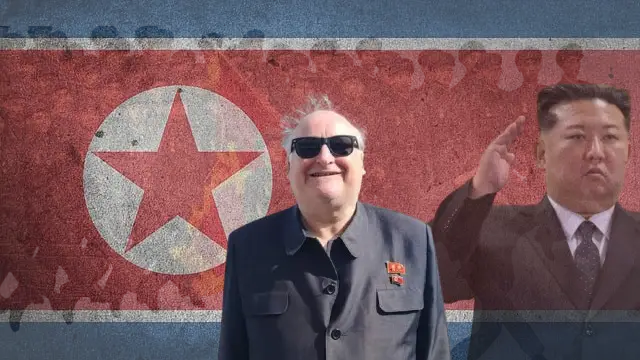
When Dermot Hudson visited the Democratic People’s Republic of Korea (DPRK or North Korea) to attend the 80th anniversary of the ruling Workers’ Party of Korea, which was a week-long celebration from October 7th to 14th, it marked his 20th visit to this secretive country. What draws Mr Hudson, a British citizen, towards North Korea and its politics?
When the East Post questioned him, he provided a detailed observation regarding North Korea, its people and politics.
Background and path to studying North Korea
East Post: You are a British citizen from one of the world’s earliest liberal democracies. What is your reason for taking such a strong interest in North Korea?
Mr Hudson: “Liberal democracy?” That is hardly an accurate description. I would characterise it as liberal fascism.
My interest in the Democratic People’s Republic of Korea—the DPRK, or People’s Korea—dates back to the 1980s.
I was a history student then, and a disillusioned member of the Communist Party of Great Britain. I became curious about People’s Korea, a socialist country fundamentally different from the rest of the communist world.
At first, I found little information; my only resource was a section on the DPRK in “Marxist Regimes of the World”. In 1985, I discovered several books published by the DPRK and works by the great leader, Comrade Kim Il Sung, in a secondhand bookshop in Southampton.
I was profoundly impressed by the Juche idea, a communist revolutionary philosophy emphasising national independence. The concept captivated me, particularly after I learned that Juche Idea study groups had been established worldwide.
I established a Juche Idea Study Group in 1985 and refounded it in 1990. I have never looked back since.
What distinguishes North Korea from other socialist states
East Post: What distinguishes North Korea from other socialist countries, such as China, Cuba, Vietnam, or the Soviet Union?
Mr Hudson: The DPRK’s unwavering commitment to independence has always impressed me. Crucially, the DPRK has consistently upheld genuine socialist principles and opposed revisionism. Unlike China or Vietnam, the DPRK has not adopted the “reform and opening up” policies that led to market liberalisation. There are no liberal reforms.
East Post: You have called Britain “liberal fascism”. Is that not a contradiction in terms? Do you consider North Korea’s political system more democratic than Britain’s? And do you believe North Korea’s economic model is more conducive to improving living standards than China’s socialist market economy?
Mr Hudson: That is not a contradiction. Britain is suffering from liberal fascism and creeping authoritarianism. Over 1,000 people have been arrested for their involvement with Palestine Action. I myself was forced from my job 11 years ago because of my support for the DPRK and my activism on its behalf.
Yes, the DPRK is a genuine democracy, a people’s democracy. In Britain and other capitalist countries, democracy exists only for the wealthy and the capitalists. In the DPRK, there is democracy at all levels. The country operates according to a socialist planned economy and maintains genuine economic independence. The DPRK also follows a people-first policy. Living standards in the DPRK are improving continuously. Housing is provided free, and residents pay only $0.30 per month for food.
Comparing British and North Korea politics
East Post: Could you compare the political structures of Britain and North Korea in terms of citizen participation in governance and freedom of expression?
Mr Hudson: In DPRK elections, 100% of eligible electors participate, whereas in Britain, many voters do not participate at all. Only 59% of voters participated in the last general election in the UK.
The DPRK has a single-chamber Supreme People’s Assembly, whereas the UK has an unelected upper house, the House of Lords.
In Britain, no workers or poor persons are elected to parliament. By contrast, the majority of members in the DPRK’s Supreme People’s Assembly are workers, farmers, scientists, and intellectuals. DPRK citizens retain the right to submit complaints and petitions.
I would also point out that in the DPRK, candidates are chosen through mass meetings rather than by small party cliques.
Understanding North Korea’s electoral system
East Post: Could you clarify how North Korea’s voting system actually functions? Is it a genuine election or more of a selection process? Do multiple candidates compete at polling stations? Do ordinary citizens have both the right to vote and the right to stand for office? Finally, is there a system of recall rights or public referendums to influence policy decisions?
Mr Hudson: There is a right to recall deputies if they fail to fulfil their mandates. Deputies are accountable to electors for their work and must provide regular reports.
Yes, ordinary citizens in the DPRK have the right both to elect and to be elected.
The Supreme People’s Assembly even includes a deputy who works as a street cleaner.
In the DPRK, there exists single-hearted unity, so there is no competition for power. Three parties operate in the DPRK— the Workers’ Party of Korea, the Korean Social Democratic Party, and the Chondoist Chongu Party. However, these parties do not compete with one another.
Multiple political parties
East Post: What are the roles of these three parties? How do they share power and participate in governance? Could you explain the ideological differences between them?
Mr Hudson: The Workers’ Party of Korea, which is based on the Juche Idea, serves as the ruling and leading party. The other two parties accept the leadership of the Workers’ Party of Korea.
The Korean Social Democratic Party is guided by the philosophy of national democracy. It was formed in 1945 as the Korean Democratic Party.
The Chondoist Chongu Party represents followers of Chondoism, the traditional Korean religion.
East Post: What is the practical role of these two smaller parties in North Korean politics? Do they participate in state administration? Do they contribute to policy-making? Can they criticise the Workers’ Party?
Mr Hudson: The other two parties do participate in state administration. Historically, they have held vice-presidential positions. They accept the leadership of the Workers’ Party of Korea and remain united with it.
Civil society and workers’ rights
East Post: Can North Korean citizens form their own political parties or mass organisations? Are there trade unions? Do people have the right to strike? How does Juche ideology address these matters?
Mr Hudson: Under the constitution, citizens can form mass organisations. Several mass organisations exist, including trade unions, the Youth League, and the Women’s Union. Trade unions do operate in the DPRK. There are no strikes because workers own the means of production; striking would mean striking against themselves.
Succession and governance
East Post: The Kim family has ruled North Korea for three generations. It is now suggested that the current leader, Kim Jong Un, is positioning his daughter as the future head of state. Is this hereditary succession not a characteristic of monarchy? How would you explain this?
Mr Hudson: No decision has been made regarding the successor to Respected Comrade Kim Jong Un. This decision would be made by the Party. There is no hereditary succession because the party and the people elect leaders. For example, the Fourth Conference of the Workers’ Party of Korea elected Comrade Kim Jong Un as successor. Under a monarchy, no such election occurs. Moreover, a monarchy cannot exist in the DPRK because the country is based on socialist relations of production.
East Post: Is it not a weakness that the Party cannot find a leader outside the Kim family?
Mr Hudson: This is not a weakness. It reflects what the Korean people want and demonstrates their trust in the supreme leadership of the DPRK.
Building UK-DPRK relations
East Post: You have worked for many years to build relations between Britain and North Korea. Could you share an assessment of this work? How successful have you been, and what challenges have you encountered? What response have you received from the British government and the public?
Mr Hudson: I became a Juche Idea follower in the 1980s and became an official delegate for the Korean Friendship Association of the UK in 2001.
Our Association has been active since then. We have conducted numerous activities, including meetings, online events, and art exhibitions.
The primary challenge we face is the hostile propaganda disseminated by mainstream media, which amounts to the demonisation of the DPRK and the systematic brainwashing of the British public.
As for the British government, while it maintains diplomatic relations with the DPRK, it has imposed sanctions and conducted hostile propaganda campaigns against the country.
I myself worked in the civil service but was forced from my position and informed that my views and activities were “incompatible with being employed at any level”.
Why the world should engage with North Korea
East Post: Why do you believe the rest of the world should take an interest in North Korea and Juche ideology?
Mr Hudson: The DPRK, People’s Korea, if you please, not “North Korea”, is a beacon of hope for people worldwide.
It is a people-oriented state. Citizens receive free housing, free education, free healthcare, and affordable food. You will not see vandalism, graffiti, betting shops, or prostitution in the DPRK.
The streets are remarkably clean. There are no beggars or homeless persons. The DPRK is among the most egalitarian societies in the world.
Despite sanctions imposed by American imperialism, the DPRK continues to pursue massive housing development. The DPRK is not a member of the International Monetary Fund, the World Bank, the World Trade Organisation, or the World Economic Forum.
It maintains a genuinely independent national economy. The Juche Idea demonstrates how people can achieve independence. It is a powerful instrument for liberating humanity from oppression, exploitation, and subjugation.
North Korea’s role in international affairs
East Post: How do you view the DPRK’s role in the current geopolitical situation and the international workers’ movement?
Mr Hudson: The DPRK supports numerous anti-imperialist struggles. It has taken a principled position on Palestine and supported the anti-fascist struggle of the Russian people.
The Workers’ Party of Korea is developing closer ties with communist and workers’ parties and anti-imperialist movements.
During my time in Pyongyang, I observed delegations from Iran and Nicaragua, as well as representatives from the Women’s International Democratic Federation, the World Federation of Democratic Youth, and the World Federation of Trade Unions.
The Workers’ Party of Korea is a key player in the international communist and workers’ movement.
Economic conditions and living standards
East Post: International media frequently reports that the DPRK faces severe economic hardship, that its people suffer from hunger, and that the economy is stagnant. Considering the extensive sanctions imposed by the US, what is your assessment of the country’s economic condition and the living standards of its people?
Mr Hudson: No one was starving. There were no beggars or homeless persons whatsoever. Additionally, electricity was abundant, with no power cuts.
Housing is provided free of charge, and food costs only $0.30 per month, which in the UK would not purchase an inexpensive sandwich. Considerable construction activity was evident.
Entire new streets have been constructed that would cost millions or billions in the West. My impression was that the sanctions have had no discernible effect.
Religious freedom in North Korea
East Post: How much religious freedom exists in the DPRK? Do you have statistics on the percentage of the population that follows religion versus those who are atheists?
Mr Hudson: The majority of the population is atheist. A small number of Christians live in the DPRK. The country has a Catholic Church, two Protestant churches, and a Russian Orthodox church. Buddhist temples also exist.
Countering negative media portrayals
East Post: Finally, why do you believe mainstream media worldwide publish what you consider absurd or misleading reports about the DPRK? Have you considered ways to counter this narrative?
Mr Hudson: Mainstream media serves only the elites and the bourgeoisie. They oppose the DPRK because it is a socialist country and because of the example it provides to ordinary people. The solution is to conduct more comprehensive informational activities and to encourage people to visit the DPRK and witness reality firsthand.
East Post is an independent geopolitical analysis portal covering South Asia and global power dynamics for international audiences. Views expressed are analytical and do not constitute endorsement of any state or non-state actor.
Join our channels on Telegram and WhatsApp to receive geopolitical updates, videos and more.
