

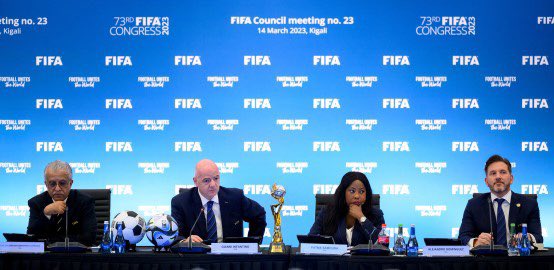
FIFA, the apex governing body of world football, confirmed its plan to arrange a 104-match World Cup in 2026 instead of the emblematic 64-game format. On Tuesday, March 14th, FIFA Council explained its 2025-30 football calendar for both men’s and women’s football, including the reshaping of the 2026 World Cup. The announcement came from FIFA ahead of its congress in Kigali, Rwanda.
The 2026 FIFA World Cup is set to be co-hosted by the US, Mexico and Canada. Earlier, FIFA had considered organising the 2026 World Cup with 16 groups which would have had three teams apiece in alignment with its plan to expand the existing 32-team format to a 48-team one.
With Tuesday’s deliberation, FIFA announced to switch back to the globally favoured four-team group format. Simply put, the 2026 FIFA World Cup has been rejigged to have 48 teams which would be clubbed into 12 groups.
The confirmed format means the two top teams from each group would reach the knockout stage alongside the eight best third-placed teams. With this new format, football followers across the globe are going to witness a new knockout stage named the round of 32 in the World Cup.
In 2017, FIFA proposed to expand the 2026 World Cup to a 48-team tournament and the proposal was unanimously approved by the FIFA Council. Besides, the council decided to organise 80 matches instead of the classic 64 matches, with 48 teams being clubbed into 16 groups. However, FIFA’s announcement on Tuesday revealed that it chose to revert to the popular format of the World Cup, discarding its putative radical idea.
Notably, during the 1934-1978 period, FIFA used to organise the World Cup with 16 teams. In 1982, FIFA decided to expand the tournament to 24 teams. Later in 1998, FIFA expanded its signature tournament to 32 teams. The raison d’etre for FIFA’s decision to expand the tournament is to broaden the chances for more teams from Asia, Africa and the Caribbean to take part in incontrovertibly the biggest football show of the world.
East Post is an independent geopolitical analysis portal covering South Asia and global power dynamics for international audiences. Views expressed are analytical and do not constitute endorsement of any state or non-state actor.
Join our channels on Telegram and WhatsApp to receive geopolitical updates, videos and more.