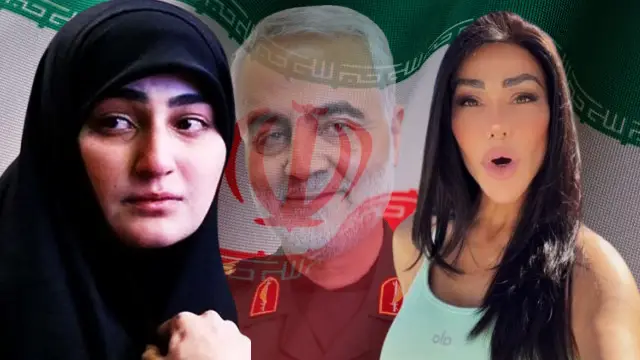
On Saturday, April 4th 2026, Marco Rubio announced that US authorities had detained two women he identified as the niece and grand-niece of Qassem Soleimani, the iconic Islamic Revolutionary Guards Corps (IRGC) commander killed by the US in January 2020. Within hours, that claim was publicly rejected by Mr Soleimani’s daughter, Zeinab Soleimani, who runs the Qassem Soleimani Foundation in Iran, introducing a contradiction that has placed the credibility of the US account under sustained scrutiny.
Washington presented the detentions as a targeted action linked to a central figure in Iran’s military apparatus. Instead, the family itself denies any connection—undermining the premise on which the announcement was constructed. It also exposes inherent problems in the administration that are rocking President Donald Trump’s boat.
Rubio’s rabble-rousing on Soleimani’s niece, grand-niece
Writing on X, Mr Rubio said, “Until recently, Hamideh Soleimani Afshar and her daughter were green card holders living lavishly in the United States.”
“Afshar is the niece of deceased Iranian Major General Qasem Soleimani,” he claimed. He accused her of being “an outspoken supporter of the Iranian regime who celebrated attacks on Americans” and claimed the woman referred to the US as the “Great Satan”.
Until recently, Hamideh Soleimani Afshar and her daughter were green card holders living lavishly in the United States.
— Secretary Marco Rubio (@SecRubio) April 4, 2026
Afshar is the niece of deceased Iranian Major General Qasem Soleimani. She is also an outspoken supporter of the Iranian regime who celebrated attacks on…
The secretary claimed their legal status has been terminated and the duo is in Immigration and Customs Enforcement’s (ICE) custody, “pending removal from the United States.”
He further stated: “The Trump Administration will not allow our country to become a home for foreign nationals who support anti-American terrorist regimes.”
The language of the announcement placed emphasis not only on legal status, but on political alignment—suggesting a convergence between immigration enforcement and national-security framing.
Soleimani’s heir slams Rubio’s niece, grand-niece claim
The central assertion has been directly challenged by Zeinab Soleimani, who stated that the individuals named by Mr Rubio have no familial connection to her father. Speaking to the Iranian and regional media later on Saturday, she claimed that the family has no such relatives living in the US.
This denial doesn’t just contradict Mr Rubio’s claim, which has been amplified by American state-sponsored media, but it also creates a structural impact. Mr Rubio and the ICE apparently used the “Soleimani” keyword to witch-hunt a mother-daughter duo who are critical of American imperialistic policies. To cover up the crackdown on free speech, Mr Rubio alleged links to Mr Soleimani.
It’s this announcement and the detention that acquire deep geopolitical meaning. The narrative architecture of Mr Rubio’s announcement regarding Mr Soleimani’s purported niece and grand-niece getting detained and awaiting deportation starts eroding as soon as the denial from Iran comes. However, as a safety valve, the American state media remains mum on the denials and the further implications of such witch-hunting on the First Amendment.
Observers familiar with Iranian political and familial networks note that the Soleimani family’s public profile makes such connections relatively traceable. In that context, the emergence of a categorical denial introduces a level of inconsistency that is difficult to reconcile with routine verification standards.
Soleimani’s niece, grand-niece narrative exposes credibility gap
The episode has shifted attention from the detention itself to the process behind the claim.
Consider the fact that ICE detained Mr Soleimani’s so-called niece and grand-niece because of their purported familial links and political views. These are not peripheral details but the central pillar on which Mr Rubio attempts to build a case.
If that identification is incorrect, the implications extend beyond a single misstatement. It raises questions about the verification standards applied by US authorities, particularly in cases carrying geopolitical sensitivity. In such contexts, the threshold for public claims is typically high, given their potential diplomatic and legal consequences.
The sequence of events instead suggests a reversal of that order—where a politically charged assertion entered the public domain before its factual basis was conclusively established. This inversion is what has drawn scrutiny. When narrative framing appears to precede verification, the credibility of the broader claim comes under pressure.
For observers, the issue is therefore less about the detention itself and more about institutional reliability. It puts into question Mr Trump’s anti-immigrant policy and the activities of the ICE, which have been flagged several times by American lawmakers, rights activists and different organisations.
Yet, Mr Rubio’s claims regarding the detention of Mr Soleimani’s niece and grand-niece, the amplified propaganda against those Americans who oppose the war and a hearsay forming the basis of an ICE operation highlight the underlying threats that the Trump administration’s overtly anti-immigrant position poses to American society.
Another reason that possibly irked the US regime against Ms Afshar and her daughter is that they are not adhering to the norms expected from the Iranian diaspora living in the West. Ms Afshar’s photos that flooded the internet to validate Mr Rubio’s allegation of her living a “lavish life” in the US show she is not a conservative, religious woman. Rather, she appears to have assimilated with the West, something that the advocates of Western democracy demand for Iranian women. However, when such women don’t subscribe to the American-Israeli views on “freeing Iranians” from the Islamic Republic, they become targets of the regime.
Critics believe her stance on Iran, despite her not conforming to the stereotype of a conservative, veiled Muslim woman, has turned Ms Afshar into an American target.
What seems to be a targeting of some purported members of Mr Soleimani’s extended family, critics believe, can now turn into a broader witch-hunt against those opposing the American aggression on Iran. This can evolve into a broad template for Mr Trump to suppress his critics.
Domestic reaction and amplification
The announcement triggered sharply divided responses within the US. Supporters of Mr Trump framed the move as a necessary extension of national-security policy, particularly in the context of confrontation with Iran. Critics, by contrast, argued that the case risks testing constitutional protections if immigration enforcement is perceived to be linked to political expression rather than legal status alone.
The reaction was amplified in digital spaces, where far-right figures cheered the move, circulated additional names of Iranian nationals critical of US policy, and demanded their deportation. The development has highlighted how the US administration can peddle any lie and then assemble its far-right supporters to amplify the propaganda. Eventually, these political stunts aim at diverting the public from an ignominious situation on the Iran front.
War pressure as context, not cause
The controversy around Mr Soleimani’s alleged niece and grand-niece has been unfolding against the backdrop of an intensifying confrontation between the US-Israel nexus and Iran, where both sides continue to advance competing narratives over recent military developments.
At a time when Iran has shot down two American planes and a helicopter after Pentagon officials claimed they had decimated Tehran’s air defence system, Mr Trump’s regime needs more issues that can distract the people.
He and his regime need distractions, critics say, to cover up inconsistencies in the messaging—oscillating between assertions of strategic success and pleading for a ceasefire—with rising inflation causing a sharp decline in the president’s approval ratings.
According to CNN, two-thirds of Americans blame Mr Trump’s policies for the inflation. A majority of young Republicans believe he has betrayed the “Make America Great Again” and “America First” slogans to play second fiddle to Israel. In a mid-term election year, this sinking of approval ratings can be catastrophic for the Republicans and Mr Trump in particular. Some analysts suggest that such pressures may influence the timing and framing of high-profile announcements. Yet in this case, the immediate question is more fundamental—whether the claim itself withstands basic factual scrutiny before any broader political interpretation is applied.
The dispute is no longer centred on who was detained, but on whether the justification offered can be sustained. When a claim of this scale is contradicted at its source, the issue shifts from enforcement to credibility—and in geopolitical contests, credibility is often the first casualty, and the hardest to recover.
East Post is an independent geopolitical analysis portal covering South Asia and global power dynamics for international audiences. Views expressed are analytical and do not constitute endorsement of any state or non-state actor.
Join our channels on Telegram and WhatsApp to receive geopolitical updates, videos and more.