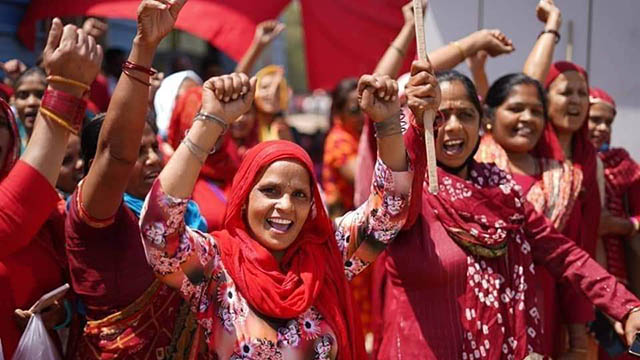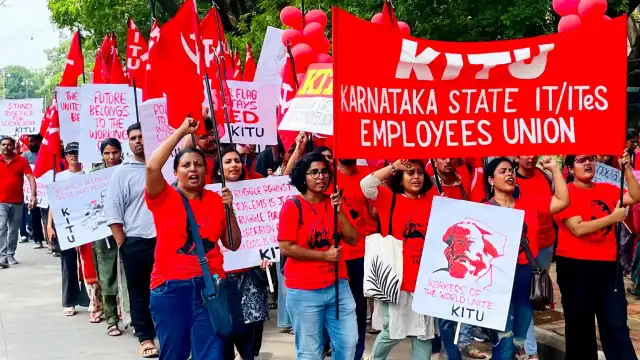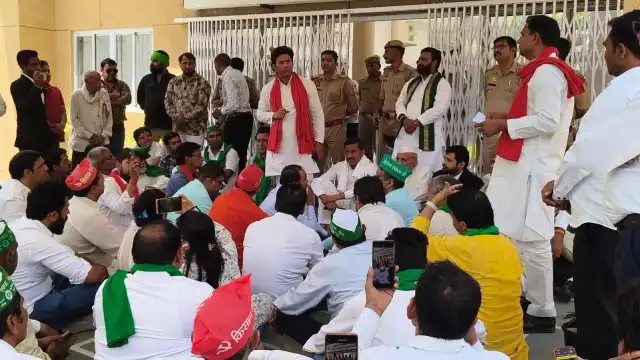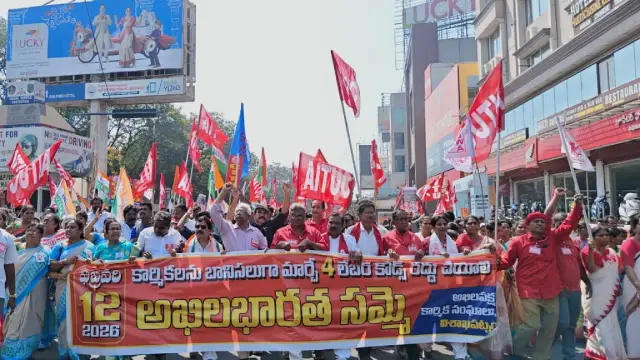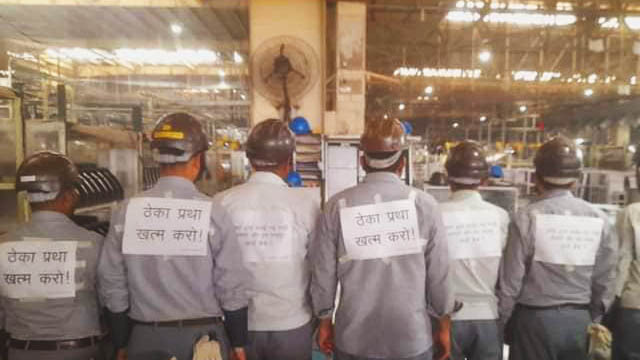
In Haryana’s Gurugram (formerly Gurgaon), located on the outskirts of the Indian capital New Delhi, antagonism between Japanese management and Indian workers in a company— Belsonica Auto Components India Pvt Ltd (BACI)—sparked a major labour movement.
The BACI Employees Union (BACIEU) accused the Japanese owners of running a vindictive campaign against Indian workers and intending to implement the new Labour Codes enacted by Prime Minister Narendra Modi-led Bharatiya Janata Party’s (BJP) government in 2020.
The union leaders alleged that the Japanese are planning to terminate all regular workers and hire contract workers instead. The BACIEU alleged that the new Labour Codes of 2020 are ‘anti-worker’ and they “serve the interests of the capitalists rather than the workers”.
The BACIEU has been on a continuous strike since March 1st after the Japanese management rejected the demands of the Indian workers against retrenchment. As a result, on April 18th, Indian workers in BACI were found working in the factory with posters on their backs highlighting their demands.
According to the Indian workers, the Japanese management and Indian workers are at loggerheads after the latter refused to budge to the former’s ‘unjust demands’, which would lead to massive retrenchment. The BACIEU alleged that Haryana’s BJP government, despite its ‘nationalist rhetoric’, not supporting the Indian workers against the Japanese management, but helping the latter.
In 2006, BACI was established to supply automobile components to the Maruti Suzuki factory in Gurugram, which is also co-owned by the Japanese. In 2016, the number of workers in this factory was 1,370. BACIEU president Mohinder Kapoor told East Post that currently, the factory has around 700 regular workers and 126 casual workers.
Since Modi’s BJP passed the contentious four Labour Codes in the Parliament in 2020, Kapoor alleged that Japanese management planned to forcefully retrench Indian workers and replace them with contract-based, disenfranchised workers.
Kapoor alleged that the Japanese authorities introduced a voluntary retirement scheme for Indian workers in 2021 to reduce the size of the workforce. But most of the young workers refused to retire voluntarily and rejected the Japanese management’s offer.
After this, Kapoor alleged, as the Indian workers refused to take voluntary retirement, the Japanese management alleged that many of the workers had forged work experience and educational qualification documents. Under the guise of verifying the documents, they filed a police complaint against some workers, accusing them of using forged documents. Kapoor said in 2021 alone, 22 workers—21 regular and one temporary—were booked and dismissed for allegedly using forged documents.
The Japanese management also started issuing chargesheets against Indian workers in 2021 who allegedly delayed joining work after the 2020 Covid-19 lockdown. The Japanese management asked the workers why they shouldn’t be penalised for the delay in joining work. The BACIEU alleged that it was done to further pressurise the Indian workers.
Thirty-four names were included in this list after the Japanese management initiated an investigation in 2021. They dismissed one worker on October 21st 2022, and two on December 23rd 2022, alleging they used forged documents.
After this, on April 7th, 2023, three temporary Indian workers were also retrenched by the Japanese authorities. Indian workers went on strike on March 1st 2023 against the ongoing layoffs. Infuriated by this, on March 17th, three union leaders, including Kapoor, general secretary Ajit Singh, and organisation secretary Sunil Kumar, were fired without notice and were forcefully evicted from the factory with the help of bouncers and policemen.
The union leadership told East Post that the Japanese management continued to take various retaliatory measures against the Indian workers. Two union workers were issued chargesheets on March 29th, while two union members and ten regular workers were also issued chargesheets on March 30th.
The rest of the workers have stepped up their protest, alleging that the Japanese management is attacking Indian workers and attempting to disenfranchise them at the workplace by enforcing the new Labour Codes.
Labour unions claimed that in the Gurugram-Manesar region, the proportion of regular workers in car factories averages 17%, while their proportion in auto parts factories is only 2% to 3%. In this scenario, around 50% of BACI’s workforce is regular workers, which the Japanese management has been trying to reduce to cut down their operational costs.
The labour unions also alleged that in the clash between the Japanese and the Indians, the ruling BJP sided with the foreigners, despite regularly raising the tempo of ‘nationalism’.
The BACIEU alleged that bouncers hired by the Japanese management have been deployed inside the factory to intimidate the Indian workers and refrain them from joining any labour initiative. The state’s labour department also remained a mute spectator so far.
Despite several attempts, the BACI management couldn’t be reached. As tension simmers between the Japanese management and Indian workers, both parties are at a standoff. While keeping the negotiation channel open, the Indian workers have called this a ‘struggle’ against the Japanese management for their existence and vowed to continue it until their demands are met.
East Post is an independent geopolitical analysis portal covering South Asia and global power dynamics for international audiences. Views expressed are analytical and do not constitute endorsement of any state or non-state actor.
Join our channels on Telegram and WhatsApp to receive geopolitical updates, videos and more.