The spark was local. The escalation was not.
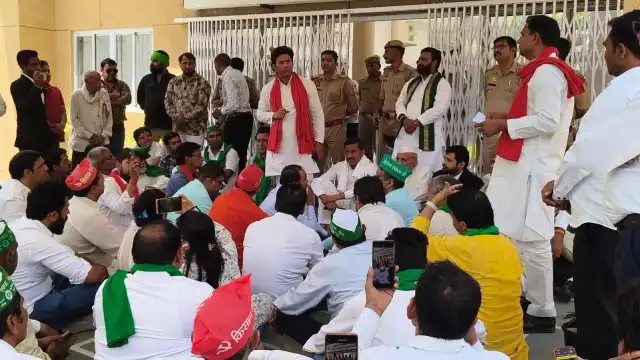
What began on April 13th as a wage dispute inside a private factory in the northern Indian city of Noida—triggered by management’s refusal to align wages with the minimum floor rate fixed by Uttar Pradesh, India’s most populous state—rapidly spilt onto the streets, spreading across industrial clusters in Uttar Pradesh and neighbouring Haryana. Within hours, protests engulfed Uttar Pradesh’s Noida and Greater Noida, and Haryana’s Manesar, as well as parts of Faridabad, blocking arterial roads and drawing a forceful police response.
By the end of the first phase of unrest, more than 300 workers and labour activists had been detained in Noida alone, according to police sources, with additional detentions reported across adjoining industrial areas. Section 144 was imposed in several pockets, and paramilitary units were deployed to restore order.
Yet the unrest cannot be reduced to a single wage dispute. It reflects a deeper convergence of domestic labour tensions and external economic shocks—most notably the inflationary pressures triggered by the ongoing conflict in West Asia involving the United States and Israel against Iran.
From wage dispute to regional flashpoint: How Noida and Faridabad’s labour unrest unfolded
The initial protests were centred on wage revision demands amid rising living costs. However, the situation escalated as workers across factories in the National Capital Region’s (NCR)—which adjoins the federal capital, New Delhi—industrial belt joined in, many of them contract labourers employed in large manufacturing units.
Companies that came under the spotlight during the unrest include Richa Global Exports, Motherson, Kent RO Systems Ltd, Dixon Technologies India Pvt Ltd, Rainbow Fabart Pvt Ltd, Spark Minda Sai Ltd, Itel Mobile Devices Pvt Ltd, and Anubhav Apparels Pvt Ltd, where workers alleged long hours, wage suppression, and denial of statutory benefits.
As protests intensified, reports emerged of lathi charges, tear gas use, and large-scale detentions. In Manesar and Noida, trade unions alleged that women workers were subjected to force by male police personnel. Authorities, however, have framed the developments within a law-and-order lens.
The Uttar Pradesh government, led by Chief Minister Yogi Adityanath, has pointed to a possible “larger conspiracy” behind the unrest, with officials referring to “vested interests” and even suggesting foreign involvement. Trade unions have rejected these claims, arguing that they are attempts to deflect attention from economic grievances.
The economics behind Noida and Faridabad’s labour unrest
At the centre of the workers’ protests lies a widening gap between wages and the costs of survival across India.
Workers across the NCR industrial belt, many of them migrants from Bihar, Uttar Pradesh, West Bengal, and Jharkhand, report monthly earnings ranging from Rs 10,000 to Rs 12,000, with some earning up to Rs 15,000. Even where minimum wages are officially higher, enforcement remains inconsistent.
The cost structure they face tells a different story. Rent for a single-room accommodation in dense parts of Noida ranges between Rs 5,000 and Rs 7,000. A family of four spends at least Rs 8,000 to Rs 10,000 on food each month due to rising prices of essentials such as rice, pulses, oil, and vegetables. When electricity, transport, communication, and education expenses are added, total monthly expenditure exceeds Rs 20,000.
This arithmetic has pushed many workers into chronic debt, with irregular wage payments, unpaid overtime, and lack of social security, deepening the crisis. Domestic workers, largely unorganised, have also begun mobilising, with protests reported in areas such as Sector 121 demanding minimum wages and regulated working conditions.
Trade unions frame a national moment
India’s central trade unions have interpreted the Noida, Faridabad labour unrest as part of a broader structural crisis rather than an isolated episode.
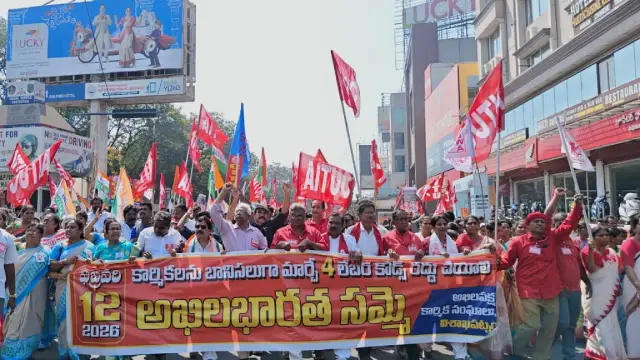
India’s oldest trade union, the All India Trade Union Congress (AITUC), condemned what it described as “repression let loose on agitating workers” in Manesar and Noida. In a statement issued by its national general secretary, Amarjeet Kaur, the AITUC demanded the release of detained workers and called for immediate dialogue, asserting that “minimum wages are not revised in many states for the last 10 years despite price rise in basic essentials.”
AITUC further argued that workers are being denied fundamental rights, stating that “overwork, non-payment of dues, compromised workplace safety, and denial of unionisation have become common across industrial hubs.”
Echoing this position, the All India Central Council of Trade Unions (AICCTU) described the protests as a response to “starvation-level wages” and the expansion of 12-hour workdays. The organisation said that workers across sectors have been denied Employees’ State Insurance, Employees’ Provident Fund, bonuses, and overtime payments, while state authorities have “resorted to lathi charge, tear gas, and arrests instead of dialogue.”
AICCTU alleged that both police forces and private security personnel were deployed to suppress workers and noted that even activists and lawyers attempting to assist detained workers were targeted.
Leena Chatterjee Bose, a national leader of the AITUC, characterised the developments as the beginning of a wider confrontation, stating that “the labour unrest in places like Noida, Panipat, and Surat is just the beginning of an all-India struggle against anti-worker policies.” She warned that when “oppression reaches its peak, the working class takes to the streets and fights back.”
Other organisations, including the United Trade Union Congress (UTUC), have mobilised solidarity protests across industrial units, signalling a consolidation of trade union response. The UTUC’s West Bengal unit called upon the state’s workers to stage solidarity demonstrations on Thursday, April 16th, Dipak Saha, the state leader of the organisation, told the East Post.
It’s not just the UTUC and the factory workers. The Karnataka State IT/ITeS Employees’ Union (KITU) also extended solidarity with the protesting workers in Noida, Faridabad and beyond. The KITU, which represents India’s tech workers in the IT hub of Bengaluru, overlooked the distance and stood in support of the workers participating in the unrest in Noida and Faridabad.
The labour code faultline
At the heart of the conflict lies India’s restructured labour regime.
The consolidation of 44 labour laws into four labour codes has been presented by the government as a reform aimed at simplifying compliance and improving the ease of doing business. Trade unions, however, argue that these codes fundamentally alter the balance of power in favour of employers.
Union leaders contend that the new framework makes unionisation more difficult, weakens inspection mechanisms through self-certification, raises thresholds for layoffs without government approval, and expands fixed-term employment. They also argue that it effectively normalises longer working hours while restricting the right to strike.
According to AITUC and AICCTU, these changes have created a situation in which “collective bargaining is increasingly difficult”, and labour protections are being systematically diluted.
A pattern beyond NCR
The NCR unrest follows a series of worker mobilisations across the country over the past few months.
Protests have been reported in refinery areas in Barauni, industrial zones in Panipat, textile hubs in Surat, and manufacturing clusters in Singrauli and Manesar. In each of these locations, the core demands have remained consistent: higher wages, enforcement of eight-hour workdays, payment of overtime at double rates, and access to social security.
Trade unions argue that the absence of effective tripartite dialogue between government, employers, and workers has allowed local disputes to escalate into broader confrontations.
Global trigger: war and inflation
The timing of the unrest is not incidental.
The ongoing conflict in West Asia involving the United States and Israel against Iran has disrupted energy flows and contributed to rising global fuel prices. For India, which remains heavily dependent on imported oil and gas, the impact has been transmitted through higher costs of LPG and essential commodities.
For industrial workers whose wages have remained stagnant, this has translated into a sharp erosion of real incomes.
At the same time, India’s integration into global supply chains—particularly those linked to Western markets—has placed downward pressure on labour costs even as input costs rise. Businesses cite global uncertainty and cost pressures, while workers experience declining purchasing power.
The result is a structural squeeze in which global shocks at the top intersect with wage compression at the bottom.
State response and political faultlines
The response of state governments in Uttar Pradesh and Haryana—both ruled by Prime Minister Narendra Modi’s far-right Bharatiya Janata Party—has prioritised containment of unrest and continuity of industrial activity.
Authorities have framed the protests as a law-and-order issue, with investigations into alleged conspiracies and external instigation. Trade unions, however, argue that this reflects a deeper alignment between state power and corporate interests, particularly in the context of labour reforms.
The political framing of the unrest—ranging from conspiracy claims to accusations of “vested interests”—has further polarised the situation, reducing the space for negotiation.
An inflexion point for labour
The labour unrest in Noida and Faridabad marks more than a local disruption. It signals a potential inflexion point in India’s labour landscape.
The immediate demands—higher wages, regulated working hours, and enforcement of labour rights—remain rooted in everyday survival. But the underlying conflict is structural, shaped by labour reforms, global economic pressures, and the evolving relationship between state and capital.
If the current trajectory continues, the NCR protests may represent the early phase of a broader cycle of industrial unrest.
For now, the message from the factory floors of northern India is clear: the cost of economic adjustment is being contested—and the workers are no longer willing to absorb it in silence.
East Post is an independent geopolitical analysis portal covering South Asia and global power dynamics for international audiences. Views expressed are analytical and do not constitute endorsement of any state or non-state actor.
Join our channels on Telegram and WhatsApp to receive geopolitical updates, videos and more.