Europe today speaks of India in superlatives. It is the “world’s largest democracy,” a “trusted partner,” and a strategic counterweight to China. The European Union’s push to accelerate trade negotiations with New Delhi reflects a broader Western consensus: India is no longer optional—it is central. But beneath this convergence lies a contradiction Europe has chosen not to confront.
The deeper its engagement, the more difficult it becomes to ignore mounting evidence that India’s democratic architecture—particularly its electoral processes—is under growing strain.
Strategic imperative
For Europe, the rationale is structural.
India offers scale: a vast market, a labour base, and a geopolitical hedge against China. For Washington, the calculus is even clearer—India is a pillar in the Indo-Pacific strategy first sharpened under Donald Trump and sustained thereafter.
This has produced a rare transatlantic consensus.
India must be engaged, strengthened, and integrated.
Even if that means asking fewer questions.
SIR exercise: Numbers demand scrutiny
At the centre of the current controversy lies the Special Intensive Revision (SIR) of electoral rolls conducted by India’s Election Commission.
Officially, the exercise is administrative—aimed at removing duplicate or ineligible voters. But the scale of deletions has raised serious concerns.
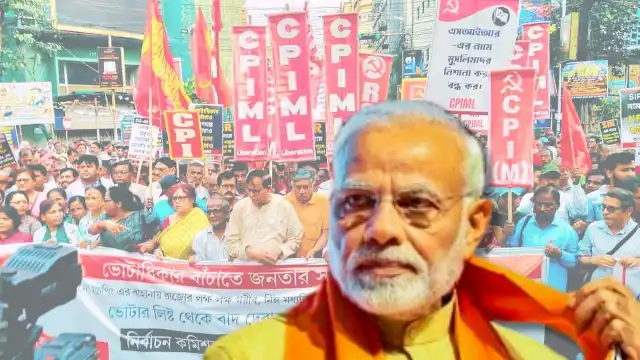
According to The Hindu, over 20m names were deleted from voter rolls in Uttar Pradesh following the SIR exercise. In West Bengal, around 9m voters were excluded, with data showing that 34% of those removed were Muslims.
These are not marginal adjustments. They represent electoral shifts at the population scale.
Reports and political responses across states suggest that documentation requirements, verification drives, and compressed timelines may have disproportionately affected poorer and marginalised communities—those least equipped to navigate bureaucratic scrutiny.
The controversy itself is not new. Critics, including opposition leaders and civil society voices, have long alleged that such exercises risk being used to influence electoral outcomes.
The question is no longer whether revision is necessary.
The question is whether revision at this scale risks becoming exclusionary.
Why SIR is controversial now
Criticism of the SIR has intensified because of its potential to reshape not just voter rolls—but voter access itself.
Analysts and political observers warn that the process, especially in states with high migrant populations, risks excluding legitimate voters due to documentation gaps and administrative errors.
Voices from the ground and political movements have gone further, arguing that migrant workers and marginal communities are particularly vulnerable in such exercises.
Even within institutional processes, concerns have surfaced. Submissions referenced in court proceedings point to allegations of intimidation, violence, and irregularities linked to the revision process.
Nobel laureate Amartya Sen has warned that such exercises carry a real risk of wrongful deletions that could disproportionately disenfranchise the poor.
Minorities, documentation, and disproportionate impact
A report by BBC News highlights growing anxieties around voter verification processes in India, particularly among Muslim communities and economically vulnerable groups.
The issue is structural.
Access to documentation—proof of residence, birth records, legacy data—is uneven in India. When electoral legitimacy is tied tightly to paperwork, exclusion becomes a statistical probability.
A separate report in The Guardian notes that such electoral processes are increasingly viewed by minorities through the lens of insecurity, particularly amid broader political developments.
Critics argue that such processes, even if neutral in design, can produce unequal outcomes in practice.
And when those outcomes consistently affect specific communities, neutrality itself comes into question.
BJP, majoritarian politics, and minority anxiety
The SIR controversy cannot be separated from the political context in which it is unfolding.
Under Narendra Modi, critics argue that India has witnessed a shift toward majoritarian nationalism, often described as Hindutva. His far-right Bharatiya Janata Party (BJP) rules the majority of India’s provinces.
Multiple international analyses have pointed to rising anti-Muslim rhetoric, legal targeting, and growing insecurity among minorities in India. This has intensified in all states where the BJP has seized power.
Reports and commentary across platforms have highlighted how the BJP has increasingly framed political discourse targeting Muslims and Christians as demographic or cultural threats, reinforcing social polarisation.
For many critics, the concern is not just rhetoric, but its convergence with administrative processes such as voter verification.
The “Vote Theft” allegations
The controversy has been politically amplified by Rahul Gandhi, who has repeatedly alleged large-scale manipulation of voter rolls.
In a press interaction, Mr Gandhi claimed that voter fraud is being “centrally carried out,” citing irregularities such as the deletion of legitimate voters and the suspicious addition of names to electoral rolls.
His remarks—though rejected by authorities—have shifted the debate from isolated irregularities to systemic suspicion.
The Election Commission maintains that the process is transparent and rule-based.
But the absence of independent, widely trusted audits has allowed mistrust to deepen.
Institutional drift beyond elections
The SIR controversy does not stand alone.
A separate BBC News report has highlighted broader concerns about democratic freedoms in India, including pressures on dissent, media, and civil society.
Over time, electoral concerns, institutional pressures, and majoritarian politics have begun to converge into a broader question about the direction of India’s democracy.
Europe’s own standards—and the Indian exception
This is where the contradiction sharpens.
The European Union has long positioned itself as a global defender of electoral integrity—challenging irregularities abroad, imposing pressure where needed, and linking democratic standards to partnerships.
And yet, in India’s case, this framework appears suspended.
Despite credible media reports of large-scale voter deletions and opposition allegations of manipulation, Brussels has remained publicly silent.
There have been no resolutions, no formal warnings, no conditionalities attached to engagement.
Political economy of silence
The reason lies in material reality.
India is not just another partner—it is a market of strategic consequence. European industries see it as a destination for exports, investment, and supply chain diversification.
At a time of economic fragility within Europe, access matters.
So does alignment.
For the United States and its allies, India is a geopolitical counterweight to China. Europe, despite internal disagreements with Washington, has broadly aligned with this vision.
In such a framework, scrutiny becomes a risk.
Silence becomes policy.
System in transformation
What is unfolding in India under Mr Modi’s BJP is not the abandonment of democracy, but its recalibration.
Elections continue. Institutions function. Procedures remain intact.
But the conditions under which they operate are increasingly contested.
It is this duality—formal democracy alongside structural asymmetry—that allows the system to endure while its character evolves.
And it is precisely this ambiguity that enables external actors to look away.
For the world, the question is no longer whether India is democratic.
It is whether democracy still matters as a criterion for partnership.
Because if electoral integrity can be overlooked at this scale—when it involves a partner as central as India—it signals a deeper shift.
Not just in policy, but in principle.
From a rules-based order to a selective one.
Where values are enforced where convenient—and ignored where costly.
And in that shift, Europe risks losing not leverage, but legitimacy.
East Post is an independent geopolitical analysis portal covering South Asia and global power dynamics for international audiences. Views expressed are analytical and do not constitute endorsement of any state or non-state actor.
Join our channels on Telegram and WhatsApp to receive geopolitical updates, videos and more.