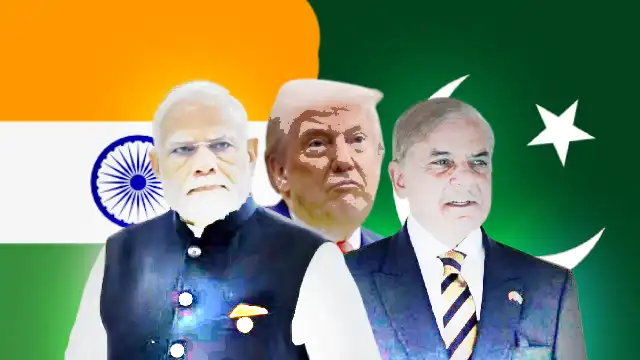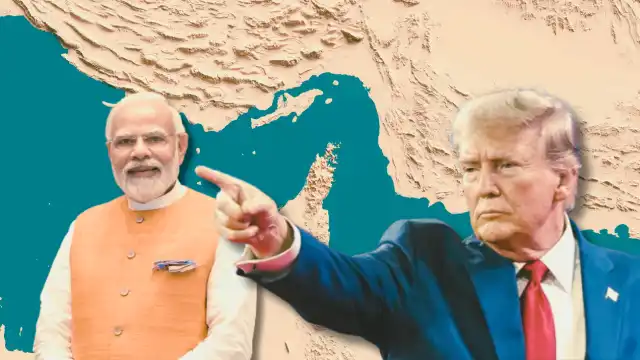
When Indian Prime Minister Narendra Modi spoke with US President Donald Trump on Tuesday, April 14th, the conversation was framed as routine diplomacy. But in the context of the escalating Strait of Hormuz crisis, it revealed something deeper: the widening gap between India’s claim of “strategic autonomy” and its actual alignment with Washington.
Mr Modi’s remarks following the call—particularly his emphasis on keeping the Strait of Hormuz “open and secure”—came without any criticism of the US naval blockade on Iran, even as tensions persist despite a two-week-long ceasefire. In doing so, India’s Strait of Hormuz policy appears less like neutral balancing and more like calibrated acquiescence to US priorities.
“Received a call from my friend President Donald Trump. We reviewed the substantial progress achieved in our bilateral cooperation in various sectors. We are committed to further strengthening our Comprehensive Global Strategic Partnership in all areas,” Mr Modi wrote on X.
Received a call from my friend President Donald Trump. We reviewed the substantial progress achieved in our bilateral cooperation in various sectors. We are committed to further strengthening our Comprehensive Global Strategic Partnership in all areas. We also discussed the…
— Narendra Modi (@narendramodi) April 14, 2026
“We also discussed the situation in West Asia and stressed the importance of keeping the Strait of Hormuz open and secure,” he added.
What the prime minister did not say, however, is equally telling. There was no reference to the legality of the US blockade, no call for de-escalation, and no articulation of an independent Indian position—despite the fact that the Strait of Hormuz is central to India’s energy security.
India’s Strait of Hormuz policy exposes constrained autonomy
The episode lays bare a structural reality. India’s Strait of Hormuz policy is constrained less by strategic choice and more by economic dependence and elite alignment with the West.
At a time when Iran—India’s partner in platforms such as BRICS and the Shanghai Cooperation Organization (SCO)—was subjected to massive attacks from what many describe as the Israel-US nexus, New Delhi avoided calling for peace while maintaining proximity to Washington.
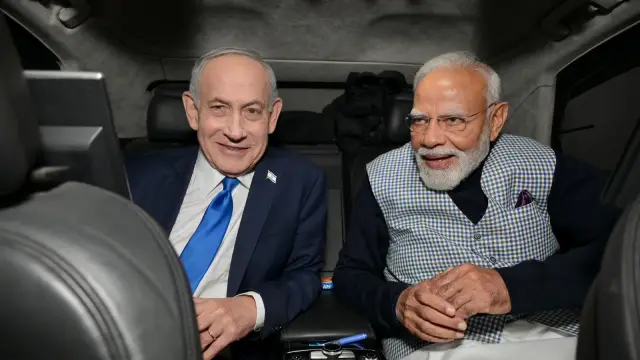
Two days before the Israel-US nexus launched attacks on Iran, Mr Modi was touring Israel, showing bonhomie between him and Prime Minister Benjamin Netanyahu, who faces serious corruption charges.
Had an excellent meeting with Prime Minister Netanyahu. Expressed gratitude to him for the warm welcome earlier in the day. It is a delight to be back in Israel after 9 years. We discussed a wide range of subjects aimed at boosting bilateral ties. Sectors such as technology,… pic.twitter.com/uh1cyL411c
— Narendra Modi (@narendramodi) February 25, 2026
During his visit, Mr Modi also addressed the Israeli parliament, the Knesset. He called Israel “fatherland” while comparing it to India, which he called the “motherland”.
Addressing the Knesset. Do watch my speech. @KnessetENG https://t.co/a8V6Ah5HwY
— Narendra Modi (@narendramodi) February 25, 2026
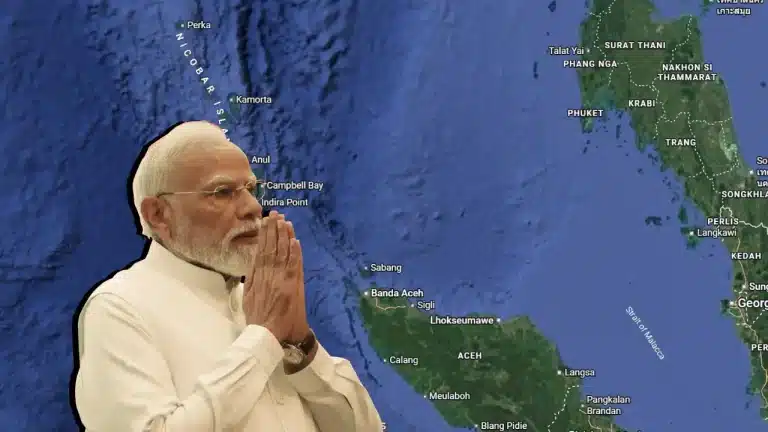
Mr Modi had earlier criticised Iran for retaliatory actions against the US and Israel. However, his government remained a mute spectator after an Iranian frigate was torpedoed by the US in the Indian Ocean region close to Sri Lanka, when it was returning after attending an event organised by the Indian Navy.
This contradiction is not incidental. It reflects a broader pattern in India’s foreign policy—one that seeks to maintain ties across rival blocs but increasingly tilts towards the West in high-stakes crises.
Silence, signalling, and selective engagement
India’s calibrated silence extended to the killing of Iran’s supreme leader, Sayyed Ali Khamenei. While Mr Modi refrained from commenting, sections of his Bharatiya Janata Party (BJP) support base publicly celebrated the killing.
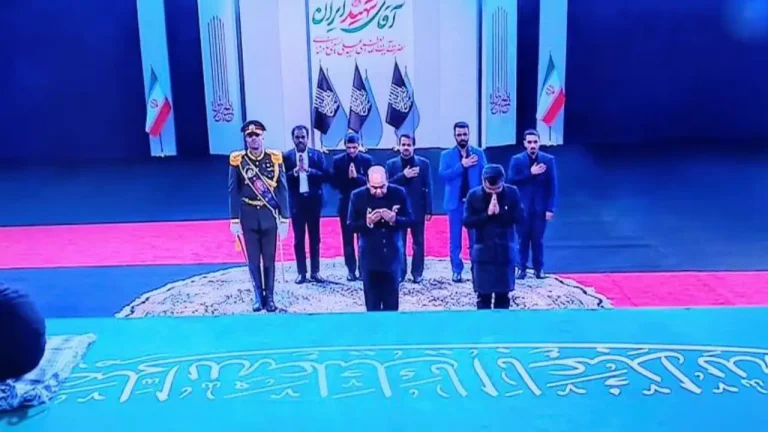
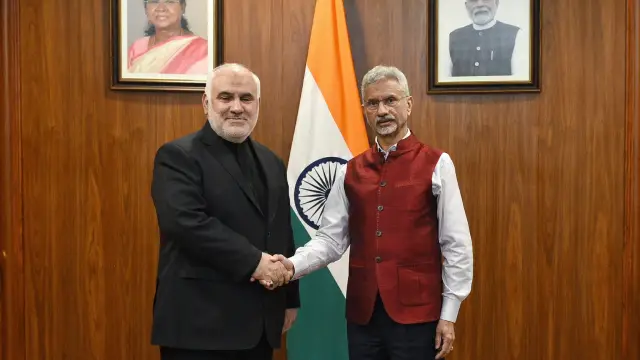
Subsequently, India sent Pabitra Margherita, a deputy minister in the Ministry of External Affairs, to attend the 40th-day (Chehelum) mourning.
Minister of State Shri Pabitra Margherita offered solemn respects on behalf of the Government of India at the 40th day (Chehelum) mourning ceremony organized by the Embassy of Iran in New Delhi.
— Randhir Jaiswal (@MEAIndia) April 12, 2026
India–Iran relations are anchored in deep rooted civilizational, cultural and… pic.twitter.com/atZle5aKk4
The BJP also deputed Mukhtar Abbas Naqvi, its prominent Shi’ite face, who described Mr Khamenei as a “martyr”.
Today participated in Commemoration Ceremony organised at Iran Culture House in New Delhi to pay homage on Fortieth Day of martyrdom of Supreme Leader of Iran and great spiritual personality Ayatullah Ali Khamenei Ji. A large number of people from all communities of the society… pic.twitter.com/2CgXCVoJZX
— Mukhtar Abbas Naqvi (@naqvimukhtar) April 12, 2026
This dual signalling—silence at the moment of escalation, followed by symbolic outreach—mirrors India’s broader Hormuz policy: reactive, cautious, and internally contradictory.
India’s Strait of Hormuz policy: Oil without alignment
Even as it avoided political alignment with Tehran, India moved to secure energy supplies.
During the war, and with American permission, India purchased Iranian crude oil for the first time in seven years, alongside continued imports of Russian oil. The first delivery arrived this week, according to a statement by India’s Petroleum Ministry on April 4th.
“Amid Middle East supply disruptions, Indian refiners have secured their crude oil requirements, including from Iran,” the ministry stated.
The news reports and social media posts of an Iranian crude cargo being diverted from Vadinar, India to China due to “payment issues” are factually incorrect. 🇮🇳India imports crude oil from 40+ countries, with companies having full flexibility to source oil from different sources…
— Ministry of Petroleum and Natural Gas #MoPNG (@PetroleumMin) April 4, 2026
This reflects a pattern: India engages economically with Iran when necessary, but avoids translating that engagement into political support—further complicating its Strait of Hormuz policy posture.
Eroding goodwill in Tehran
Iran, for its part, has maintained that no toll has been imposed on Indian-flagged oil tankers and has emphasised its friendship with India. Yet the political gap is widening.
Tehran has taken note of India’s domestic handling of protests against Mr Khamenei’s killing, where authorities cracked down on demonstrations by Indian Shi’ite Muslims condemning US-Israeli actions.
In a symbolic gesture, Iranian President Dr Masoud Pezeshkian, in a post on X on Tuesday, April 14th, listed civilisational states—but did not include India.
The essence of civilizations reveals itself at critical historical junctures. The positions taken by Spain, China, Russia, Türkiye, Italy, and Egypt against the warmongering and crimes of the Zionist regime stem from their deep cultural and historical roots.
— Masoud Pezeshkian (@drpezeshkian) April 14, 2026
While not definitive, such signals point to a steady erosion of India’s political capital in Iran.
Follow the money: why India leans West
To understand India’s Strait of Hormuz policy, one must look beyond diplomacy and examine economic realities.
The United States remains India’s most critical export market. US goods and services trade with India totalled an estimated $212.3bn in 2024, up 8.3% ($16.3bn) from 2023.
US goods trade alone reached $149.4bn in 2025. Exports from the US to India stood at $45.6bn, up 9.8% ($4.1bn), while imports from India rose to $103.8bn, up 18.9% ($16.5bn). The US goods trade deficit with India widened to $58.2bn in 2025, a 27.1% increase ($12.4bn).
Services trade totalled $83.4bn in 2024, with US exports at $41.8bn and imports at $41.6bn. The US recorded a services trade surplus of $102m in 2024, compared to a deficit of $76m in 2023.
By contrast, India’s trade with Russia—though strategically important—remains skewed. Bilateral trade reached $68.7bn in FY 2024-25, with Indian exports at $4.9bn and imports at $63.8bn. Services trade stood at $1.021bn in 2021. The two countries aim to reach $100bn by 2030.
With China, India continues to run a significant trade deficit. In 2025, China surpassed the US to become India’s largest bilateral trade partner. The bilateral trade reached $151.1bn in the financial year 2025-26. However, India suffers a trade deficit of over $112bn with China.
Strategic Trade Balance
India vs United States, China & Russia (2024-2026)
- US Goods Exports to India (2025)$45.6bn
- US Goods Imports from India (2025)$103.8bn
- Russia Exports to India (FY 24-25)$63.8bn
- India Exports to Russia (FY 24-25)$4.9bn
These figures illustrate a structural reality: India’s economic ecosystem—from exports to IT services—is deeply tied to the US and European markets.
Elite alignment and policy constraints
This dependence is reinforced by elite alignment.
Indian businesses are heavily invested in American and European markets, while sections of the Indian elite maintain financial and familial ties to the West. The IT sector remains particularly reliant on US demand.
Politically, this creates constraints. The BJP, which draws support from these constituencies, cannot afford to disrupt Indo-US relations. Nor can India antagonise US-aligned Arab monarchies, which remain central to the global petrodollar system.
Even though Mr Trump has pushed a trade deal that threatens to reverse India’s gains, Mr Modi’s government has agreed to it, fearing to irk Washington, as Indian elites’ interests are closely tied to Wall Street.
As a result, India’s participation in blocs such as BRICS and the SCO increasingly sits uneasily with its Strait of Hormuz policy and broader stance in West Asia.
IMEC and the geography of contradiction
The US-backed India-Middle-East-Europe Economic Corridor (IMEC), announced during the G20 Summit in New Delhi in 2023, was intended to bypass chokepoints such as the Strait of Hormuz and the Bab al-Mandeb.
Yet, more than two years later, the project remains stalled.
Israel’s war on Gaza and the broader conflict involving Iran have disrupted the corridor’s feasibility. Saudi Arabia continues to insist on progress towards a Palestinian state, while the US and Israel resist such conditions.
Alternative proposals—such as routing the corridor through Egypt—face their own complications.
For India, Israel’s participation remains crucial. Gautam Adani’s Adani Enterprises holds a controlling stake in Haifa Port, a key node in the proposed corridor. Shifting the route could undermine these investments, reinforcing the intersection between private capital and strategic policy.
Energy realignments and US leverage
Parallel developments in the energy sector further shape India’s Strait of Hormuz policy.
Mukesh Ambani’s Reliance Industries has been pushed to invest in a major refinery project in Texas, aligning with US efforts to expand domestic refining capacity. At the same time, Washington’s moves to control Venezuelan oil and increase drilling could enable it to supply more oil to Europe—and potentially to India.
If successful, this would reduce Europe’s dependence on West Asian oil transported through the Strait of Hormuz, altering global energy flows.
Under such conditions, India may increasingly turn to more expensive American oil to maintain access to export markets, even at an economic disadvantage.
Chabahar and the cost of hesitation
Nowhere is India’s strategic hesitation more visible than in Chabahar Port.
Despite signing a 10-year contract in May 2024 through India Ports Global Limited to operate the Shahid Beheshti terminal and committing $120m, India has yet to fully operationalise the project.
Concerns over US sanctions and geopolitical pressure continue to delay progress.
This undermines India’s ambitions to develop the International North-South Transport Corridor and bypass China’s Belt and Road Initiative. It also weakens alternative connectivity projects such as the Persian Gulf-Black Sea corridor via Iran and Armenia.
A narrowing space
India’s Strait of Hormuz policy ultimately reflects a narrowing strategic space.
It seeks to balance between competing powers, but its economic dependencies and elite alignments increasingly pull it towards the United States. Its engagements with Iran remain transactional, while its commitments to multipolar platforms appear constrained.
The result is a foreign policy that speaks the language of autonomy but operates within limits set elsewhere.
As the Strait of Hormuz crisis unfolds, that contradiction is no longer abstract. It is visible, measurable, and—perhaps most importantly—costly.
East Post is an independent geopolitical analysis portal covering South Asia and global power dynamics for international audiences. Views expressed are analytical and do not constitute endorsement of any state or non-state actor.
Join our channels on Telegram and WhatsApp to receive geopolitical updates, videos and more.