When Iran launched missiles at US military installations spread across the Gulf monarchies, its message was unmistakable: even a regional power could alter the calculations of a superpower by threatening a single maritime chokepoint. The Strait of Hormuz, through which roughly one-fifth of the world’s crude oil and one-third of its liquefied natural gas passes, became the instrument of that threat. For the next several months, insurance premiums spiked, shipping lanes became increasingly contested, and global energy markets absorbed a geopolitical risk premium that rippled through supply chains from Europe to East Asia.
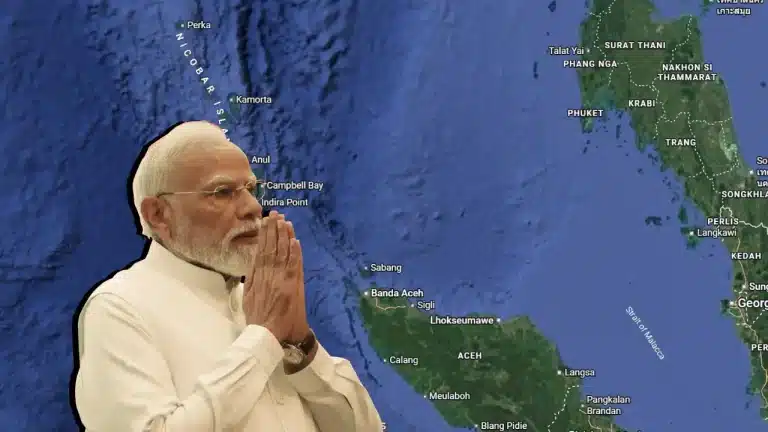
Thousands of miles away, India is drawing its own conclusions from that lesson. Over the past four months, Prime Minister Narendra Modi has undertaken an intensive diplomatic campaign across the Indo-Pacific, simultaneously announcing defence partnerships with Indonesia, Australia, and New Zealand in recent weeks while committing billions of dollars to infrastructure development on Great Nicobar Island, a territory positioned near the Strait of Malacca—an even larger and more economically critical chokepoint than the Strait of Hormuz.
Taken together, these developments suggest a broader strategic pattern. They reveal New Delhi’s desire to exploit geography, maritime power and great-power competition in the twenty-first century to counter its rival, China.
From securing lanes to securing leverage
For decades, India’s Indo-Pacific policy centred on a relatively defensive proposition—securing sea lanes. Under successive governments, from Manmohan Singh through Mr Modi’s first two terms, Indian strategic thinking emphasised freedom of navigation, rules-based order, and the protection of merchant shipping from piracy and regional instability. This framing casts India as a custodian of regional stability—a “net security provider” in Indian terminology, as Mr Modi himself has repeatedly stated.
Today, the emphasis increasingly appears to be shifting. The rhetorical commitment to open sea lanes persists. The official statements from New Delhi speak of “a peaceful, stable and prosperous Indo-Pacific” underpinned by adherence to international law. Yet beneath this familiar language, a different strategic logic is taking shape.
India is investing in infrastructure, forging defence partnerships and positioning military capabilities in ways that suggest a second preoccupation. The investments suggest that New Delhi is increasingly interested not only in securing sea lanes but also in expanding its strategic influence over them. This distinction matters not only for China, which has long been anxious about its dependence on maritime corridors it does not control. It matters for the global economy.
Strait of Malacca arithmetic
The Strait of Malacca is not a military flashpoint yet. It is, rather, an economic indispensability that has somehow remained peripheral to Western strategic thinking despite its centrality to Asian trade.
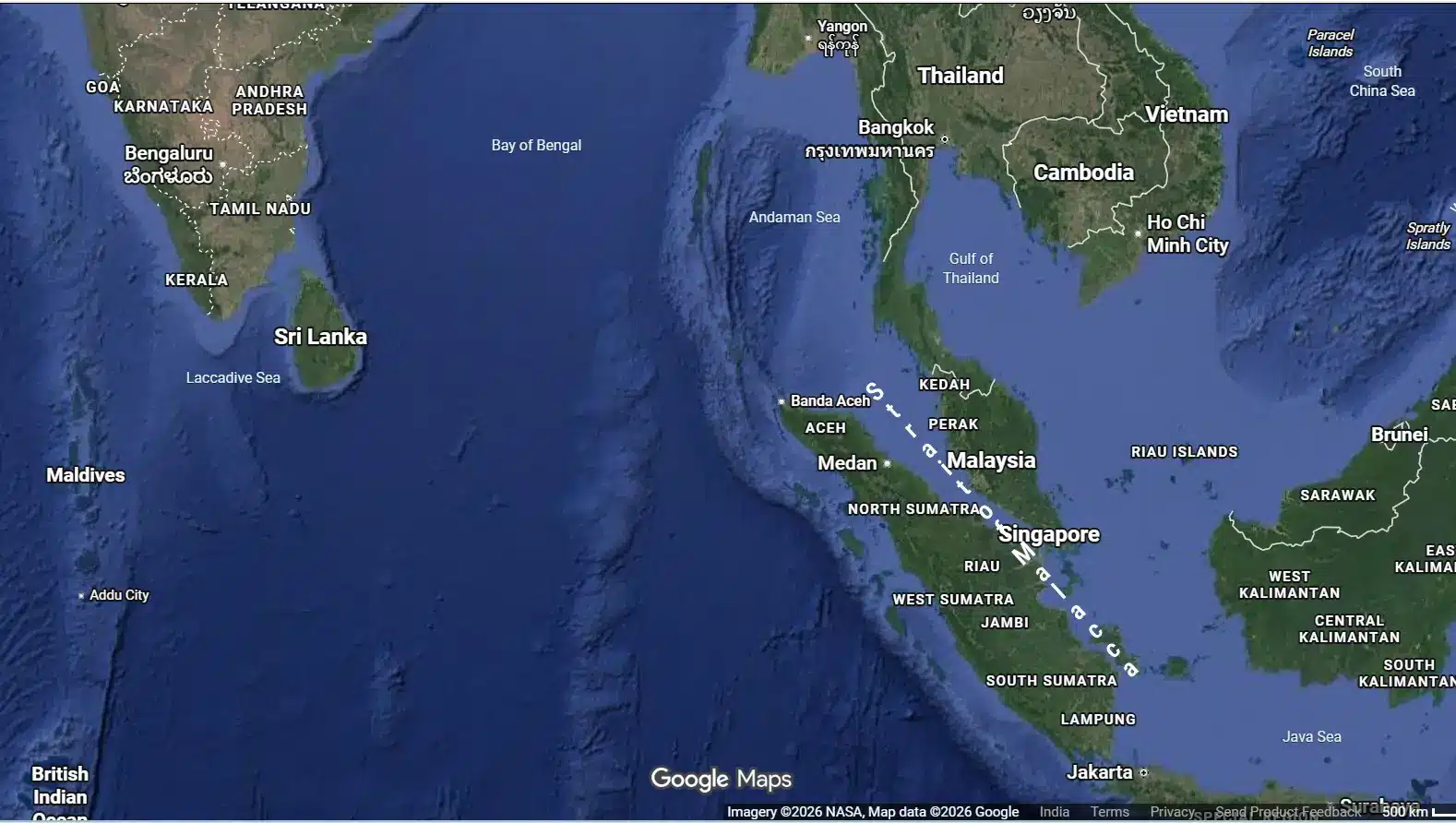
The numbers hardly justify such neglect. Approximately one-third of all seaborne trade passes through the Strait—roughly $1.5 trillion in annual commerce. For China alone, the figure is more consequential. Between 45% and 55% of Chinese crude oil imports transit the Strait of Malacca, along with substantial flows of liquefied natural gas destined for Tokyo, Seoul, and Singapore. In the reverse direction, Chinese-manufactured exports bound for Europe and America follow the same route. The Strait of Malacca is, in essence, an artery connecting the world’s largest manufacturing economy to its principal export markets.
The Strait of Malacca’s vulnerability lies not in its width—it spans roughly 900km at its broadest point, narrowing to 2.7km at the Pillars of Hercules equivalent, the Philip Channel—but in the political fragmentation of its littoral states. Malaysia, Singapore, and Indonesia share responsibility for enforcing maritime order within the Strait of Malacca’s territorial waters. No single power controls it, which has been a source of both stability and risk.
China’s strategic planners have been explicit about their anxiety. In 2003, former Chinese president Hu Jintao reportedly coined the term “Malacca Dilemma” to describe China’s vulnerability to a potential blockade of this critical chokepoint. The concern was not fanciful.
In 2011, Randall Schweller and Xiaoyu Pu published an influential analysis suggesting that energy chokepoints were among the most significant security vulnerabilities facing Beijing’s development model.
China’s response has been methodical: the China-Pakistan Economic Corridor (CPEC) aims to create an alternative route to the Arabian Sea; the China-Myanmar Economic Corridor (CMEC) pursues overland connectivity; the Belt and Road Initiative (BRI) has financed port development from Gwadar to Hambantota to Djibouti, creating a network of strategic alternatives to Strait of Malacca dependence.
India’s response, by contrast, has been less visible but no less revealing. Rather than creating alternative routes around the Strait of Malacca, New Delhi is building capabilities that could enhance its influence within and around it.
Great Nicobar: Infrastructure as strategy
The Great Nicobar Island sits at the southern extremity of India’s Andaman and Nicobar Islands chain, approximately 230km from the northern entrance to the Strait of Malacca, near the maritime boundary with Myanmar and Indonesia. The island already hosts a tri-service command of the Indian armed forces, reflecting its long-standing strategic value.
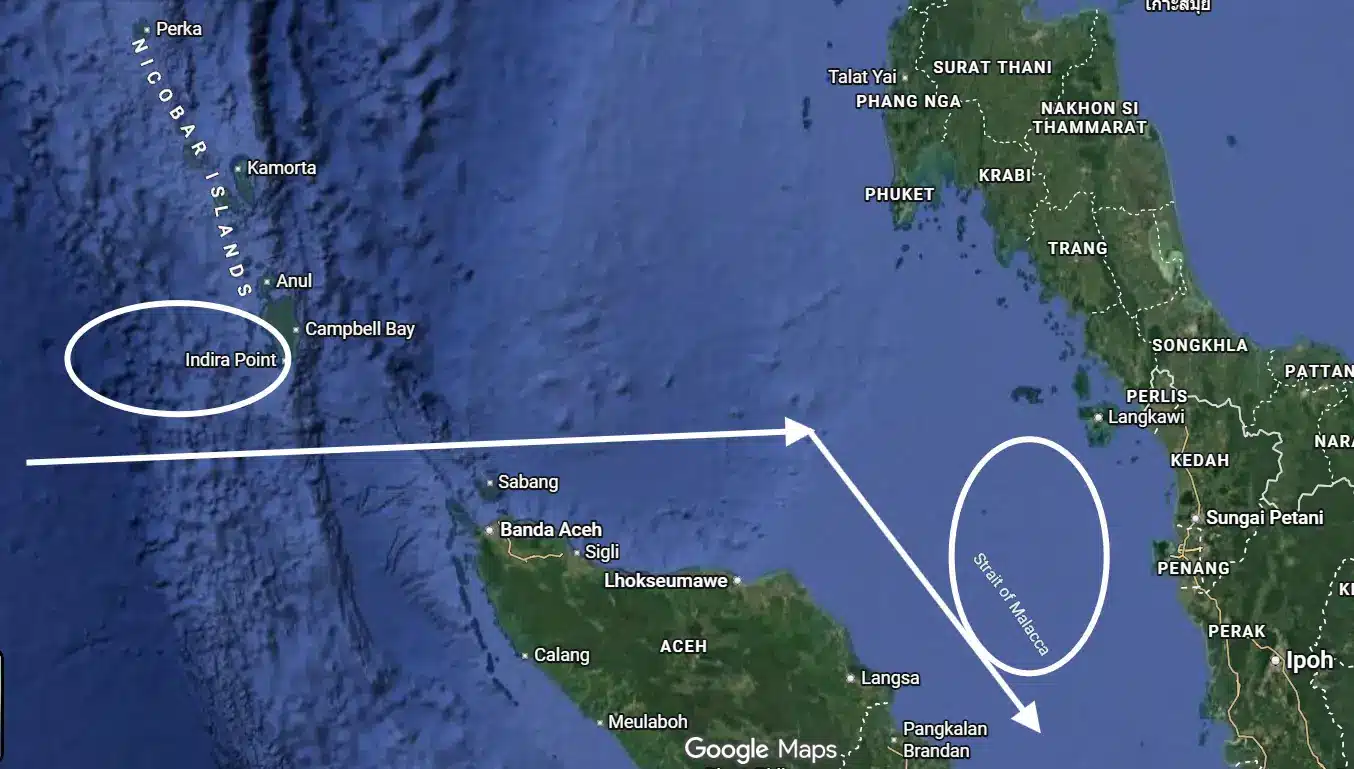
The Great Nicobar Project—formally approved by India’s National Green Tribunal in June 2026 after protracted environmental review—represents a substantial escalation of this presence. The project comprises multiple components, including a transhipment hub designed to intercept containerised cargo en route between West Asia, South Asia and East Asia; a civilian and military airport capable of accommodating large transport and surveillance aircraft; dedicated gas and solar power generation facilities; and a new township to house approximately 150,000 residents by the project’s completion in 2047.
The total cost is estimated at $9bn to $11bn, making it one of India’s largest infrastructure investments in the maritime domain. The project is structured in three phases, with the first focusing on port and airport infrastructure.
On its surface, the project is an economic and commercial proposition. India’s ports have struggled with capacity constraints as the country’s trade has expanded. Vizhinjam, a deep-water port developed in Kerala in the southwest, and Vadhavan, a planned mega-port in Maharashtra’s Palghar district, address India’s western and southern maritime trade requirements. Great Nicobar is framed as addressing eastern and regional trade in Southeast Asian markets.
By developing Great Nicobar as both a transshipment hub and a military facility, New Delhi is effectively positioning itself to influence maritime commerce at one of the world’s most important economic choke points.
Diplomatic architecture: Binding partners to a strategy
Viewed in isolation, India’s joint announcements with Indonesia, Australia and New Zealand during Mr Modi’s visit in July 2026 appear to be routine partnership maintenance. Yet the timing and sequencing reveal a different pattern.
Indonesia: Opposite gateway
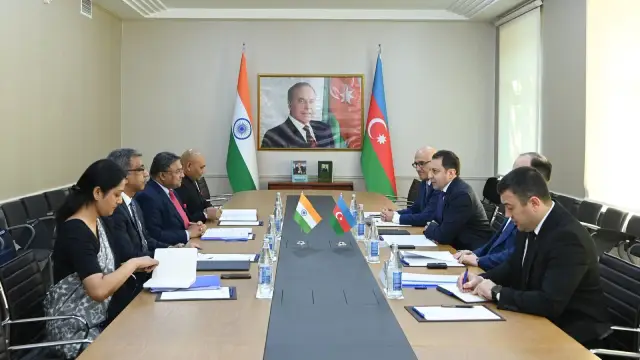
Indonesia occupies a peculiar position in the Strait of Malacca geography. The Strait is bounded on its western flank by Malaysia, on the north by Thailand, and on the eastern flank by Indonesia. Indonesia, in effect, controls the southern gateway to the Strait. The India-Indonesia Joint Statement of July 7th, captures the strategic significance of this proximity.
The document emphasises maritime cooperation, maritime domain awareness, information sharing and defence exercises. It references India as a potential contributor to Indonesia’s maritime security. It commits both countries to enhanced naval coordination and capacity-building. It discusses a “substantial upwards trajectory” in strategic partnership.
What is unsaid is perhaps more important than what is stated. Indonesia, under President Prabowo Subianto—who visited India as chief guest for India’s Republic Day celebrations in 2025—has not objected to India’s Great Nicobar development.
Moreover, Indonesia has also signed a “major defence cooperation partnership” with the US on April 14th, amid the Pentagon’s military adventurism in the Strait of Hormuz. Jakarta has consistently supported US President Donald Trump’s policies and has maintained a soft stance on Israel’s aggression against Gaza. It has been claimed that Mr Subianto has been enhancing strategic ties to help Indonesia use its geography as a lever to pressure China.
This is where India sees a confluence of geopolitical interests. As New Delhi, which is concerned over China’s growing status, tries to utilise its geography to keep a check on Beijing, Jakarta’s willingness to deepen defence ties reduces one potential obstacle to its eastern maritime strategy.
Australia: Providing strategic depth
Australia’s role in this emerging configuration differs from Indonesia’s. Australia lacks Indonesia’s geographic proximity to the Malacca Strait but provides strategic depth across the broader Indo-Pacific. The India-Australia Joint Declaration on Defence and Security Cooperation (July 9th) emphasises defence interoperability, joint exercises, mutual logistics support, and—significantly—the extension of defence partnership across “all domains.”
The declaration also notes with satisfaction the growing frequency and complexity of bilateral defence exercises and the establishment of an Annual Defence Ministers’ Dialogue as a formal institutional mechanism. In the language of alliance management, this represents institutionalisation—the conversion of ad-hoc cooperation into permanent bureaucratic structures.
Australia brings several assets to this configuration. First, it provides intelligence-sharing capabilities, particularly satellite imagery and surveillance of Chinese military activities across the Indo-Pacific. Second, it offers industrial collaboration on defence manufacturing, critical minerals supply chains, and advanced technology. Third, it positions India within broader Western technological and security ecosystems while maintaining strategic autonomy.
New Zealand: Expanding institutional architecture
New Zealand occupies a less militarily prominent position than Australia but plays a disproportionate role in shaping Indo-Pacific institutions. The India-New Zealand Strategic Partnership Roadmap to 2030 (announced July 11th) commits both countries to regular diplomatic engagement, defence cooperation through exercises and exchanges, maritime cooperation, and the expansion of intelligence dialogue.
New Zealand’s weight lies not in military capability—its defence spending is modest by regional standards—but in its diplomatic standing within ASEAN, the Pacific Island Forum, and various multilateral institutions. Wellington has consistently taken an anti-China stance that suits India’s long-term interests.
Soon after Mr Modi’s visit, New Zealand’s Foreign Minister Winston Peters commented that the country shouldn’t be fazed by any possible Chinese objection to its joining a new defence alliance. This came soon after Australia proposed an anti-China military bloc including Fiji and New Zealand.
“It’s important that Pacific countries and those seriously concerned about the long-term implications of such potential behaviour are resistant right here and right now, and that’s what we’re doing,” Mr Peters told the press.
According to Chinese experts, New Zealand is using the pretext of the People’s Liberation Army (PLA) Navy’s intercontinental ballistic missile test in the Pacific Ocean on July 6th to justify its participation in a future military bloc.
These developments are helping Mr Modi’s strategic interests that focus on leveraging the Strait of Malacca for India’s geopolitical gains.
The Quad question: why partnerships are fragmenting into minilaterals
A critical observer of Indo-Pacific diplomacy in mid-2026 would notice something conspicuous by its absence from India’s announcements: the Quad. The Quadrilateral Security Dialogue, comprising India, Australia, Japan, and the United States, was heralded in 2017 as the institutional foundation of a new Indo-Pacific order. It became a pivotal anti-China military entente over the years, according to Chinese geopolitical observers. Yet in the past 18 months, the Quad’s momentum has palpably slowed.
Several factors explain this slowdown. In January 2025, Mr Trump assumed his second presidency and rapidly recalibrated American foreign policy toward China by initiating a tariff war. Eventually he had to retreat after raising the tariffs to over 140% on imports, as the American industries and technology sector suffered.
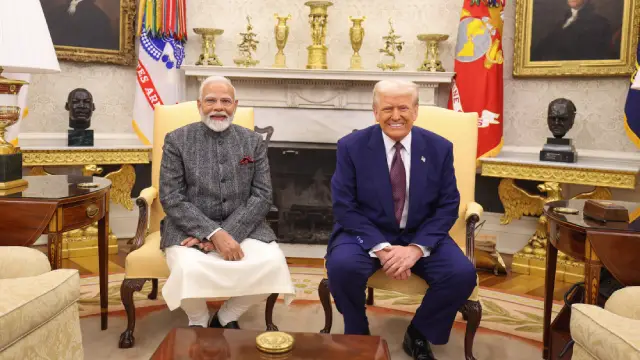
After suffering a setback in the 42-day war with Iran, Mr Trump visited China in May 2026, pursuing engagement where his predecessors had pursued containment. The Trump administration’s focus has been on reducing the US military footprint in Asia following the turbulence in West Asia. The US renegotiating alliance commitments created uncertainty about Washington’s long-term strategic commitment to Indo-Pacific balancing.
Secretary of State Marco Rubio visited India in May 2026 to participate in the foreign minister-level meeting of the Quad and remained non-committal about Mr Trump’s participation in the top summit of the body. This indicates that the US has been aiming at downgrading the status of Quad.
These developments coincided with Mr Trump’s maiden visit to Beijing, where Washington assured enhancing trade ties with its arch-rival. This indicated a shifting priority on White House’s strategy board, causing further inconvenience for India, which has acted as a junior partner of the US in the Indo-Pacific war theatre.
Simultaneously, the Trump administration pursued protectionist trade policies that collided with India’s development interests, particularly regarding agricultural and pharmaceutical exports. US engagement with Pakistan—deepened through military aid and strategic reassurance—cut against Indian regional interests in ways that previous administrations had attempted to manage more carefully.
These shifts have not destroyed the Quad. India, Australia, and Japan remain committed to the institution, and Japan’s Prime Minister, Sanae Takaichi, has herself visited India and reaffirmed the Quad’s importance. However, the framework’s capacity to drive coordinated Indo-Pacific strategy has diminished. In response, India has accelerated the development of bilateral and minilateral partnerships that can function independently of American commitment.
The India-Indonesia, India-Australia, and India-New Zealand announcements can be read as responses to this fragmentation. They represent a strategy of redundancy. If Quad-level coordination becomes uncertain due to the US, India will establish bilateral relationships and smaller groupings that serve similar strategic purposes.
This is not a rejection of the Quad framework. It is a hedge against its unreliability. India is building a portfolio of anti-China partnerships that can sustain strategic coordination in the Indo-Pacific even if the United States reduces its emphasis on the region or reorders its priorities.
Strategic autonomy versus strategic anxiety
How India’s own policymakers understand these developments remains contested, even within New Delhi. Two interpretations coexist, sometimes uneasily.
The first interpretation emphasises strategic autonomy. According to this view, India is behaving as it has for decades—maintaining a foreign policy unaligned with any single power, building relationships across the ideological spectrum, and prioritising India’s core interests above great-power rivalries. This is the language of Indian statecraft since the Cold War—Jawaharlal Nehru’s non-alignment doctrine translated into contemporary practice. From this perspective, India’s partnerships with Australia and New Zealand represent independent strategic calculation, not dependence on Western alignment.
A second interpretation emphasises strategic anxiety. India’s diplomatic acceleration, according to this reading, reflects anxiety about American reliability and uncertainty about the trajectory of US-India relations. If the Trump administration is willing to pursue protectionist tariffs against India, reset ties with Pakistan, and subordinate India’s Iran interests to a hardline posture toward Tehran, what confidence should New Delhi place in long-term American commitment?
Qian Feng, director of the Research Department at Tsinghua University’s National Strategy Institute, articulated this second interpretation in the Global Times in July 2026. According to Mr Qian’s analysis, the Trump administration’s transactional approach to diplomacy has eroded strategic trust between New Delhi and Washington. The administration prioritises American interests in ways that disregard Indian regional interests. Under these conditions, Mr Qian argues, India is rationally diversifying its partnerships to reduce dependence on any single power.
There is empirical weight to this argument. India’s Ministry of External Affairs has, in recent months, emphasised dialogue with China, deepened economic engagement with Southeast Asia, and expanded defence relationships with countries not necessarily aligned with Washington. This is observable diversification, not strategic imagination, geopolitical experts believe. It reflects a shift in India’s cost-benefit calculation regarding alignment.
Yet the autonomy interpretation is not baseless either. India has, throughout the Modi period, maintained relationships with Russia despite Western pressure, pursued independent economic policies despite IMF or World Bank preferences, and refused to formally join alliances even when partnership has deepened. The partnerships with Australia, Indonesia and New Zealand, viewed through this lens, represent India exercising agency in defining its role in the Indo-Pacific rather than following Washington’s script.
The truth is likely contextual. India is simultaneously asserting autonomy and responding to uncertainty about American reliability. These are not contradictory positions. Rather, they reflect New Delhi’s calculation that strategic autonomy now requires building partnerships against China’s rise that can function independently of Washington’s preferences.
China’s decades-long hedge against Strait of Malacca vulnerability
If India’s strategy around the Strait of Malacca is a recent development, China’s anxiety about Malacca is not. Beijing has been explicit and sustained in its concern about dependence on a chokepoint it does not control.
China’s response has been multifaceted. The CPEC, finalised in 2015 and now substantially operational, provides overland connectivity from Gwadar port in Balochistan to western China, bypassing maritime routes entirely. The Gwadar port itself—developed with Chinese capital and operated under Chinese management agreements—serves as an alternative outlet for Chinese commerce, particularly for western China’s energy and manufactured goods.
The CMEC pursues similar logic through overland rail and pipeline infrastructure. The strategic railroad connecting Yunnan province through Myanmar to India’s northeast (though Chinese ambitions for this route exceed the current construction phase) envisages an alternative maritime-to-land substitution for trade flows.
China has also built the China-Europe rail freight and has been investing in the crucial International North-South Transport Corridor.
Within the maritime domain itself, China has pursued port development across the Indian Ocean littoral—in East Africa (Djibouti, Kenya), South Asia (Sri Lanka‘s Hambantota, Bangladesh‘s Chittagong), the western Indian Ocean (United Arab Emirates, Oman), and Southeast Asia (Cambodia). These facilities serve commercial purposes but also create nodes in a network of Chinese strategic presence that reduces (though cannot eliminate) China’s dependence on any single maritime chokepoint.
China’s military presence in the Indian Ocean has similarly expanded. The establishment of a military facility at Djibouti in 2017 provided China with its first permanent overseas military base. The presence of Chinese intelligence vessels in the Indian Ocean and the regular deployment of PLA Navy frigates and destroyers through Asian waters have grown substantially since 2015.
Beijing’s underlying logic is simple—if one chokepoint becomes contested or coercible, alternatives exist. This redundancy is expensive and time-consuming to build, but it is, in Chinese strategic calculation, a necessary investment in reducing vulnerability to coercion.
India, by contrast, is pursuing the inverse strategy—not creating alternatives to Malacca, but increasing its influence around the Strait. This is not a hedge against China alone. It is a positioning for influence in a region where maritime commerce remains central to economic activity and where geography can amplify strategic power.
Global economy and politics of uncertainty
This is the moment for analysis to step back from the Indo-Pacific rivalries and ask: what implications does this strategic competition hold for economies far removed from maritime Asia?
The answer is not straightforward because the mechanisms of disruption are multiple and operate through different channels.
Direct shipping impacts
The most obvious channel is direct impact on shipping costs and insurance premiums. The Strait of Hormuz, during the Iran-US confrontation, saw shipping premiums spike by 5 to 10% within weeks of heightened tensions. Fuel surcharges and insurance costs represent significant variables in global logistics, feeding through to retail prices, manufacturing competitiveness, and inflation measures.
If India’s capabilities around Great Nicobar were ever perceived as potentially threatening to maritime traffic—a hypothetical unlikely under normal circumstances but possible during an acute crisis—shipping insurance premiums for vessels transiting the Strait of Malacca would adjust immediately. Owners of cargo destined for Europe or the west would demand higher rates or reroute shipping entirely, adding days to transit times.
Commodity price transmission
The Malacca Strait is, in economic terms, the critical artery through which energy and materials flow from the Middle East and Africa to Asia’s manufacturing economies. Approximately one-quarter of global LNG passes through the Strait. Approximately 45% of Chinese crude oil imports traverse Malacca. Substantial percentages of Southeast Asia’s energy security depend on trade through these waters.
Any sustained increase in uncertainty about maritime access would manifest in commodity markets rapidly. Oil prices would adjust upward. LNG spot prices would increase. Thermal coal prices would spike. These commodity prices, in turn, feed through to energy costs across Europe and North America. An increase of $5 to $10 per barrel of oil, sustained over quarters, represents a material shock to inflation profiles and central bank policy calculations.
Supply chain complexity
Malacca’s vulnerability matters not because a blockade is probable but because modern supply chains operate with minimal buffer inventory. Just-in-time manufacturing means that disruptions to shipping lanes—even temporary ones—rapidly cascade through production networks.
Consider semiconductors, the inputs to which transit multiple sea lanes multiple times during the manufacturing process. Silicon wafers manufactured in Taiwan transit through Malacca to Malaysia for assembly, then through Malacca again en route to Singapore for testing, then again through the Strait bound for final assembly in South Korea or Japan. If maritime transit through Malacca were delayed by 10 days due to heightened security measures or perceived instability, semiconductor production across East Asia would face simultaneous input delays, compounding manufacturing disruption.
The cost of this disruption would not be borne by Asia alone. European manufacturers depend on East Asian semiconductors, precision components, and manufactured goods. Any disruption to Malacca affects European production competitiveness within weeks.
Politics of strategic uncertainty
Perhaps most consequentially, heightened strategic rivalry around Malacca introduces persistent uncertainty into logistics planning. Shipping companies, insurance markets, and manufacturing firms must make decisions about routing, timing, and risk premiums without clarity about whether the current regime—freedom of navigation, low-cost transit, predictable shipping lanes—will persist.
This uncertainty itself has an economic cost. Firms build precautionary inventory, invest in alternative logistics networks, and reduce reliance on just-in-time manufacturing—all activities that add expense and reduce efficiency. The “Malacca risk premium,” even if never actualised in a physical disruption, manifests in higher logistics costs across global supply chains.
For Europe, which imports the majority of its manufactured goods and materials through Asian maritime corridors, this risk premium represents a tax on competitiveness imposed by geopolitical developments thousands of kilometres away.
Zero-sum Indo-Pacific: Structural question
At the heart of these developments lies a structural question that remains inadequately examined: is the Indo-Pacific becoming an arena of competing interests that can only be satisfied through zero-sum accommodation? Or do mechanisms exist through which strategic competition can coexist with economic cooperation?
The evidence points in both directions simultaneously. On one hand, the behaviour of major powers—India, China, the United States, Australia, Japan—suggests they view maritime geography, port infrastructure, and strategic presence as finite goods. If India increases its leverage around Malacca, China’s autonomy in that corridor declines. If China develops alternative corridors (through CPEC and CMEC), it reduces the leverage that any single power can exert. This is the logic of beggar-thy-neighbour competition.
Yet Asia’s economic integration, despite strategic rivalry, remains substantial. China and India trade. India and Australia trade. The United States and China remain deeply integrated in supply chains despite military competition. These economic relationships create incentives for restraint that pure strategic logic might not support.
The question is whether these incentives are sufficient to prevent an escalatory cycle. The Malacca Strait has not been a flashpoint because no power has chosen to make it one. India’s development of Great Nicobar and Australia’s deepening defence ties need not trigger Chinese retaliation if Beijing calculates that acceptance of India’s enhanced role is preferable to reciprocal escalation. This is the language of rational deterrence and strategic stability.
Yet deterrence is stable only if both sides accept the status quo as preferable to alternatives. If China perceives Great Nicobar as an unacceptable constraint on its strategic autonomy, or if India perceives China’s corridor development as an encroachment on its regional interests, the logic inverts toward conflict.
Geopolitics of regional frameworks
One mechanism through which zero-sum competition might be moderated is through inclusive regional institutions. The ASEAN Regional Forum, the East Asia Summit, and ASEAN-centred security dialogues explicitly include all major powers and emphasise consensus-based decision-making and institutional constraint on unilateral action.
India and China are both members of these frameworks. Indonesia, which chairs ASEAN, has an explicit interest in preventing great-power rivalry from destabilising Southeast Asia. The India-Indonesia Statement emphasises maritime cooperation within ASEAN frameworks, suggesting Delhi’s intention to pursue its strategic interests within institutional constraints rather than through unilateral action.
Australia and New Zealand, conversely, operate outside ASEAN frameworks, which may constrain their ability to influence how India’s and China’s rivalry is managed at the regional level. The Quad framework, if it functions as intended, provides a mechanism for coordinating policy among the members of the anti-China bloc. Yet the Quad’s reduced momentum, discussed earlier, means this coordinating mechanism is currently underpowered.
Geography as destiny—or as choice?
The Strait of Hormuz reminded the world that geography can shape strategy as profoundly as military power or economic weight. Iran, despite its relatively modest military capabilities, demonstrated how control over a maritime chokepoint could influence the calculations of far stronger adversaries. For major powers accustomed to assuming uninterrupted access to global trade routes, the lesson was difficult to ignore.
India’s investment in Great Nicobar suggests New Delhi has drawn its own conclusions. The island is more than an infrastructure project. Together with India’s expanding defence partnerships across the Indo-Pacific, it represents an effort to convert geography into strategic leverage at the gateway to one of the world’s most important maritime corridors.
Whether Great Nicobar ultimately emerges as a commercial hub, a strategic deterrent or another point of geopolitical friction will depend less on the island itself than on how Asia’s major powers choose to compete. China is investing in alternative trade corridors to reduce its dependence on the Strait of Malacca. India is strengthening its position around the Strait through infrastructure, diplomacy and military cooperation. Both strategies seek to reduce vulnerability, but together they also risk reinforcing a cycle in which every new hedge encourages another.
The broader consequence extends beyond Asia. For three decades, globalisation has rested on the assumption that the world’s busiest sea lanes would remain open, predictable and politically neutral. If maritime chokepoints increasingly become instruments of strategic competition rather than conduits of commerce, the costs will not be borne by India or China alone. They will be reflected in supply chains, commodity markets and the wider global economy.
The real question, therefore, is not whether geography matters—it always has. It is whether the Indo-Pacific’s emerging powers can transform strategic geography into a source of deterrence without turning the region’s economic lifelines into the next front line of great-power rivalry.
East Post is an independent geopolitical analysis portal covering South Asia and global power dynamics for international audiences. Views expressed are analytical and do not constitute endorsement of any state or non-state actor.
Join our channels on Telegram and WhatsApp to receive geopolitical updates, videos and more.