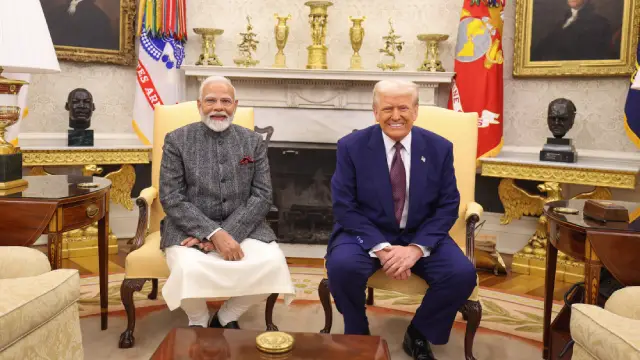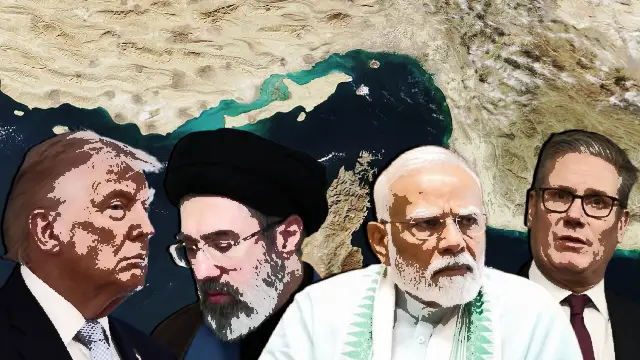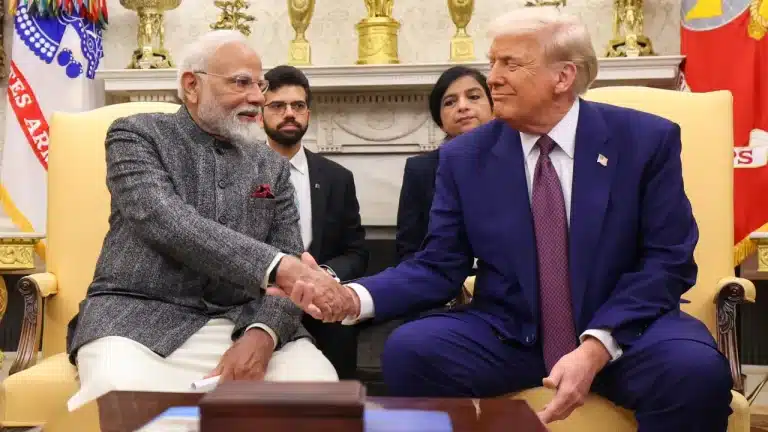
As Prime Minister Narendra Modi prepares to sit across the table from US President Donald Trump at the 2026 G-7 Summit in Évian-les-Bains, France, on June 17th, three Indian sailors lie dead — killed not by a hostile adversary, but by the forces of India’s most consequential strategic partner. In the first fortnight of June, American naval forces struck three commercial vessels in the Gulf of Oman. One such strike killed three Indian crew members aboard the Palau-flagged tanker MT Settebello. India’s Ministry of External Affairs (MEA) summoned the US chargé d’affaires, Jason Meeks, and “lodged a strong protest,” describing the attacks as “tragic and avoidable.” Mr Modi himself has said nothing.
That silence — absolute, deliberate, and growing louder by the day — is the defining political fact of Mr Modi’s journey to France. At the G-7 Summit, he will smile for the cameras, press ahead with trade talks, and advocate for a multi-billion-dollar infrastructure corridor that runs through Israel. What was expected was a summit that would cement India’s standing as an independent global power. Instead, it is shaping up as a demonstration of how far that independence extends — and where it stops.
US attacks on ships in Gulf of Oman: What happened and who died
The sequence of US attacks on ships in the Gulf of Oman unfolded across five days in early June, and each strike added to the diplomatic pressure accumulating around Mr Modi’s summit schedule.
On June 8th, American forces struck the Palau-flagged oil tanker Marivex. All 24 crew members were rescued by the Royal Oman Navy. Two days later, on June 10th, the MT Settebello was hit. Three of its 24 Indian crew members were killed—Aditya Sharma, a cadet; Shivanand Chaurashiya, a fitter; and Patnala Suresh, a chief engineer. On June 11th, American forces struck again — this time the Guinea-Bissau-flagged MT Jalveer. The Royal Oman Navy carried out rescue operations; the crew survived. The Indian government confirmed that US naval forces had carried out all three strikes, noting that two of the vessels were under US sanctions and a third was deemed non-compliant with Washington’s oil embargo against Iran.
India’s formal response was, by New Delhi’s standards, unusually pointed. The MEA summoned Meeks and “deeply protested” the use of “lethal and deadly force” against civilian shipping, warning that such actions “undermine the safety, security and stability of international maritime commerce in a sensitive region at a difficult time.”
The MEA used the term “summoned” for Mr Meeks, unusual in its diplomatic parlance, to emphasise the gravity of the situation.
Yet Mr Modi — who has cultivated an image as a strongman capable of confronting Pakistan across the Line of Control and launching cross-border operations against militants — has offered no public rebuke of Mr Trump, no statement of condolence naming the circumstances of the three sailors’ deaths, and no indication that the matter will be raised at the G-7 Summit in France.
Over the next few days, I will be in France and Slovakia to attend various programmes, including bilateral talks, multilateral engagements and interaction with the Indian diaspora. The focus will be on boosting economic as well as cultural linkages.
— Narendra Modi (@narendramodi) June 13, 2026
The visit will begin with…
Two narratives, one phone call
A telling divergence has emerged over what actually transpired during the telephone conversation between External Affairs Minister S Jaishankar and US Secretary of State Marco Rubio following the Indian sailors’ deaths.
According to India’s account, Mr Jaishankar raised strong objections to the US attacks on ships carrying Indian crew. The minister’s social media post presented this as a firm protest in keeping with the MEA’s public position.
Spoke to US Secretary of State Marco Rubio this evening. I reiterated India’s strong protest at the attacks by the US Navy in the Gulf that killed three Indian mariners. Such lethal actions against commercial shipping are not justified.
— Dr. S. Jaishankar (@DrSJaishankar) June 12, 2026
The US Department of State offered a materially different characterisation. In its readout, the State Department stated: “The Secretary stressed that all commercial vessels should immediately comply with orders from U.S. forces as they seek to uphold peace and security in the Strait. He underscored that violations of the U.S. blockade and the illicit transport of Iranian oil will not be tolerated (sic).”
No apology was issued. Neither the Department of State nor the Pentagon acknowledged any wrongdoing. What emerged from the US readout was not a concession to Indian concerns but a warning— vessels that Washington judges to be in violation of its self-declared blockade in the Strait of Hormuz remain at risk of military action. India’s response, in the American account, registered as a minor friction to be managed, not a demand to be met.
Critics in New Delhi have noted the implication. If Washington’s position is that it will continue striking ships it deems non-compliant, and India has not secured even an expression of regret, the protest amounts to diplomatic paperwork rather than a change in American conduct.
India’s Iran paradox: Solidarity without reciprocity
The contrast between India’s posture and Tehran’s response has not gone unnoticed.
Iran, which has watched Mr Modi maintain distance from its government throughout the American-Israeli military campaign — a campaign that killed the Iranian supreme leader, military commanders and civilian officials — nonetheless chose to condemn the attacks on Indian sailors with unusual force.
Iranian Foreign Ministry Spokesperson Esmaeil Baqaei wrote on X: “The brutal US attacks on Indian commercial vessels which have killed at least three Indian nationals stand as clear evidence of America’s ongoing policy of armed robbery and state piracy. The international community must hold the United States accountable for its lawless conduct, which continues to threaten global peace and security while endangering the freedom of navigation.”
The brutal U.S. attacks on Indian commercial vessels which have killed at least three Indian nationals, stand as clear evidence of America’s ongoing policy of armed robbery and State piracy.
— Esmaeil Baqaei (@IRIMFA_SPOX) June 11, 2026
We extend our sympathies to the families and friends of the slain Indian sailors and…
The irony is structural. Iran, the target of American and Israeli military action, is demanding accountability for India’s dead — while India, whose citizens were killed, has declined to do so.
Mr Modi’s government did not condemn the killing of Iranian civilians or top officials during the American-Israeli campaign against the Islamic Republic. When Iran struck US military assets positioned in Gulf states, Mr Modi expressed solidarity with those monarchies — formal allies of Washington and Tel Aviv. In May, Mr Modi signed a mutual defence pact with the United Arab Emirates, which, according to the office of Israeli Prime Minister Benjamin Netanyahu, hosted him during the height of the conflict. India’s participation in BRICS and the Shanghai Cooperation Organization‘s declarations condemning the American-Israeli campaign on Iran represent a formal posture that has not translated into practical consequences for either bilateral relationship with the US or Israel.
IMEC calculation: Trade, infrastructure and whose interests
Mr Modi’s presence at the G-7 Summit in France is not primarily about diplomacy. It is about a connectivity project whose financial architecture reveals who, beyond the Indian state, stands to benefit from these alliances.
The India-Middle East-Europe Economic Corridor (IMEC) was announced at the 2023 G-20 Summit in New Delhi as a potential alternative to China‘s Belt and Road Initiative, running from India’s west coast through Gulf ports to Israel’s Haifa Port and into European markets. France, Italy, the United States, Japan, and key European Union members are all stakeholders. Mr Modi will use the summit in France to press for IMEC’s implementation.
The project has been rendered largely dormant since Israel’s military campaign in Gaza, Lebanon, Syria, and Iran disrupted the political conditions in which Gulf monarchies were willing to participate. Saudi Arabia, a key node in the planned route, has publicly cooled on the project. Yet India continues to promote it.
Critics have noted the reason for that enthusiasm goes beyond national strategy. Adani Ports and Special Economic Zones, the port conglomerate owned by billionaire Gautam Adani — who critics say maintains close ties to Mr Modi’s ruling Bharatiya Janata Party — operates India’s largest port at Mundra, the planned IMEC gateway on India’s west coast. In 2022, Adani Ports acquired a 70% stake in Israel’s Haifa Port, the corridor’s intended Mediterranean terminus. Mr Adani has publicly described the Haifa acquisition as having “immense strategic and historical significance for both nations.” Reports suggest the group is also eyeing port infrastructure in Greece, which would slot into the IMEC route through Europe.
Reliance Industries, another corporate giant with close ties to the government, features in the same geopolitical architecture. In March 2026, Mr Trump announced a $300bn oil refinery investment in Texas backed by Reliance — a deal explicitly framed by the White House as a mechanism to reduce America’s trade deficit with India.
Against this backdrop, India’s reluctance to confront Washington over the deaths of three sailors in the Gulf of Oman acquires a different character. It is not merely diplomatic caution. It is, critics argue, the arithmetic of commercial dependence.
On trade, the two countries have been working towards an interim deal — a framework under which the US would reduce tariffs on Indian goods from 25% to 18%, while India would commit to $500bn in American imports over five years, including oil, aircraft, and technology. Legal challenges in the US paused those talks. With the G-7 Summit in France now weeks away, negotiations have restarted, with officials aiming at a first tranche by mid-July. Mr Modi is not arriving at Évian to raise the matter of Indian sailors killed in the Gulf of Oman. He is arriving to sign agreements tying India to the collective West.
Opposition backlash: Voices Modi has not silenced
The killing of the three sailors has fractured the normally reliable consensus between Mr Modi’s government and India’s pro-establishment media and military commentators, producing the most sustained criticism of the prime minister’s foreign policy posture in recent memory.
Rahul Gandhi, leader of the Indian National Congress (INC) and of the parliamentary opposition, was direct. “When any foreign power murders an Indian, the Prime Minister has to speak up. But heaven forbid he should utter even one word,” he wrote on X. “Next week at the G-7, just days after the murder of our sailors, Modi ji will smile, embrace, and sign agreements — but for those three Indians, he won’t have a word to spare,” Mr Gandhi said. “A compromised PM cannot protect the sons of Mother India, because he lacks either the courage or the strength to confront those who took the lives of those sons,” he added.
अन्तर्राष्ट्रीय जल में तीन दिन में तीन जहाज़ों पर अमेरिकी हमलों में तीन भारतीयों की मृत्यु हो गई। और हमारे Compromised PM? एक शब्द तक नहीं।
— Rahul Gandhi (@RahulGandhi) June 12, 2026
जब कोई विदेशी ताकत किसी भारतीय की हत्या करे, तो प्रधानमंत्री को बोलना पड़ता है। लेकिन मजाल है जो ये एक शब्द बोल जाएं।
अगले हफ्ते G7 में,…
INC spokesman Pawan Khera was equally pointed, targeting Mr Jaishankar’s diplomatic language directly. “‘Not justified?’ That is the phrase you use for an overpriced airport sandwich, not for a military strike that kills civilians,” Mr Khera wrote. “The appropriate words for America’s actions are: illegal, reckless, and unacceptable. Instead, we got the kind of carefully sterilised euphemism that manages to offend no one — except the families of the dead,” he added.
India should have demanded – and received – an unconditional apology for the killing of three young Indian sailors in an American military strike.
— Pawan Khera 🇮🇳 ಪವನ್ ಖೇರಾ (@Pawankhera) June 13, 2026
Instead, Secretary Rubio reportedly chose to issue a warning, declaring that failure to comply with the orders of the U.S. military… pic.twitter.com/5BSoYnVqyl
The Communist Party of India (Marxist) [CPI(M)] issued a statement that went further. “Such arrogance from Washington is possible only because the Modi government refuses to stand up for India’s sovereignty and its citizens. The US knows there will be no consequences, no accountability, not even a public condemnation. Indian lives are not expendable. India must unequivocally condemn this attack, demand justice for the sailors killed, and reject this shameful surrender of sovereignty,” the CPI(M) said in its statement.
The US kills 3 Indian sailors. The MEA refuses to name the US. Modi continues to praise the "India-US strategic partnership."
— CPI (M) (@cpimspeak) June 13, 2026
Now the US State Department's account of the Rubio-Jaishankar call does not even express regret for the Indian lives lost.
This is what subservience… pic.twitter.com/g77qs48FTh
However, it’s not just the INC or the CPI(M) attacking the government’s stance.
What has been politically significant is that the criticism has not remained on the left.
Major General (Retd) Gagan Deep Bakshi, one of India’s most recognisable pro-government television commentators and a consistent defender of Mr Modi’s military decisions, warned at a television debate that the US is treating India as a “doormat” — and that if India behaves like one, it will be treated as one.
INDIAN LIVES MATTER.3 Indian ships have been attacked by the Americans and 3 innocent unarmed Indians murdered. Video clips show the ship was static. No transcripts of communications between ship and US Navy have been provided. 90% of Iran,s oil goes to China. Reportedly over…
— Maj Gen (Dr)GD Bakshi SM,VSM(retd) (@GeneralBakshi) June 13, 2026
Major General (Retd) Bishamber Dayal, another fixture of India’s television news ecosystem, flatly rejected the suggestion that the US strikes on ships with Indian crew were accidental, and questioned why New Delhi had not escalated the matter to the United Nations.
THIS IS WHAT REAL ANGER LOOKS LIKE 🔥
— Mr Sharma (@sharma_views) June 13, 2026
MANAK: Are we moving toward “No one killed the three Indians”?
MAJ. GEN. DAYAL 🎯: No. Americans killed them. Why should we accept this? A case should be filed against the American ship, the owner and the man who gave the order.
MANAK:… pic.twitter.com/1hSqxa6BK7
Even former BJP parliamentarian Subramanian Swamy — a Hindu nationalist critic of Mr Modi from within the right — condemned the prime minister’s restraint.
“India should ask the US Ambassador in New Delhi to go back to Washington and remain there unless the US expresses regret for the reckless killing of our citizens on sea. But Modi is a pussycat before Donald. He shivers before him,” Mr Swamy wrote on X.
India should ask US Ambassador in New Delhi to go back to Washington and remain there unless US expresses regret for the reckless killing of our citizens on sea. But Modi is a pussy cat before Donald. He shivers before him.
— Subramanian Swamy (@Swamy39) June 13, 2026
Mr Swamy had previously alleged that Mr Modi’s presence in Jeffrey Epstein’s contact files is being leveraged by Mr Trump — an unverified and contested claim, but one that speaks to the degree to which far-right scepticism of the Modi-Trump relationship has deepened.
What the G-7 Summit in France will — and will not — produce
Mr Modi’s summit diplomacy in France has a predictable shape. He will position India as an emerging artificial intelligence hub, a growing data centre economy, and a post-pandemic manufacturing alternative to China. He will promote the trade framework being finalised with Washington. He will advocate for IMEC. He will meet Mr Trump.
What he will not do — or, more precisely, what India’s record and its current trade and infrastructure calculus make vanishingly unlikely — is publicly name the three sailors killed in the Gulf of Oman or demand American accountability in Mr Trump’s presence. Doing so would antagonise not only the US but France, Italy, and the EU members who share a stake in the corridors of capital that IMEC represents.
There is also a harder geopolitical calculation at work. India had previously signalled interest in joining a UK-led coalition aimed at forcibly reopening the Strait of Hormuz to aid American operations. That it has not done so while also failing to condemn the blockade places it in an increasingly narrow channel: too aligned with Washington to stand with Tehran, too reliant on Gulf states to oppose the blockade, and too commercially invested to pay the cost of confrontation.
The gap between India’s stated doctrine and its demonstrated behaviour has rarely been so visible. Strategic autonomy — the principle that India can engage all powers without becoming a client of any — requires the capacity to impose costs when alliances cross red lines. At this G-7 Summit in France, Mr Modi will demonstrate that when the US kills Indian sailors in the Gulf of Oman, no such cost exists.
For European observers who have tracked American and Israeli military operations across West Asia, the question Mr Modi’s appearance in France poses is not whether India is a reliable partner. It is whether a country that cannot openly protest the killing of its own citizens by a strategic ally — and sends its prime minister to sign trade deals with that ally days later — can meaningfully be called independent at all.
Mr Modi has declined to answer that question. The summit in France will not change the facts and his attitude.
East Post is an independent geopolitical analysis portal covering South Asia and global power dynamics for international audiences. Views expressed are analytical and do not constitute endorsement of any state or non-state actor.
Join our channels on Telegram and WhatsApp to receive geopolitical updates, videos and more.