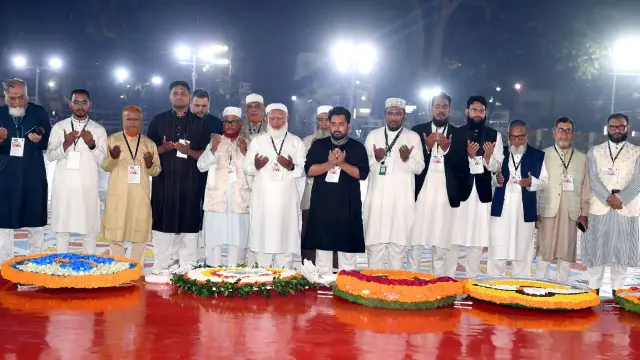
On June 7th, West Bengal minister Dilip Ghosh attended a commemoration at the US Consulate in Kolkata marking the 2002 terrorist attack on the American Center. Organised with the participation of Kolkata Police and US diplomatic officials, the event honoured the police personnel who lost their lives in the assault and reaffirmed bilateral security cooperation.
The terrorist attack on the American Center, Kolkata, on 22nd January 2002 remains a solemn reminder of the supreme sacrifice made by brave Kolkata Police personnel in the line of duty. Their courage, dedication and unwavering commitment to protecting the city continue to inspire… pic.twitter.com/VOiS5D00sl
— Kolkata Police (@KolkataPolice) June 7, 2026
The image that emerged from the event, however, was not merely one of remembrance.
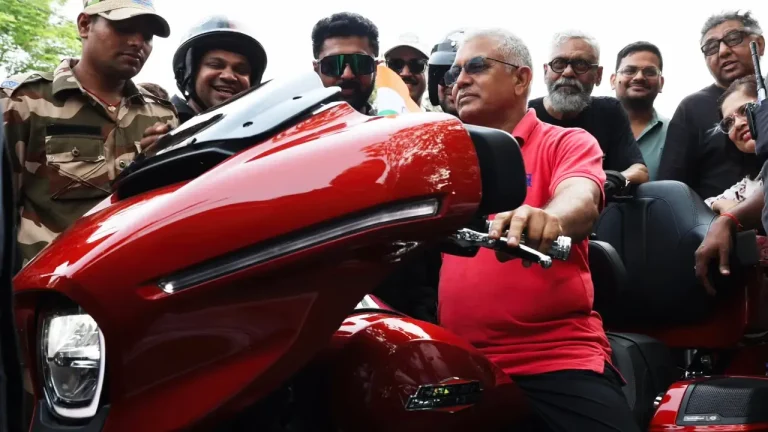
Photographs and videos shared by Mr Ghosh, a veteran leader of Prime Minister Narendra Modi’s far-right Bharatiya Janata Party (BJP), showed him riding a Harley-Davidson motorcycle, one of the most recognisable American consumer brands. Viewed in isolation, there would have been little reason to read political significance into the moment. Ministers attend diplomatic functions routinely. Motorcycles are, after all, motorcycles.
Yet politics often acquires meaning through context rather than through individual acts.
Just two hours earlier, Mr Ghosh had posted images of himself participating in a cycling campaign promoting sustainable transport.
Mr Ghosh’s appearance at the US Consulate in Kolkata also came amid renewed debate over India-US trade negotiations, ongoing allegations by BJP leaders of an “American deep state”interfering in Indian politics, and a controversial campaign against hawkers and informal vendors in parts of West Bengal.
Taken together, those developments reveal a set of contradictions extending far beyond a motorcycle ride.
They raise questions about the relationship between India’s strategic-autonomy narrative, its economic engagement with Washington, its environmental commitments and its model of urban development.
‘Deep state’ and deepening partnership
For much of the past two years, sections of the BJP ecosystem have repeatedly argued that foreign actors are attempting to shape Indian politics. They blame all Opposition activities as espionage activities funded by the US “deep state”, a term borrowed from US President Donald Trump’s 2016 campaign.
Billionaire George Soros has frequently been invoked by BJP leaders and supporters as a symbol of alleged external interference. India’s key opposition figures, especially Indian National Congress’s (INC) Member of Parliament Rahul Gandhi, are often portrayed by the Hindu nationalist ruling party as funded by the “deep state”.
These allegations intensified during recent political controversies, including protests over examination irregularities, unemployment, and governance failures by a newly founded Gen-Z outfit.
The argument has become familiar.
India, according to this narrative, faces not merely domestic opposition but coordinated pressure from international networks seeking to influence its political trajectory. The BJP-affiliated far-right rabble-rousers claim that the American “deep state”, Pakistani intelligence and the Communist Party of China are jointly acting behind the stage to destabilise Mr Modi’s government.
Although Mr Trump’s administration has repeatedly claimed that it’s not involved in any “regime change” operation unlike its predecessors, the BJP-affiliated Hindutva camp has not stopped lambasting the Opposition for having ties with the “deep state”.
Whether one accepts that interpretation or not, it has become an important element of the BJP’s political discourse.
Yet this narrative exists alongside a parallel reality.
India and the US continue to deepen strategic, military and economic cooperation under Mr Modi. Defence ties have expanded. Technology partnerships have multiplied. Diplomatic engagement remains intensive. Trade negotiations continue despite periodic tensions.
The contradiction is not unique to India. States frequently cooperate with powers they simultaneously criticise.
What makes the contradiction striking in this instance is the symbolism.
A political ecosystem that often warns against American influence also seeks closer economic integration with Washington. A minister representing that ecosystem arrived at a US diplomatic event and rode one of the most iconic American consumer products ever exported abroad.
The image does not invalidate concerns about foreign influence.
It does, however, illustrate the growing distance between the language of political mobilisation and the realities of statecraft.
Strategic autonomy meets Trump’s trade pressure
The Harley-Davidson itself carries political baggage.
For years, Mr Trump repeatedly cited Harley-Davidson when criticising Indian trade policy. The American manufacturer became one of the most visible symbols of Washington’s demand for greater market access in India.
Mr Trump argued that Indian tariffs discriminated against American products. Harley-Davidson became a recurring example in speeches, interviews and trade discussions.
New Delhi eventually reduced tariffs on imported motorcycles as part of broader efforts to manage trade relations with Washington.
Supporters of the move argued that tariff reductions were a practical necessity. India could not afford a prolonged trade confrontation with the world’s largest economy. Maintaining access to American markets and avoiding punitive tariffs, which Mr Trump imposed despite Mr Modi’s bonhomie with him, required compromise.
Critics viewed the development differently.
They argued that the negotiations reflected an increasingly asymmetric relationship in which Washington used economic leverage to extract concessions. Harley-Davidson, from this perspective, became a symbol not of free trade but of the unequal bargaining power that often characterises economic relations between advanced and developing economies.
The broader trade discussions remain fluid. The Harley-Davidson episode showed how India, which enjoyed a trade surplus with the US, gradually diluted its leverage just to please Mr Trump. Although the trade deal that the two countries finalised under Mr Trump’s coercion remains suspended, Mr Modi’s opponents believe
Yet the motorcycle retains symbolic importance because it sits at the intersection of two competing narratives.
One presents India as an emerging pole in a multipolar world capable of pursuing strategic autonomy.
The other reflects the reality that even large developing economies remain vulnerable to pressure from dominant economic powers.
The image from Kolkata brought those narratives into unusually close proximity.
Two visions of mobility
The symbolism became even sharper because of the timing.
Hours before attending the US Consulate event, Mr Ghosh participated in a cycling initiative promoting environmentally sustainable transport.
The contrast was striking.
Within a single afternoon, two distinct visions of mobility appeared on the minister’s social media accounts.
One emphasised low-carbon transport, sustainability and fuel conservation.
The other featured an American motorcycle brand whose commercial success depends upon large-displacement engines and consumption patterns far removed from the realities of most Indian households.
This does not mean Harley-Davidson motorcycles are environmentally non-compliant.
All Harley-Davidson models currently sold in India comply with BS6 Phase 2 emission standards. The issue is not regulatory compliance.
The issue is resource intensity.
The entry-level Harley-Davidson X440 achieves approximately 35 km per litre under optimal conditions. Over an annual riding distance of 10,000 km, it consumes around 286 litres of petrol and emits roughly 658 kg of carbon dioxide.
A heavyweight Harley-Davidson such as the Fat Boy consumes approximately 555 litres of petrol over the same distance and produces around 1.28 tonnes of carbon dioxide annually.
The comparison with India’s most common commuter motorcycles is revealing.
Popular budget motorcycles such as the Hero Splendor or Honda Shine typically achieve between 60 and 70 km per litre. Driven over 10,000 km annually, they consume roughly 154 litres of petrol and generate around 354 kg of carbon dioxide.
The entry-level Harley-Davidson, therefore, produces nearly twice the emissions of a budget commuter motorcycle.
The heavyweight variants produce almost four times as much. While both categories meet India’s regulatory standards, their contradiction isn’t technological. Rather, it is developmental.
Harley-Davidson vs budget Indian motorcycles
A comprehensive look at performance, fuel efficiency, and environmental costs in India
Indian budget commuter
(e.g., 100cc–125cc segment)
Harley-Davidson X440
(Entry-level roadster)
Harley-Davidson heavy cruiser
(e.g., Fat Boy 114 / Fat Bob)
Calculated at approximately 2.3 kg of CO₂ generated per litre of petrol consumed.
Achieved when riding at a steady, optimum cruising speed (70–80 km/h for mid-range, 80–90 km/h for heavy cruisers).
- Manufacturing mass and resources: A typical Indian budget motorcycle scales at around 110–125 kg, whereas a premium Harley-Davidson heavyweight cruiser tips the scales between 300 kg and 380 kg. Producing a single heavy cruiser demands up to three times more raw steel, aluminium, rubber, and chemical chrome plating.
- Emission standards: Both vehicle classes sold in India comply fully with the strict BS6 Phase 2 (OBD-2) regulations, ensuring tailpipe toxins like Carbon Monoxide (CO) and Nitrogen Oxides (NOₓ) are tightly controlled. However, total greenhouse gas (CO₂) output scales directly with fuel consumption.
- Consumables and maintenance waste: Heavyweight Harley-Davidson V-twin engines require 3 to 4 litres of synthetic oil per service, compared to less than 1 litre for a budget commuter. Additionally, wider high-performance tyres and heavy-duty brake pads generate more microplastic and material waste over their operating lifecycle.
Governments across the Global South are increasingly encouraged to pursue lower-carbon growth paths while simultaneously opening markets to products whose environmental footprints are significantly larger than those of products used by ordinary consumers.
The issue becomes particularly sensitive when fuel security itself has emerged as a national concern.
Recent instability in West Asia, following American-Israeli aggression on Iran, and threats to shipping through the Strait of Hormuz have once again highlighted India’s dependence on imported energy.
The situation has become so precarious that, before his six-nation tour in May, Mr Modi called for fuel conservation and for cutting unnecessary expenses, including foreign tours and gold purchases. After hiking fuel prices in May and cooking gas prices in June, Mr Modi’s government has failed to assure the common people regarding energy stability. The government has rather declared that it has fuel that can last for 80 days.
Against that backdrop, Harley-Davidson becomes more than a motorcycle brand.
It becomes a symbol of competing priorities.
Politics of aspiration
The environmental debate intersects with a class question.
India’s most popular commuter motorcycles generally cost between Rs 75,000 and Rs 100,000. They are designed around affordability, fuel efficiency and daily utility.
The Harley-Davidson X440 starts at roughly Rs 235,000.
Most imported Harley-Davidson models cost far more. Premium variants range from more than Rs 1.3m to well over Rs 6m.
For the overwhelming majority of Indian households, such products remain unattainable.
Their significance is therefore symbolic rather than practical.
They represent aspiration, status and consumption. These drive the average urban BJP supporters.
The political question concerns what forms of aspiration public policy encourages and whose interests those choices ultimately serve.
This question becomes particularly relevant in West Bengal, where debates over urban redevelopment and informal livelihoods have intensified since the BJP came to power in May.
Roads, hawkers and development
Before having his photo clicked with the Harley-Davidson without wearing a helmet, Mr Ghosh had ridden a Honda Gold Wing superbike, also without a helmet. While sharing the experience on social media, Mr Ghosh emphasised that, as the state’s roads are “encroached upon” by illegal street vendors, the BJP government will now evict them and widen the roads to ensure that people riding superbikes can do so without any hassle.’
His comments came in the backdrop of a statewide anti-encroachment operation carried out by the Indian Railways and other public sector undertakings owned by the Union Government. The BJP sympathisers argue that the hawkers have to be evicted as they occupy public spaces, without any compensation or rehabilitation.
The dispute over hawkers and roadside vendors is often presented as a local administrative issue.
In reality, it reflects a broader conflict over the meaning of development.
Government officials argue that removing encroachments is necessary to improve mobility, reduce congestion and modernise urban infrastructure.
Critics counter that such measures disproportionately affect informal workers who rely on public spaces for survival.
The left parties that have been mobilising anti-eviction movements in Kolkata and other cities lambast the BJP for targeting the poor with bulldozers. They allege that the BJP-led government at the Union and the States have been trying to give away more public land to corporate houses, especially those belonging to tycoons perceived close to Mr Modi.
Those opposing the BJP claim that cities require infrastructure, while the people require livelihoods.
The challenge lies in balancing the two, which the BJP is not doing, alleges the left and other opponents of the dispensation.
What makes the Harley-Davidson image politically potent is that it emerged within this broader context.
As the BJP government pursues a road expansion and anti-encroachment drive, it inevitably faces questions about who benefits from those policies.
Far-right forces and their supporters see cleaner, more efficient cities. Critics, especially the left, see the displacement of vulnerable populations in favour of more affluent forms of consumption.
The motorcycle itself did not create that debate.
It simply became a convenient symbol through which competing visions of development could be understood.
Why West Bengal matters
The geopolitical dimension adds another layer.
West Bengal occupies a strategic position within one of the most contested regions of contemporary Asia.
The state shares borders with Bangladesh, Nepal, and Bhutan, while providing access to the Bay of Bengal, a maritime theatre of growing importance to both Washington and Beijing. It’s close to the China border and connects India’s crucial northeastern regions to the mainland through a narrow corridor.
Bangladesh has become a particularly significant arena of competition. India has seen a significant spike in bilateral tensions and border confrontations with Bangladesh over the forceful deportation of alleged “infiltrators” in recent days.
The US seeks to maintain influence across the Bay of Bengal as part of its broader Indo-Pacific strategy. India is a close partner of the US in the military buildup against China. Meanwhile, the US has been accused of assisting anti-India forces in Bangladesh and Myanmar.
At the same time, China continues expanding its economic footprint through infrastructure investment, trade and financing. China has already engaged Bangladesh in building a river plan close to India’s border, and is allegedly assisting both the rebels and the military junta in Myanmar.
India sits between these competing pressures.
Its eastern frontier has therefore acquired strategic importance extending well beyond state politics.
In this context, diplomatic engagement in Kolkata cannot be entirely separated from broader regional calculations.
The city increasingly functions as a gateway between South Asia, Southeast Asia and the Bay of Bengal.
What occurs there often reflects wider geopolitical currents.
Visible contradiction
The significance of Mr Ghosh’s appearance at the US Consulate lies neither in a motorcycle ride nor in a commemorative ceremony.
It lies in the convergence of several contradictions that increasingly shape contemporary India.
The far-right, Hindutva-incensed camp that warns of foreign influence continues to deepen engagement with the very power it often criticises.
A government that champions strategic autonomy finds itself negotiating within an international economic system still heavily influenced by American leverage.
Leadership that calls for fuel conservation simultaneously embraces symbols of fuel-intensive consumption.
An administration pursuing urban modernisation faces criticism over the impact of those policies on informal livelihoods.
None of these contradictions is unique to India.
Many rising powers confront similar tensions.
Yet the image from Kolkata’s US Consulate made those tensions unusually visible.
The Harley-Davidson that carried Mr Ghosh during the US Consulate in Kolkata’s event on June 7th was therefore more than a motorcycle.
It was a symbol of a larger debate about the future direction of Indian development, the limits of strategic autonomy in an unequal international economy, and the choices that emerging powers must make as they navigate between domestic priorities and external pressures.
Those questions will endure long after the photographs from the event have faded from public attention.
East Post is an independent geopolitical analysis portal covering South Asia and global power dynamics for international audiences. Views expressed are analytical and do not constitute endorsement of any state or non-state actor.
Join our channels on Telegram and WhatsApp to receive geopolitical updates, videos and more.