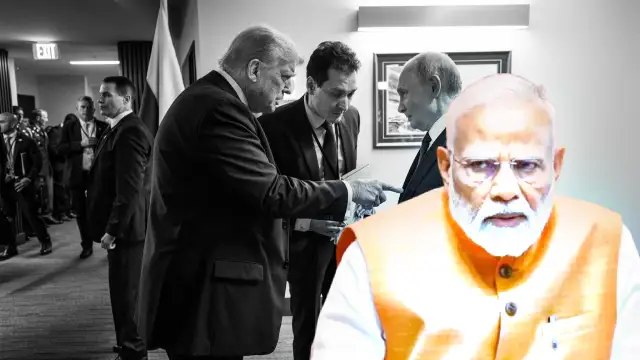
One country that had been pinning its hopes on the outcome of Russian President Vladimir Putin’s meeting with US President Donald Trump at the Alaska summit, despite not being directly or indirectly involved in the Ukraine conflict, was India. Yes, the Alaska summit was of great importance to Prime Minister Narendra Modi.
And like the American and European stakeholders, India too has been disappointed by the outcome of the Alaska summit between Mr Putin and Mr Trump.
While it’s imperative for the American policymakers and European leaders in Brussels to seek an honourable end to the three-and-a-half-year-long Ukraine conflict as a face-saver, for India, this conflict has recently jeopardised its long-term economic interests. Thus, without being a party to the conflict, India wants it to end, but Mr Modi’s “friend” Mr Putin is not in a hurry.
Thank my friend, President Putin, for his phone call and for sharing insights on his recent meeting with President Trump in Alaska. India has consistently called for a peaceful resolution of the Ukraine conflict and supports all efforts in this regard. I look forward to our…
— Narendra Modi (@narendramodi) August 18, 2025
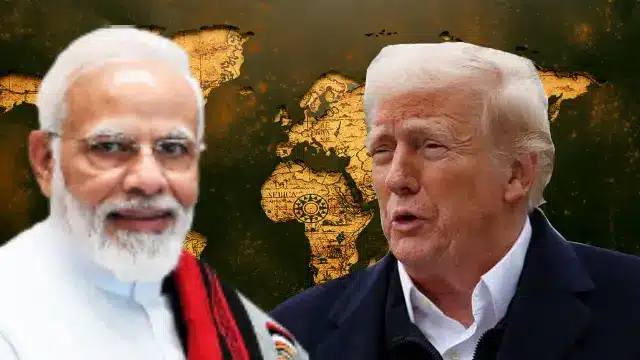
In the fast-evolving geopolitical landscape, India’s stakes have become high in the Russia-Ukraine war, despite playing no role in its trajectory. The bitter irony is that India is now suffering because of Mr Modi’s much-hyped “close ties” and “personal friendship” with Mr Putin and Mr Trump.
Modi’s geopolitical shocks
As soon as the US president announced 25% base tariffs on goods imported from India, Mr Modi’s federally ruling, far-right Hindu nationalist Bharatiya Janata Party (BJP) faced a major political ignominy in the country.
While the BJP believed that the Modi-Trump bonhomie, which thrived during Mr Trump’s first tenure in the White House, would act in its favour in the South Asian geopolitical landscape, the reality was quite different.
After he failed to secure India’s interests during his February 2025 US tour, Mr Modi faced repeated shocks from the US administration.
On the one hand, Mr Trump claimed he brokered a ceasefire between India and Pakistan after a border skirmish took place in the second week of May, following Mr Modi’s much-hyped “Operation Sindoor”, a targeted military strike on terrorist infrastructures within Pakistan to avenge the April 22nd Pahalgam terrorist attack; on the other, he imposed tariffs on India higher in comparison to Pakistan and Bangladesh, two neighbours with whom Mr Modi’s government’s relations have soured.
In both cases, the BJP and the prime minister were at the receiving end.
The claim that the US president played a pivotal role in brokering a ceasefire with Pakistan has put to question Mr Modi’s much-hyped “patriotism”.
The Opposition sought clarifications from the prime minister—who desisted from saying that Mr Trump is lying, a challenge that Leader of the Opposition in Lok Sabha (lower house of the Parliament) Rahul Gandhi threw towards him—regarding the authenticity of Mr Trump’s claims.
Mr Gandhi and the collective Opposition called Mr Modi’s “patriotic” claims a hoax and accused him of sacrificing India’s interests for the sake of his “friendship” with Mr Trump.
When Mr Trump imposed a 25% tariff on imports from India, the agitations grew stronger, and it became hard for Mr Modi and the BJP to defend themselves or take a U-turn regarding their approach towards the Trump administration.
And the worst was yet to come! In August, Mr Trump further imposed another 25% penalty tariff on Indian imports to punish Mr Modi’s government for buying oil from Russia. Although a part of the Russian oil India buys and refines, especially at the refinery owned by Mukesh Ambani, an oligarch considered close to Mr Modi, makes its way to the US, India faced Mr Trump’s wrath.
Apart from mildly criticising the American decision, Mr Modi’s government and the BJP could do nothing substantial. This raised questions about his claims of using “personal friendships” with statesmen to push India’s interests.
Alaska Summit and Modi’s dilemma
Soon after the additional 25% tariffs were imposed on India, though the Ministry of External Affairs issued a meek protest, Mr Modi remained quiet.
While appearing confident, Mr Modi soon announced he would be visiting China, his first trip since 2018 and after the May 2020 clash between the Indian Army and the Chinese People’s Liberation Army in eastern Ladakh’s Galwan Valley, where 20 Indian soldiers were killed.
While India claims that the prime minister will visit to attend the Shanghai Cooperation Organization’s (SCO) summit, which will take place in China’s Tianjin, it’s expected that he will use the occasion to reset ties with the Chinese, a process he started under the initiative of Mr Putin from the October 2024 BRICS Summit in Russia, where he had his first one-to-one meeting with Chinese President Xi Jinping.
Earlier, Mr Modi had skipped the SCO Summit in Russia’s Astana soon after returning to power for the third consecutive time in July 2024, apparently under the West’s pressure and to avoid meeting the Chinese president.
This time, experts claim Mr Modi is trying not only to reset the China-India ties by meeting Mr Xi, but also to revive the Russia-India-China (RIC) axis to put pressure on the US.
During his meeting with Chinese Foreign Minister Wang Yi in New Delhi on August 19th, Mr Modi emphasised improving China-India ties.
Glad to meet Foreign Minister Wang Yi. Since my meeting with President Xi in Kazan last year, India-China relations have made steady progress guided by respect for each other's interests and sensitivities. I look forward to our next meeting in Tianjin on the sidelines of the SCO… pic.twitter.com/FyQI6GqYKC
— Narendra Modi (@narendramodi) August 19, 2025
However, even though it appears that Mr Modi is going to use the “multipolarity” card against Mr Trump’s threats, the complex geopolitical equations show that he’s not in a position to bargain with the US or blackmail Washington, a fact that the White House is aware of.
What Mr Modi was waiting for was a formal deal or a positive message from the Alaska Summit. However, it didn’t happen. While his “dear friend” Mr Putin got what he wanted from his other “dear friend” Mr Trump, Mr Modi got nothing from the summit.
A concrete step towards peace in Ukraine means approaching a situation where the US would withdraw the additional tariffs on India, which can jeopardise Indian exports, as its commodities will face stiff competition in the US.
As India’s economy isn’t well-diversified, its domestic consumption remains low, and its manufacturing capacities aren’t as big as China’s, its exporters rely largely on exporting to the US and Europe, where India enjoyed a trade surplus until now.
India can’t replace the US with China, with whom India has a negative trade surplus, as it won’t buy India’s export surplus. In this case, Mr Modi has to wait for the conflict in Ukraine, with which India has no direct connection, to end.
Alas! Alaska showed no such signs to Mr Modi.
To add to his problems, the US government’s trade delegation, which was supposed to come to India to negotiate the tariffs, has cancelled its trip.
Finally, Mr Modi pinned his hopes on the outcome of Volodymyr Zelenskyy’s meeting with Mr Trump in the White House on Monday.
However, this also disappointed India, as no conclusion was reached by the Europeans and Americans that would suit India’s immediate interests.
Now, as his dear friends play an intriguing geopolitical chess, Mr Modi remains the impatient observer, who just wants the game to be over soon.
However, his “dear friend”, Mr Putin, who holds the key to the process, has indicated that he won’t retreat until Russia gains its objectives—long-term security guarantees from the West.
Until that moment arrives, which Mr Modi has been advocating, it appears that India will have to be a reluctant advocate of the RIC and the multipolar world to draw Mr Trump’s attention.
East Post is an independent geopolitical analysis portal covering South Asia and global power dynamics for international audiences. Views expressed are analytical and do not constitute endorsement of any state or non-state actor.
Join our channels on Telegram and WhatsApp to receive geopolitical updates, videos and more.