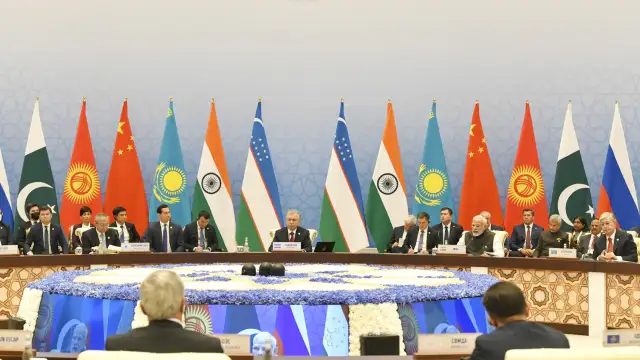
Indian Prime Minister Narendra Modi is skipping the Shanghai Cooperation Organisation (SCO) Summit hosted by Kazakhstan in Astana from July 3rd to 4th. Instead, he is sending External Affairs Minister (EAM) S Jaishankar. But why is Mr Modi skipping the SCO Summit in Astana?
While Mr Modi has cited the ongoing session of the Parliament, the maiden one during his third tenure, as a reason behind skipping the SCO Summit, critics believe otherwise.
Before getting closer to the reasons that could’ve influenced Mr Modi’s decision regarding the SCO, it’s important to look into some other important developments.
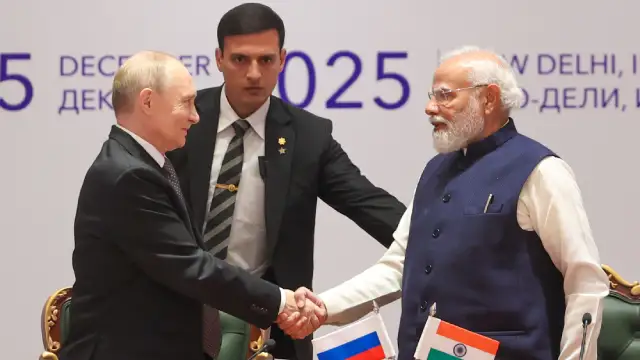
Despite Mr Modi skipping the SCO Summit, he is reportedly visiting Russia on July 8th to meet Russian President Vladimir Putin.

Mr Modi is also likely to attend the BRICS (an intergovernmental organisation including Brazil, Russia, India, China South Africa and some other countries) Summit in October hosted by Russia. Apart from these, Mr Modi has recently highlighted the deepening defence ties between India and Russia as well as India’s bilateral relations with Kazakhstan.
According to social media posts by geopolitical observers in India, Mr Modi’s decision to skip the SCO Summit while ensuring he visits Russia and keeps the Kazakhs happy comes from his third consecutive term’s foreign policy priorities.
To the West, with love
Behind Mr Modi skipping the SCO Summit lies New Delhi’s efforts to appease the US-led collective West, with which there has been a continuous effort to strengthen relations. Even Mr Modi’s first foreign tour was to Italy, where he attended the G7 Summit that took potshots at Russia.
After attending the G7 Summit, where the India-Middle East-Europe Economic Corridor (IMEC) proposal was discussed on the sidelines ministerial meeting. The IMEC is a project that plans to bypass China’s Belt-Road Initiative (BRI).
To India, the IMEC is an important project, which will help its long-term purpose of strengthening its alliance with the US, especially in the Indo-Pacific war theatre through military ententes like QUAD.
According to former Indian Army officer and geopolitical expert Pravin Sawhney, Mr Modi is skipping the SCO Summit in Astana because he is willing to avoid Chinese President Xi Jinping, who is a far more important ally for Mr Putin.
Mr Sawhney claims, that India doesn’t want to be seen endorsing the concept of Global Security Initiative that’s based on indivisible security promoted by Beijing and Moscow through SCO. As Mr Modi wants India to be a strong US ally, it can’t support the Beijing-Moscow proposal that runs contrary to the absolute security model of the US, based on the ‘rules-based order’.
Omitting China and Pakistan
Although the SCO is becoming a crucial platform for multipolarity, to which Mr Modi and Mr Jaishankar occasionally pay lip service, it’s evident that Mr Modi wants to avoid sharing the platform with the leaders from China and Pakistan, which can have adverse political implications for his Hindu nationalist Bharatiya Janata Party (BJP).
As China is becoming a global economic superpower to reckon with, the grand welcome Mr Xi receives vis-a-vis Mr Modi becomes a concern for India’s establishment, the BJP and the mainstream media that uses the optics to support a very surrealistic narrative around India’s purported foreign policy victories and growing status.
Moreover, Mr Modi didn’t receive any personal greetings from Chinese President Xi on his re-election in June. The Chinese Ministry of Foreign Affairs congratulated Mr Modi, which was acknowledged by India’s Ministry of External Affairs.
For Mr Modi, it would be a matter of ego to be present in a place where Mr Xi’s presence can overshadow him.
Chinese President Xi received a grand welcome in Kazakhstan on his visit, with three Kazakh Air Force fighter jets escorting his plane as it entered the country’s airspace.
In a welcoming ceremony organised for Mr Xi, a group of Kazakh children sang “Ode to the Motherland” in Chinese.
“China and Kazakhstan share a long tradition of friendship,” remarked Mr Xi upon arrival in Astana.
In an op-ed written by Mr Xi, he also highlighted, “Our two countries have always supported each other and have always been partners in times of challenge. Our mutual political trust has reached a new level.”
Before Kazakhstan, India held the presidency of the SCO and organised the summit in July 2023. However, apparently, in a bid to avoid the Chinese and Pakistani leaders, Mr Modi organised a virtual summit.
Critics highlight that India had been preparing for a US-led proxy war with China following the skirmish at the Galwan Valley in mid-2020.
The joint military exercise with the US on the disturbed Indo-China border in November 2022 and the QUAD’s Malabar Naval exercise off Australia has shown that India is an “enemy of China”, experts allege.
The Agnipath scheme, which was introduced as a pilot recruitment scheme in all three forces—Army, Airforce and Navy—of non-officer grade soldiers in June 2022 without consulting even the chief of staff is also seen by critics as an attempt to prepare for the US-provoked proxy war with China.
In his post on X (formerly Twitter), Mr Sawhney also wrote that Mr Modi’s government has made it clear that New Delhi will be a part of the US’s tech supply chain and will not accept China’s tech standards.
Chinese tech, which is gaining currency in the global south, has been far surpassing the US tech.
Mr Sawhney has highlighted it saying that this decision will make India’s trade with BRICS, SCO and Euroasian Economic Union (EEU) increasingly difficult in the years to come.
The Russian ballet
On any given day, any current affairs student in India would claim that India and Russia have strong and time-tested ties. But is that so?
Here is what’s visible over the surface:
Mr Modi and Mr Putin often reaffirm India-Russia ties and praise each other overlooking the West’s uneasiness.
While Mr Modi is skipping the SCO Summit in Astana, he is doing a balancing act—or a damage control—by visiting Moscow for the first time this July since 2019.
Ever since Russia started its special military operations in Ukraine, India has ignored the US-led West’s threats and sanctions and continued importing cheap oil from Moscow.
Both have been discussing a payment mechanism in rupee-ruble to circumvent the American dollar’s dominance and the impact of the sanctions on trade with Russia.
Not just a tour now, the Indian prime minister is also expected to attend the BRICS Summit in October, in Russia, and solidify New Delhi’s relations with participating nations.
Recently, Russian Foreign Minister Sergey Lavrov underscored that Moscow has documented a “privileged strategic partnership” with India and said that New Delhi “perfectly fits” in Moscow’s strategic foreign policy line.
He added that India has made a “choice” to deal in national currencies, just like China did despite the mounting economic sanctions on Russia by the West. He underscored that about 60% of trade between Moscow and New Delhi is settled in national currencies instead of US dollars.
“They are fully aware of the discriminatory nature of what the West is doing,” Mr Lavrov said.
Now this brings to some underlying problems in the India-Russia ties.
Mr Sawhney warned that Mr Putin’s Russia, which has been extending an olive branch to New Delhi and underscored India-Russia ties for so long, has been aware of the fact that Mr Modi is not wholeheartedly with Moscow-Beijing’s Asia-Pacific geopolitical strategy as it’s involved in the US’s Indo-Pacific strategy.
Being in the US military scheme will push New Delhi to accommodate more of Washington DC’s demands than Moscow’s despite hyping the concept of “multilateralism” and having military agreements with Russia.
This is a reason, probably as a backup, Russia has already invited Pakistan to join the International North-South Trade Corridor, realising fully that it will make India uncomfortable. The fact is that India decided to not take part in the BRI after Pakistan signed up for it.
As of now, Russia has been strengthening ties with Pakistan, which also has strong ties with China. However, if Mr Putin and Mr Xi agree to invite Pakistan to be a member of the BRICS, it will not only isolate India from its traditional ally Moscow but will also isolate India in this growing bloc.
What’s India losing?
Mr Modi appointed Mr Jaishankar to participate in the SCO Summit where regional security concerns, connectivity and trade will be discussed. However, Mr Modi skipping the SCO Summit seemingly does not upset the member nations, including the Kazakhs. Kazakhstan President Kassym-Jamart Tokayev called the Indian prime minister over the telephone in late June. During this conversation, Mr Modi reportedly delivered his “full support for the success of the upcoming SCO Summit in Astana.”
Staying away from crucial multipolar platforms, which have the potential to shape the future, while attending the G7 Summit, a body to which India is neither a member nor has a high level of profitable engagement, can’t be considered part of any pragmatic geopolitical strategy.
While India has enmity with China, which is also one of its biggest trading partners, avoiding scopes of dialogues and initiatives to restore normalcy with its superpower neighbour might take India on a road downhill.
It might leave India economically and technologically in a backward state and rely more on the US, which itself has a 99% debt-to-GDP ratio at present.
India might be forced out of the collective security system led by the global south while being left with the Western security system which has proven to be feeble, as exhibited by Ukraine.
Mr Modi’s skipping of the SCO Summit in Astana will eventually mean New Delhi losing a great opportunity to turn challenges into opportunities and adversaries into collaborators, which is what an able diplomat should aim for. Alas! India doesn’t seem to have one.
East Post is an independent geopolitical analysis portal covering South Asia and global power dynamics for international audiences. Views expressed are analytical and do not constitute endorsement of any state or non-state actor.
Join our channels on Telegram and WhatsApp to receive geopolitical updates, videos and more.