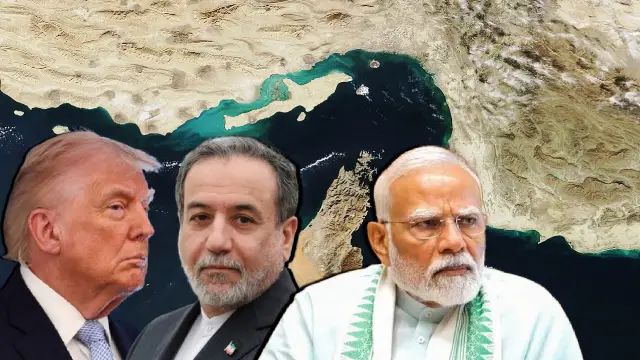
US Secretary of State Marco Rubio arrived in New Delhi this week carrying two parallel messages. The first was familiar: Washington still sees India as a strategic partner in Asia. The second was more consequential. According to Mr Rubio, negotiations between the United States and Iran may be moving towards a breakthrough that could reopen the Strait of Hormuz after months of disruption.
For India, those two developments are deeply intertwined. The country’s attempt to balance relations with the US, Iran, Israel and the Gulf monarchies is now under unprecedented strain. As tensions around Iran continue to reshape West Asia’s geopolitics, India is confronting a diplomatic crisis that is no longer confined to foreign policy circles. It is increasingly visible in fuel prices, shipping disruptions and economic anxiety at home.
The crisis exposes a larger contradiction in New Delhi’s foreign policy. India continues to speak the language of “strategic autonomy”, yet its room for manoeuvre in West Asia appears narrower than at any point in the past decade.
Iran question returns
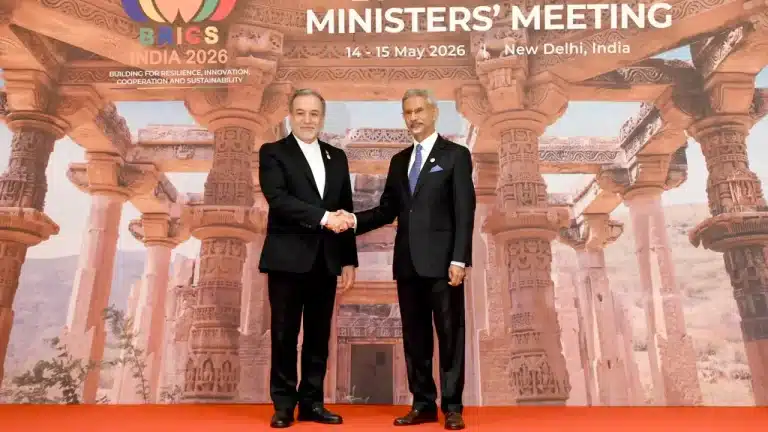
Iran’s foreign minister, Abbas Araghchi, arrived in New Delhi earlier this month for the BRICS foreign ministers’ meeting, where the war in Iran and the Strait of Hormuz crisis dominated discussions.
The visit underlined a reality that New Delhi can no longer ignore. Iran hasn’t been an energy supplier to New Delhi since Donald Trump imposed sanctions on its fuel exports during his first tenure in the White House. Yet Iran sits at the centre of India’s access to West Asia, its maritime trade routes, and its long-term connectivity ambitions. Before US sanctions intensified during Mr Trump’s first term, India had relied heavily on Iranian crude while simultaneously developing strategic projects such as the Chabahar port.
That relationship deteriorated sharply after India halted Iranian oil imports under American pressure. Since then, New Delhi has tried to maintain limited diplomatic engagement with Tehran while deepening its strategic partnership with Washington, Israel and several Gulf monarchies.
The current crisis has exposed the fragility of that balancing act.
Strait of Hormuz and India’s economic exposure
India’s vulnerability to disruptions in the Strait of Hormuz is difficult to overstate. A substantial share of the country’s crude oil and liquefied petroleum gas imports passes through the narrow maritime corridor. When the conflict around Iran escalated earlier this year, Indian shipping and energy supply chains were directly affected. Indian authorities had prioritised the return of stranded vessels before allowing more ships to travel west of the Strait because of the deteriorating security situation.
The economic effects are now being felt domestically. State-run oil marketing companies (OMCs) have repeatedly raised petrol and diesel prices this month as crude prices surged amid the Iran crisis and disruptions to Gulf shipping routes. Petrol prices have crossed the Rs 100 mark in several cities, for the first time since the Russia-Ukraine war in 2021.
During 2021-22 and the volatile period of March and April this year, Prime Minister Narendra Modi leveraged India’s ties with Russia to import cheap oil and mitigate energy supply risks. However, the circumstances didn’t provide New Delhi with any comfort for long.
The US—with which Mr Modi is keen to cosy up, even at the cost of risking India’s long-term trade interests—has withdrawn the exemption it had provided New Delhi regarding the import of Russian oil. Earlier, in 2025, the US president imposed a 50% tariff on Indian exports to the US over New Delhi’s continued purchases of Russian oil.
Although India’s External Affairs Minister S Jaishankar used to assert India’s “strategic autonomy” during Joe Biden‘s years to defend the decision to buy oil from Russia, he and Mr Modi have chosen to remain conspicuously silent in the face of Mr Trump’s threats and diktats.
Now, while Mr Modi’s far-right Bharatiya Janata Party was testing its electoral fortunes in several provincial elections, the public-sector OMCs refrained from raising the retail price of fuel. However, after the election results were announced on May 4th, the OMCs entered a price-hike spree. They have consecutively raised the prices several times, causing a political furore in the country.
The political implications are significant. Rising fuel costs threaten to push up transport and retail prices at a time when household spending remains fragile. Mr Modi addressed the nation before embarking on a six-nation tour earlier this month, urging citizens to refrain from spending money, purchasing fuel or gold, and cutting foreign tours.
While he has been trolled by the Opposition, meme-makers and comedians alike for his appeal, the prime minister has indicated only the tip of the iceberg.
What makes the situation particularly uncomfortable for New Delhi is that India currently possesses limited leverage over the crisis despite being among the countries most exposed to its consequences.
India’s diplomatic crisis on Iran: Strategic autonomy comes under pressure
India’s diplomatic positioning throughout the Iran crisis has revealed the limits of its much-publicised strategic autonomy doctrine.
Mr Modi’s government has consistently declined Iran’s call to deepen ties between the two nations, which have been historically close for decades.
India willfully avoided condemning the American-Israeli attacks on Iran that started on February 28th. The prime minister and his cabinet remained mum on the strikes and only condemned Iran’s retaliation.
Reports indicate that the Israelis waited for Mr Modi’s departure from Tel Aviv, where he paid a visit to the Zionist state, emphasising the ties between his government and Benjamin Netanyahu’s, before launching the attacks on Iran.
These irked Tehran, yet it allowed Indian-flagged vessels to pass through the Strait of Hormuz during the choking of the crucial waterway. Tehran hoped New Delhi would reciprocate.
Yet, despite Mr Araghchi’s high-level visit during the BRICS foreign ministers’ meet, his courtesy call with Mr Modi and Mr Jaishankar, and the prime minister’s telephone calls with Iranian President Dr Massoud Pezeshkian, New Delhi refused to normalise ties with Tehran.
Even though Mr Araghchi asserted at the BRICS foreign ministers’ meeting that Iran values its ties with the bloc’s members, India remained nonchalant. Sources suggest that New Delhi had initial objections to the wording chosen by the bloc to condemn the American-Israeli attacks on Iran.
Meanwhile, India maintained a cautious approach towards the Iran issue to ensure it doesn’t irk the US. After meeting Mr Araghchi, Mr Modi landed in the UAE and signed a defence deal with the Gulf monarchy. The treaty is significant in two ways.
Firstly, it shows Iran that India openly allies with its enemies despite talking about “strategic autonomy”. Iran had launched several attacks targeting the American military installations in the UAE. Moreover, Mr Araghchi strongly condemned the UAE after returning from New Delhi for hosting Mr Netanyahu during the American-Israeli aggression on Iran. While Mr Netanyahu’s office confirmed that such a trip took place amid the conflict, the Gulf monarchy has been denying it, prompting Tehran to condemn its complicity. India’s signing of a defence treaty with the UAE shows Mr Modi’s priorities to Tehran.
Secondly, the treaty, which many consider as an antidote to the Saudi Arabia-Pakistan defence treaty signed on September 17th last year. Saudi Arabia and the UAE had a diplomatic fallout over Yemen, where both parties have launched a joint aggression at the behest of the US-Israel axis. The defence treaty may strain India’s ties with Saudi Arabia, a crucial energy partner and a major investor across various sectors of the Indian economy.
Also, during his recent visit to the Nordic countries this month, the prime minister continued to lambast the Iranians for their retaliatory strikes across West Asia and remained mum on the American-Israeli aggression.
Mr Modi’s so-called “cautious” foreign policy approach has fallen flat. The cautious approach has metamorphosed into an unapologetic pro-West stance, often ignoring neighbours and traditional ties.
That caution has produced an increasingly ambiguous posture. India is attempting simultaneously to reassure Washington, maintain relations with Gulf monarchies, preserve ties with Israel and avoid a complete rupture with Tehran. The result is a foreign policy that appears reactive rather than strategic.
China outsmarts India amid diplomatic crisis over Iran issue
India’s foreign policy contrasts with China’s. It is becoming more visible. Beijing has maintained consistent engagement with Tehran while presenting itself as a diplomatic actor capable of speaking to multiple sides in the conflict. India, by comparison, has struggled to define an independent role beyond protecting its immediate economic interests.
Meanwhile, as India tries to woo the US and the West, posing as a “democratic” alternative to China in the “Indo-Pacific”, Beijing has outmanoeuvred New Delhi.
On the one hand, China hosted Mr Trump and his accomplices during their visit to Beijing this month. Mr Trump’s body language exhibited the American desperation in wooing China. Despite the bilateral diplomatic move, Beijing has emphasised its support for Iran’s position and diplomatic experts believe its shadow is unavoidable in the Iran-US negotiations brokered by Pakistan, Qatar and others.
On the other hand, while India hosted the Quad foreign minister-level meeting, where the rhetoric on a “free Indo-Pacific” was reiterated by the members of the anti-China military entente, the meeting failed to disclose whether there would be a top-level summit this year. Although India was supposed to host it this year, it seems that there won’t be any such programme. The absence of a head-of-state-level Quad summit will reduce the anti-China coalition to a pre-2021 foreign minister-level group, thereby downgrading its stature.
These developments again point to China’s backchannel diplomatic manoeuvres and engagements with the US, which may have influenced the outcome of the BRICS meet. Unlike Mr Modi, who prostrated before Mr Trump, the Chinese have compelled the US president to acknowledge how vital Beijing is to Washington.
BRICS, West Asia and India’s shrinking room for manoeuvre
The BRICS foreign ministers’ meeting in New Delhi revealed another uncomfortable reality for India: West Asia’s geopolitical crisis is increasingly shaping the agenda of institutions that New Delhi once hoped to use to expand its own strategic influence.
Iran entered the BRICS bloc expecting diplomatic support against Western pressure. Russia and China broadly share Tehran’s criticism of US coercive policies in the region. India, however, occupies a far more delicate position because of its expanding ties with Washington and Europe.
That divergence risks weakening India’s standing within the grouping precisely when New Delhi is attempting to project itself as a leading Global South power.
Sources in the Russian Ministry of Foreign Affairs share Moscow’s long-term apprehensions regarding India’s desire to strengthen ties with Europe. On the one hand, Moscow aims to deepen its ties with India across several fields and wants to retain defence contracts that have largely moved to Israel and European countries in recent years. On the other hand, Russia has been building alternative equations by strengthening ties with Pakistan, Bangladesh and China, to protect its interests in the region.
India’s attempts to appease the US and the West have raised alarms within the BRICS and other platforms, including the Shanghai Cooperation Organization. China, Iran, Russia and others have been apprehensive about India’s future roles in these bodies, as New Delhi is seen as a Trojan horse within these organisations that promote a multipolar world order.
At the same time, India’s growing closeness with the UAE and other Gulf states has not necessarily translated into greater strategic influence over the unfolding crisis. Gulf monarchies themselves are increasingly recalibrating their security relationships amid uncertainty over long-term American commitments in the region.
Most Gulf monarchies have realised that the US won’t be able to provide them with any security cover after Iran destroyed most American bases in the region. After suffering billions of dollars in losses, the Pentagon will take a long time to rebuild American military assets in these countries. In the meantime, these Gulf monarchies, sans the UAE, are tilting towards China and Russia for their security.
For India, the problem is not merely a matter of diplomatic inconsistency. It is the absence of a coherent West Asia strategy capable of withstanding major geopolitical shocks. The result of this lack of a coherent strategy is pinching the common citizens as inflation threatens to spike, with no forthcoming election to worry Mr Modi’s far-right outfit.
Ambiguity can’t manage India’s diplomatic crisis
For years, India benefited from maintaining productive relations simultaneously with Iran, Israel, the Gulf monarchies, Russia and the United States. That flexibility was often presented as evidence of strategic maturity.
However, under Mr Modi, New Delhi has increasingly distanced itself from the balanced approach. Rather, it has taken the side of the American-Israeli axis and has been part of the India-Israel-UAE-US (I2U2) coalition, which aims to consolidate Washington’s and Tel Aviv’s domination over the region.
The Iran crisis is testing whether that model still works in a more polarised geopolitical environment.
As long as instability around the Strait of Hormuz continues, India will remain exposed economically while possessing limited influence over the negotiations shaping the region’s future. Rising fuel prices and supply-chain disruptions are only the most immediate symptoms of a deeper strategic problem.
With the rupee experiencing an unprecedented free fall against the dollar, the import-dependent Indian economy is set to suffer serious jolts. As Mr Modi’s much-hyped India-Middle East-Europe Economic Corridor project remains on paper, India can’t expect a magical turnaround in the near future. Its nonchalant attitude toward Iran will only worsen its diplomatic crisis, as well as its energy and overall economic crises.
New Delhi’s diplomatic crisis over Iran is therefore not simply about energy security or shipping lanes. It reflects a broader erosion of strategic space. India is discovering that balancing multiple rival power centres becomes far harder when those rivalries escalate into open confrontation.
East Post is an independent geopolitical analysis portal covering South Asia and global power dynamics for international audiences. Views expressed are analytical and do not constitute endorsement of any state or non-state actor.
Join our channels on Telegram and WhatsApp to receive geopolitical updates, videos and more.