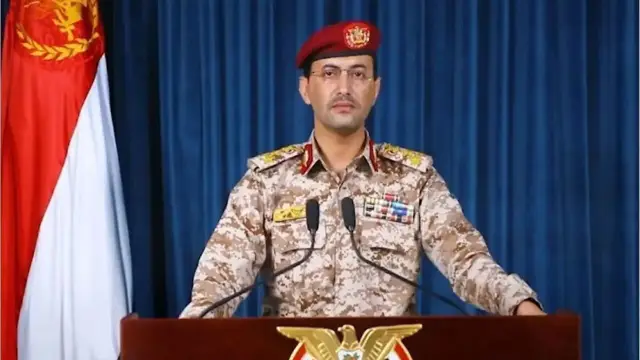
As Gaza endures relentless Israeli bombardment, Yemen has dramatically escalated its military campaign against the US and Israeli forces, adopting a two-pronged strategy that has yielded notable successes. The Yemeni resistance movement has inflicted significant setbacks on the US naval operations, following attacks on the USS Harry Truman earlier this week. In response, the US is redeploying two of its warships from the Indo-Pacific theatre to the Middle East.
Yet despite enjoying full support from Israel and the United Arab Emirates in its campaign against the Yemeni resistance, led by Houthi forces, the US has failed to achieve meaningful victories in its military offensive against this war-ravaged country.
Yemeni resistance’s escalation against Israel
On March 22nd, the Yemeni Armed Forces announced a significant intensification of their campaign against Israel. Air-raid sirens sounded across occupied Al-Quds, Tel Aviv and numerous settlements in Bethlehem and the northern West Bank after a missile was launched from Yemen.
In their statement, the Yemeni Armed Forces declared that, in accordance with Sayyed Houthi’s promise of “escalation for escalation at the highest level,” they were imposing an aerial blockade on Israel. They announced multiple military operations, stating: “In support of the oppressed Palestinian people and in backing their noble and valiant resistance, the missile force targeted ‘Ben Gurion Airport’ in the occupied Yaffa area with a Palestine-2 hypersonic ballistic missile.” They claimed the operation “successfully achieved its target”.
This marks the third operation carried out within 48 hours. The Yemeni Armed Forces warned all airlines that “Ben Gurion Airport is now unsafe for aerial navigation and shall remain so until the aggression on Gaza ceases and the siege is lifted.”
Sustained pressure on US naval forces
For the sixth consecutive day, the Yemeni Armed Forces’ drone units conducted military operations targeting several vessels affiliated with the USS Harry S. Truman carrier group, employing multiple unmanned aerial vehicles. In recent hours, the US forces launched several airstrikes on various Yemeni provinces in what the Yemeni Armed Forces described as “a failed attempt to prevent Yemen from standing in support of the oppressed Palestinian people in Gaza”.
Meanwhile, the US aggression targeted the Al-Hodeidah governorate in western Yemen.
The Yemeni Armed Forces have targeted the USS Truman with missiles and drones on 11 separate occasions since January, including five times in the past week alone, coinciding with intensified US military action against Yemen.
US reinforces naval presence
In response to these attacks, US Secretary of Defence Pete Hegseth has ordered the aircraft carrier USS Carl Vinson and Carrier Strike Group One to redirect from the Indo-Pacific to the Middle East. He has also extended the deployment of the USS Harry S. Truman and its strike group in the northern Red Sea.
The USS Vinson is expected to arrive in the Middle East next month, joining the USS Truman, which has been stationed there since December, after the USS Abraham Lincoln, USS Ford, USS Roosevelt and USS Eisenhower departed the region following repeated strikes by Yemeni forces.
The USS Ford is anticipated to return to the region in the coming weeks, bringing the number of US aircraft carriers and their accompanying strike groups—including submarines and destroyers—to three. This represents the largest US naval deployment in the region since the 2003 invasion of Iraq.
Unwavering commitment to Palestinian cause
In their statement, the Yemeni Armed Forces paid tribute to “the steadfast Palestinian people and their faithful, fighting and valiant resistance in Gaza—the first line of defence for all Arab and Islamic nations”. They expressed reverence for Palestinian “sacrifices” and honoured their “patience and steadfastness in the face of brutal aggression”.
The statement affirmed a continuing commitment to support Palestinians “until the aggression is halted and the siege is lifted—regardless of consequences or outcomes”, concluding with: “Sufficient for us is Allah, and He is the best disposer of affairs; the best protector and the best helper. Long live Yemen—free, proud and independent. Victory to Yemen and to all the free people of the nation.”
Analysis: A war of attrition
Yemen’s strategy appears to be one of sustained pressure rather than decisive engagement. By targeting high-value US naval assets and Israeli infrastructure, the Yemeni resistance forces are pursuing an asymmetric approach designed to maximise impact while minimising their own vulnerability to the US’s vastly superior military capabilities.
This approach has prompted a significant US military response, with the redeployment of naval assets suggesting that Yemen’s resistance has succeeded in disrupting the US’s strategic calculations. The pending arrival of the USS Carl Vinson and the anticipated return of the USS Ford indicate that the US is committing substantial resources to contain the Yemeni threat.
Yet the effectiveness of this US escalation remains uncertain. Previous deployments of aircraft carriers to the region have not prevented Yemeni forces from conducting operations against US naval vessels. The departure of four carrier groups following Yemeni attacks suggests that the US’s naval posture in the region has been reactive rather than strategic.
As this conflict intensifies, the cost to the US’s naval operations continues to rise, both financially and in terms of strategic flexibility. With three carrier groups potentially tied down in the Middle East, the US’s ability to project power in other theatres may be constrained—an outcome that aligns with the Yemeni resistance’s apparent objective of imposing costs on American military engagement in the region.
For Yemen itself, the prolonged conflict risks further devastation to a country already ravaged by years of war. Yet the Yemeni Armed Forces’ statements suggest they view their campaign as a moral imperative, inseparable from the broader struggle for Palestinian rights, and they appear prepared to bear the consequences of continued resistance.
East Post is an independent geopolitical analysis portal covering South Asia and global power dynamics for international audiences. Views expressed are analytical and do not constitute endorsement of any state or non-state actor.
Join our channels on Telegram and WhatsApp to receive geopolitical updates, videos and more.