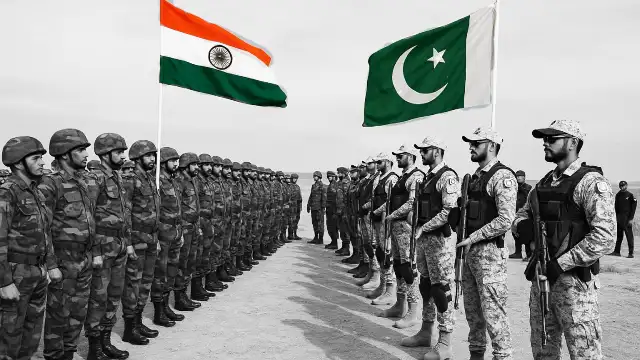
As the India-Pakistan military conflict intensifies, defence stocks soar. India’s “Operation Sindoor” on May 7th 2025 has pushed nuclear-armed neighbours to the brink. While citizens suffer, markets reveal who benefits from war.
Escalation and its beneficiaries
The India-Pakistan military conflict has claimed scores of civilian lives since tensions escalated. India’s strikes against alleged terror targets in Pakistan-controlled territories triggered fierce retaliation. Infrastructure on both sides now lies damaged.
Defence companies have emerged as clear winners. According to Bloomberg, Indian defence stocks have added nearly $5bn in market valuation since the Pahalgam terror attack on April 22nd. These stocks reached $107bn on May 7th, when India launched “Operation Sindoor”.
State-owned manufacturers like Hindustan Aeronautical Limited (HAL), missile producer Solar Industries India Limited, and Mazgaon Dock Shipbuilders have seen significant gains. Other beneficiaries include Mishra Dhatu Nigam, Garden Reach Shipbuilders & Engineers, Bharat Dynamics, and Bharat Electronics.
This pattern isn’t limited to Indian firms.
Chinese defence stocks have rallied following Pakistan’s claims that it shot down two Indian aircraft using Chinese J-10C. AVIC Chengdu Aircraft Co, which manufactures the J-10C fighter jet, saw its shares surge by the 20% daily limit on Thursday, after a 17% gain on Wednesday—its biggest two-day rally in more than two years.
War’s double-edged sword
The India-Pakistan military conflict has sent mixed signals through financial markets. While defence stocks thrive, broader indices falter. On May 8th, India’s National Stock Exchange (NSE) fell by 140.60 points (-0.58%) to 24,273.80. The BSE Sensex dipped 411.97 points (0.51%) to 80,334.81.
On Friday, soon after opening, the NSE fell 229.10 points (-0.94%) to 24,051.45. The BSE Sensex fell by 624.98 (0.78%) to 79,709.83 by midday.
Dassault Aviation, the French manufacturer of Rafale fighters, experienced share price volatility. Its stock dipped on May 7th before recovering slightly the following day.
The fluctuation comes amid claims that Pakistan downed an Indian Rafale jet using Chinese J-10C fighters and PL-15 missiles.
Though India hasn’t confirmed aircraft losses, international sources suggest otherwise. Reuters reports the loss of at least two aircraft, including one Rafale. CNN quoted a French intelligence official confirming India may have lost one Rafale jet.
Beyond stock markets
The India-Pakistan military conflict threatens broader economic stability. Currency markets have already responded, with the Indian rupee falling 1.03% to Rs 85.72 against the dollar. The Pakistani rupee has shown similar volatility, rising to PK Rs 281.37 on May 7th before falling back to PK Rs 281.16.
Economists worry about oil prices. Dmitry Kasatkin, partner at Kasatkin Consulting, told Russian news agency TASS, “One or another development of the conflict may entail absolutely diametrically opposite consequences for the oil market. For example, if the conflict remains in the local phase, then most likely we will see a short-term increase in prices.”
He added a more alarming scenario: “In case of a full-scale conflict, a medium-term decrease in prices is possible, due to the fact that India, as the largest importer, will face a decrease in production and the loss of individual infrastructure facilities (such as refineries and pipelines).”
Shifting trade routes
The India-Pakistan military conflict could reshape global shipping. Russian experts anticipate growing interest in the Northern Sea Route as tensions make the Indian Ocean riskier.
Alexander Vorotnikov, an Arctic development expert, told TASS, “As a result of the conflict, the Northern Sea Route is naturally starting to look safer. Many Asian countries, especially those friendly towards Russia, will certainly prefer to use the Northern Sea Route because nothing is as expensive as security.”
He believes further escalation would only increase traffic on the northern route: “Any further escalation of the conflict will only increase the number of those using the Northern Sea Route.”
Hyper-nationalism and corporate opportunism
The India-Pakistan military conflict has exposed stark contrasts in public response. Hyper-jingoism dominates mainstream media, particularly in India, where television channels and social media accounts amplify war frenzy. Meanwhile, calls for peace remain marginalised despite nominal government support.
Corporate opportunism has reached surreal levels. Reliance Industry Limited, owned by Mukesh Ambani, briefly claimed a patent for “Operation Sindoor”—the very name of India’s military strike. The company later attributed this to “an act by a junior worker.”
The irony is stark. India ranks 105th among 129 countries in the Global Hunger Index, while Pakistan sits at 109th. Yet both nations appear willing to divert massive resources to the India-Pakistan military conflict rather than addressing fundamental human needs.
As civilians die and infrastructure crumbles, the financial patterns make one thing clear: the India-Pakistan military conflict benefits a select few while imposing costs on the many. Defence contractors, alternative shipping routes, and opportunistic investors may prosper—but ordinary citizens on both sides of the border pay the price.
East Post is an independent geopolitical analysis portal covering South Asia and global power dynamics for international audiences. Views expressed are analytical and do not constitute endorsement of any state or non-state actor.
Join our channels on Telegram and WhatsApp to receive geopolitical updates, videos and more.