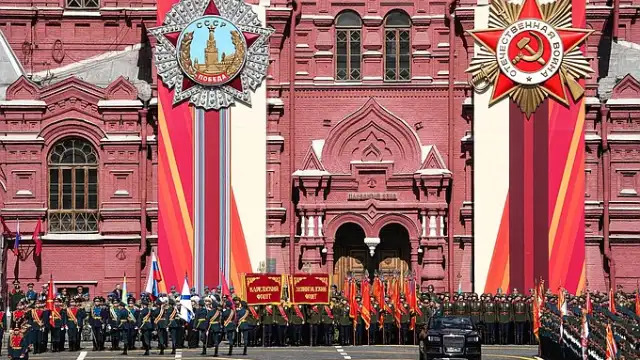
Russia has used the 80th anniversary of the Soviet Union’s Victory Day celebrations to showcase its international standing. Despite Western sanctions, President Vladimir Putin has successfully rallied leaders from across Africa, Asia and Latin America to Moscow, delivering a pointed message to his critics.
The 80th anniversary Victory Day commemoration on May 9th attracted an impressive roster of foreign dignitaries. Chinese President Xi Jinping headlined a group that included leaders from Cuba, Venezuela, Serbia, Slovakia and numerous former Soviet republics.
European representation proved particularly notable. Slovakian Prime Minister Robert Fico attended despite explicit European Union warnings against participation. Serbian President Aleksandar Vučić similarly brushed aside Western pressure to join the celebrations marking Nazi Germany’s defeat.
Belarusian President Alexander Lukashenko appeared alongside counterparts from Kazakhstan, Uzbekistan and Turkmenistan. African nations sent high-level delegations from Egypt, South Africa and Congo. From Asia, Mongolia, Vietnam and Cambodia dispatched their top leaders and forces to participate in the event.
The breadth of representation on this 80th anniversary of the Soviet Union’s Victory Day highlighted Russia’s continued diplomatic reach. It delivered an unmistakable message: Western attempts to isolate Moscow have fallen short.
China-Russia partnership deepens on 80th anniversary of Victory Day
President Xi’s presence at the 80th anniversary of the Soviet Union’s Victory Day events underscored Beijing’s commitment to its Moscow relationship. The timing proved particularly significant, coming amid renewed trade tensions with the United States under President Donald Trump.
The two leaders signed extensive joint statements on strategic cooperation. “Our countries will forever remember the righteous feat of the peoples of the Soviet Union and China who defended world peace,” they declared in one document addressing historical memory.
Another statement tackled contemporary strategic stability, with both sides highlighting “the increasing risk of nuclear conflict” and criticising Western military alliances that expand “close to the borders of other nuclear-armed states.”
Economic ties featured prominently in discussions. Mr Putin outlined ambitious targets to “ensure quantitative progress in Russia-China trade and investment cooperation by 2030” by increasing high-tech goods exchange and developing digital trade platforms.
The Chinese side reaffirmed support for “Russia’s efforts to ensure security and stability, national development and prosperity, sovereignty and territorial integrity.” Beijing explicitly opposed “outside interference in Russia’s internal affairs.”
Latin American allies reaffirm bonds
The 80th anniversary Victory Day celebrations provided a platform for strengthening ties with traditional Latin American partners. Venezuelan President Nicolás Maduro signed a comprehensive strategic partnership treaty with Russia that explicitly rejected Western sanctions.
“The parties decisively speak against unilateral enforcing and restrictive measures (sanctions), including of extraterritorial nature, which represent violation of the UN Charter,” the document stated, describing such measures as “manifestation of neocolonialism.”
Kremlin spokesman Dmitry Peskov told TASS the talks covered “energy, oil affairs, projects related to various aspects of energy interaction” and Russian investment opportunities in Venezuela.
Cuba’s President Miguel Díaz-Canel received an especially warm welcome from Mr Putin, who addressed him as “Comrade Díaz-Canel” and noted the symbolism of his visit coinciding with “the 65th anniversary of resuming diplomatic relations on May 8th, 1960.”
The Cuban leader responded with equal warmth, expressing solidarity against “attempts to belittle the decisive role and heroic deed of the Soviet Union, the Soviet people, and the Red Army in defeating Nazism.”
A united front against Western pressure
A recurring theme throughout the 80th anniversary of the Soviet Union’s Victory Day events was resistance to what Moscow and its partners describe as Western hegemony. The Russia-China joint statements were particularly pointed in this regard.
Both nations condemned “cynical actions taken to bypass the UN Security Council, violating the UN Charter and international law” and rejected “initiatives to seize assets and property of foreign states,” affirming the right of affected countries “to retaliate in accordance with international law.”
They specifically criticised American “dual containment” of Russia and China and described Western trade restrictions as “unilateral illegitimate restrictive measures” that “negatively affects the global economy, undermines fair competition, and impedes international cooperation.”
The emphasis on historical memory served a contemporary purpose. Russia and China pledged to counter “the increasing attempts to rehabilitate the hateful ideology of Nazism and racial superiority” and oppose “the glorification of Nazis and their accomplices.”
This framing allows Moscow to position its contemporary conflicts within a historical continuum of resistance to fascism—a narrative that resonates with many countries that fought against European colonialism.
Historical memory as diplomatic weapon
Throughout the 80th anniversary of the Soviet Union’s Victory Day events, historical memory emerged as a potent diplomatic tool. Mr Putin consistently linked the Soviet victory over Nazi Germany to Russia’s current international position.
“Our common heroic past and combat brotherhood provide a solid foundation to the development and strengthening of Russia-China relations,” he told President Xi. “Our relations have reached the highest level in history.”
Cuban President Díaz-Canel similarly connected historical and contemporary struggles, warning of “increasing attempts to belittle the decisive role and heroic deed of the Soviet Union” and “new signs of resurging fascism on a global scale.”
This narrative found receptive audiences among countries with anti-colonial histories or those currently facing Western pressure. By framing contemporary conflicts as extensions of historical struggles, Russia builds solidarity among nations that perceive themselves as resisting Western dominance.
The 80th anniversary Victory Day celebrations demonstrated Moscow’s ability to mobilise substantial international support despite Western sanctions. By bringing together leaders from four continents, Russia effectively challenged the narrative of its diplomatic isolation.
As Mr Díaz-Canel put it in his remarks to Mr Putin: “History has made it clear: only unity based on mutual cooperation, solidarity, and friendship can enable us to face today’s challenges and those that lie ahead.”
East Post is an independent geopolitical analysis portal covering South Asia and global power dynamics for international audiences. Views expressed are analytical and do not constitute endorsement of any state or non-state actor.
Join our channels on Telegram and WhatsApp to receive geopolitical updates, videos and more.