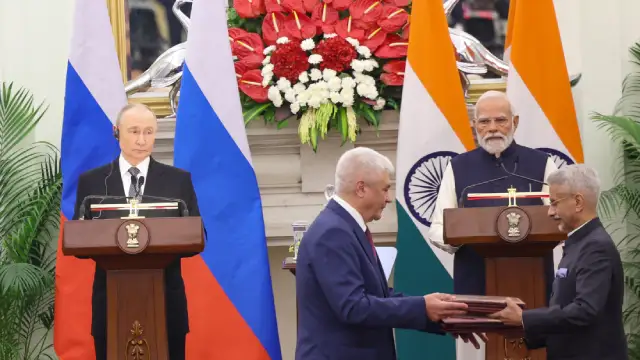
Vladimir Putin arrived in New Delhi on December 4th seeking to reaffirm Russia’s time-tested partnership with India. The Russian president left two days later with a 70-point joint statement commemorating 25 years of strategic ties. Yet a striking omission has been buried within the diplomatic verbiage. On the conflicts consuming West Asia, Russia could not move India an inch from its Israel-friendly position. The joint statement’s language on Gaza and Iran reveals the outer limits of what Moscow and New Delhi could agree upon. It also shows how, to appease New Delhi, Moscow has to let go of its own foreign policy stance on West Asia’s complex geopolitical landscape.
The statement devotes a single paragraph to West Asia conflicts. It expresses vague “concern over the humanitarian situation in Gaza” without mentioning ceasefire, genocide or Israeli aggression. On Iran, it merely urges dialogue on nuclear issues without acknowledging that Israel and the US had bombed Iranian facilities six months earlier. For Russia, which has condemned Israeli operations in Gaza as war crimes and denounced the US strikes on Iran as violations of international law, this tepid language represented diplomatic defeat. India would not budge. Russia can’t lose its oil buyer.
The contrast with Russia’s own positions is stark. Moscow has consistently voted for UN resolutions demanding immediate Gaza ceasefires. It supported the International Court of Justice (ICJ) investigation into plausible genocide charges against Israel. Russian officials have called Israeli actions in Gaza “a humanitarian catastrophe of unprecedented scale”. Yet when Russia and India sat down to draft their joint statement, none of this moral clarity survived contact with India’s red lines.
India has pursued a markedly different course on Gaza since Hamas attacked Israel on October 7th 2023. New Delhi abstained on a crucial UN General Assembly resolution on June 12th, 2025. The resolution demanded an immediate, unconditional and permanent ceasefire. It condemned the use of starvation as a weapon of war. It called for Israel to lift its blockade and open all border crossings for humanitarian aid. Some 149 countries voted in favour. Only 12 voted against, including the US and Israel. India was among just 19 abstentions.
The abstention isolated India within the Global South. It was the only country in South Asia to abstain. Every other BRICS member voted yes. All Shanghai Cooperation Organisation (SCO) members except India supported the resolution. Brazil, South Africa, Indonesia, Malaysia, Egypt and Nigeria voted for an immediate ceasefire despite maintaining relations with both Israel and Palestine. Even traditional Western allies, including Britain, Japan and Australia, voted yes. India stood apart. It was part of Prime Minister Narendra Modi’s desperate attempts to woo the US-Israel nexus, a bid which finally failed to secure India’s long-term interests.
India’s explanation for its abstention cited consistency with previous voting patterns and concerns about references to ICJ opinions. Yet this rationale collapses under scrutiny. India had voted in favour of a separate Gaza ceasefire resolution in December 2024. It supported other resolutions referencing ICJ advisory opinions. The inconsistency suggests that factors beyond legal technicalities drove India’s position. Chief among them is the Modi government’s deepening strategic alignment with Israel.
Iran attacks expose divergence between Russia and India on West Asia
The gap between Russia and India widened further over Iran. Israeli strikes on Iranian military and nuclear facilities began on June 13th 2025. The attacks targeted more than a dozen sites, including key nuclear facilities and residences of military leaders and scientists. Iran retaliated with ballistic missiles. The US joined the conflict in late June, deploying B-2 bombers to allegedly destroy three Iranian nuclear plants. The escalation threatened regional conflagration.
Russia condemned the Israeli and US attacks immediately. The SCO issued a statement on June 14th strongly condemning the military strikes as gross violations of international law and the UN Charter. Nine SCO members endorsed the statement. India did not. New Delhi was the sole dissenter within the ten-member bloc. India’s Ministry of External Affairs issued instead a carefully calibrated statement urging “both sides to avoid any escalatory steps” and engage in dialogue. It made no mention of who initiated the strikes or whether they violated international law.
India’s opposition parties condemned the government’s silence. The Communist Party of India (Marxist) called Israel a “rogue state” and demanded India add its voice to global condemnation. The chief minister of Kerala, Pinarayi Vijayan, stated that “the entire international community must speak out to end the reckless and unlawful aggression of Israel against Iran”. The Indian National Congress party criticised the government’s failure to denounce Washington’s entry into the war. Mr Modi’s government ignored these calls.
The prime minister telephoned Iranian President Dr Masoud Pezeshkian amid the crisis. Yet the call served not to express solidarity but to press Tehran toward restraint. India urged dialogue while conspicuously avoiding criticism of those who launched unprovoked attacks on Iranian territory. For a government that proclaims strategic autonomy and champions the Global South, the silence spoke volumes.
By September 2025, India’s position had shifted slightly. At the SCO summit in Tianjin, China, India signed a declaration that “strongly condemned the military strikes by Israel and the United States”. The statement called the attacks violations of sovereignty that undermined regional security. Analysts interpreted India’s reversal as a message to Washington following President Donald Trump‘s imposition of 50% tariffs on Indian goods. Yet even this shift proved temporary. The December joint statement with Russia made no mention of Israeli or American strikes on Iran whatsoever.
Moscow’s inability to move New Delhi reveals partnership’s shallow foundations
The Russia-India joint statement’s anodyne West Asia language exposes fundamental divergence beneath the rhetoric of special partnership. Russia and India have proclaimed their relationship a pillar of global peace and stability. They invoke shared opposition to Western hegemony and commitment to a multipolar world order. Yet when Russian interests in West Asia clash with India’s Israel alignment, India prioritises Tel Aviv over Moscow.
This prioritisation has concrete strategic drivers. India and Israel have forged deep defence and technology cooperation over the past decade. Israeli drones and weapons systems played important roles in India’s May 2025 airstrikes against Pakistan following the Pahalgam terrorist attack. Israel’s consul general in Mumbai publicly endorsed India’s right to self-defence. Israeli intelligence cooperation and arms sales have made Tel Aviv an indispensable partner for New Delhi’s security establishment.
India’s tilt toward Israel accelerated under Mr Modi’s Hindu nationalist government. Mr Modi has cultivated close personal ties with Israeli Prime Minister Benjamin Netanyahu. India abstained from or opposed multiple UN resolutions criticising Israeli actions in the occupied Palestinian territories. New Delhi shifted from systematically voting to support Palestine to hedging between supporting Palestine, abstaining on votes condemning Israel, and occasionally voting with Israel when resolutions specifically targeted Hamas.
The contradiction between India’s proclaimed Global South leadership and its Israel alignment has not gone unnoticed. When India abstained on the June Gaza ceasefire vote, South Africa was simultaneously pursuing genocide charges against Israel at the ICJ. Brazil, which shares India’s ambition for UN Security Council reform, voted for an immediate ceasefire. Indonesia and Malaysia, fellow democracies with large Muslim populations, supported the resolution despite economic ties with Israel. India’s position separated it from the very constituency it claims to represent.
Russia’s accommodation of India’s Israel stance reveals the asymmetry within their partnership. Moscow needs New Delhi more than New Delhi needs Moscow. Russia faces comprehensive Western sanctions and diplomatic isolation. India provides crucial economic lifelines through purchases of Russian oil and continued defence cooperation. Russia’s share of India’s arms imports has declined from 76% a decade ago to 28% today, but maintenance of existing Russian-origin equipment comprising over 55% of India’s arsenal ensures continued dependence. Mr Putin cannot risk alienating India over Gaza or Iran when Russia’s strategic position is so precarious.
Yet Russia’s acquiescence comes at reputational cost. Moscow positions itself as the champion of anti-imperialist resistance and defender of international law against Western aggression. Its unwillingness or inability to secure Indian support for a Gaza ceasefire or condemnation of strikes on Iran undermines these claims. The joint statement’s euphemistic language—”concern” over Gaza’s humanitarian situation, “dialogue” on Iran’s nuclear programme—reads as a diplomatic fig leaf covering genuine policy discord.
Strategic autonomy or expedient opportunism amid geopolitical pressures
India’s defenders argue that its position reflects strategic autonomy rather than alignment with any bloc. External Affairs Minister Subrahmanyam Jaishankar articulated a foreign policy framework, five years ago, whereby India must “engage America, manage China, cultivate Europe, reassure Russia” and ensure no other nation holds veto over Indian policy choices. By this logic, India’s refusal to condemn Israel demonstrates independence from Russian influence just as its refusal to abandon Russian oil demonstrates independence from American pressure.
This framing has intellectual coherence. India maintained warm relations with both Cold War superpowers during the Non-Alignment Movement’s heyday. It pursues economic integration with the West through UK and EU free trade agreements while preserving Russia ties and BRICS membership. It participates in the Quad security dialogue with America, Japan and Australia while attending SCO summits with Russia, China and Pakistan. India calls this multi-alignment rather than non-alignment, befitting a world where rigid bloc politics have dissolved.
Yet the evidence suggests that India’s West Asia position reflects not principled autonomy but calculated prioritisation of narrow interests. India abstained on Gaza resolutions not because it opposed ceasefires but because it fears alienating Israel and the US. India declines to condemn strikes on Iran, not because it believes in Israeli self-defence but because strategic alignment with Tel Aviv outweighs historical friendship with Tehran. When Mr Trump imposed 50% tariffs explicitly targeting Russian oil purchases, India briefly signed the SCO condemnation of Iran strikes before reverting to silence in the December Putin statement.
This pattern resembles opportunism more than autonomy. Genuine strategic autonomy would mean India articulates its independent positions on Gaza and Iran grounded in international law and humanitarian concern, regardless of pressure from any quarter. India would vote for a Gaza ceasefire because civilians require protection, not because abstention serves immediate interests. India would condemn attacks on Iranian nuclear facilities because they violate UN Charter principles, not because doing so might placate Russia during tariff disputes.
Instead, India’s positions shift based on whom it wishes to court at any given moment. The Modi government abstracts when Western pressure is strongest, condemns when relations with Washington sour, and then reverts to abstraction when seeking American favour. Russia accepts whatever India offers because Moscow lacks alternatives. This is transactional diplomacy, not the principled multipolarity India’s foreign policy establishment proclaims.
The implications extend beyond West Asia. If India cannot support basic humanitarian positions on Gaza or respect for sovereignty regarding Iran—positions endorsed by overwhelming UN majorities, including Western democracies—its claims to Global South leadership ring hollow. Countries facing humanitarian crises or sovereignty violations will note that India prioritises great power relationships over solidarity with the oppressed. The Modi government’s domestic record of democratic backsliding compounds these concerns. Freedom House downgraded India from “Free” to “Partly Free” in 2021. V-Dem Institute classifies India as an electoral autocracy. India ranks 161st of 180 countries in press freedom.
Mr Putin left New Delhi with warm words about time-tested friendship. The joint statement proclaimed mutual trust and respect for core interests. Yet the West Asia paragraphs told a different story. When forced to choose between Russian preferences and Israeli alignment, India chose Israel without hesitation. Russia could only acquiesce. For all the summit’s ceremonial grandeur and lengthy declarations, this simple fact illuminated the true state of the partnership. Russia and India share opposition to American unipolarity in the abstract. When concrete questions arise—whether to demand a Gaza ceasefire, whether to condemn attacks on Iran—their paths diverge sharply. The special partnership has clear limits. Gaza and Iran mark those boundaries precisely.
East Post is an independent geopolitical analysis portal covering South Asia and global power dynamics for international audiences. Views expressed are analytical and do not constitute endorsement of any state or non-state actor.
Join our channels on Telegram and WhatsApp to receive geopolitical updates, videos and more.