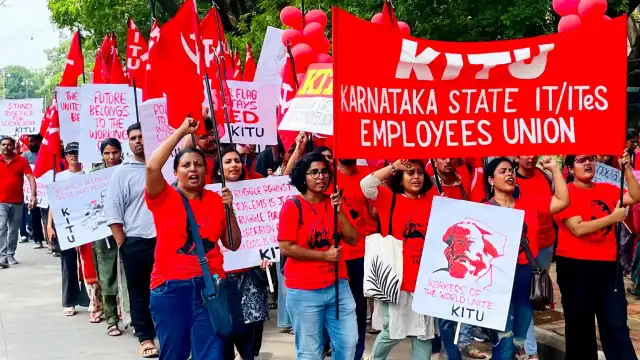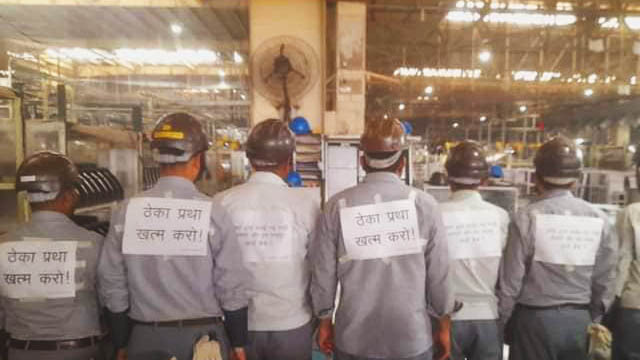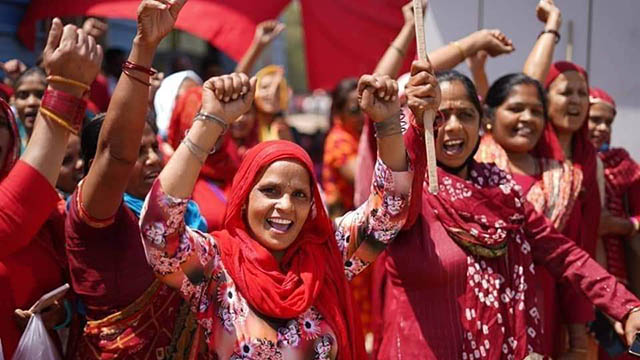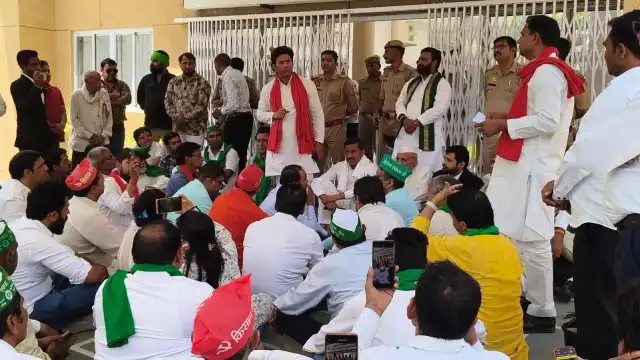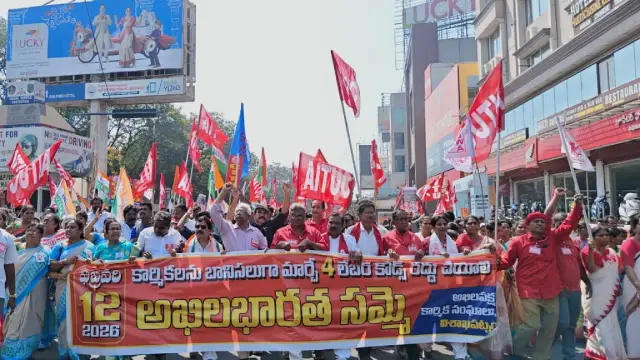
On February 12th, some 30m workers across India downed tools. Trade union leaders called it a defence of labour laws. They also cast it as a rebuke to India’s new trade deals. For once, foreign policy and the shop floor met on the same street.
More than 10 central trade unions joined the strike that saw a massive response in the public sector and organised sectors, but a very low response in Prime Minister Narendra Modi‘s far-right Bharatiya Janata Party-ruled provinces.
The Samyukta Kisan Morcha, an umbrella body of farmers, backed them. Workers and rural labourers marched together. They accused Mr Modi’s Union government of pushing “anti-people” and “pro-corporate” policies.
Union leaders argued that the government has repealed labour legislation that once protected the working class in key industries. They said the state has diluted the Mahatma Gandhi National Rural Employment Guarantee Act (MNREGA). They also opposed plans to open the farm sector to the US in ongoing trade talks.
The clash between India’s labour movement and its foreign policy has rarely looked so direct. This time it revolves around trade, tariffs and the fine print of agreements.
Labour laws in India under trade pressure
The Free Trade Agreement (FTA) between India and the European Union (EU) places labour laws on paper. Brussels insists that the pact “requires the respect of core International Labour Organization (ILO) principles covering subjects” such as freedom of association, the right to collective bargaining, the elimination of forced labour, the abolition of child labour, non-discrimination at work, and a safe and healthy working environment.
The EU also points to commitments on decent working conditions, labour inspection, social dialogue and responsible business conduct. For European policymakers, these clauses frame trade as values-based.
Yet trade union leaders in India doubt the intent behind the text. They consider the presence of labour rights clauses as a standard boilerplate, with zero enforcement intention.
The union leaders say New Delhi will neither enforce labour laws in line with ILO standards nor face serious scrutiny from the EU, unless violations become spectacular.
Sudip Dutta, all-India president of the Centre of Indian Trade Unions (CITU), told the East Post: “Firstly, the core conventions of the ILO, even those which India has signed, are not mandatory or binding conventions for India. Secondly, the fundamental condition for implementing any labour-related convention is ensuring the right to organise and the right to collective bargaining. India, as a country, does not recognise these two conventions of the ILO. Thirdly, even if a legal concept is accepted, the most important issue is the mechanism for its implementation. In India, there is no mechanism for implementing even the existing mandatory labour laws – the number of labour inspectors, labour offices, and labour courts is negligible compared to the country’s total workforce.”
“Another issue is the vast number of informal workers, who are engaged in industries like textiles, weaving, or leather, for whom there is no mechanism to implement labour standards,” Mr Dutta added.
Atanu Chakravarty, West Bengal president of the All-India Central Council of Trade Unions (AICCTU) and one of its national secretaries, struck a similar note. “The country’s Labour Code will not be an obstacle to the India-EU FTA. Even though compliance with ILO labour standards is not required, the reality is that this agreement has been signed,” he said.
“The Government of India has not ratified two core ILO conventions, 87 (Freedom of Association) and 98 (Right to Collective Bargaining). The EU has signed the agreement, knowing and understanding this,” the AICCTU leader added.
Mr Chakravarty argued that, in the India-EU trade agreement, ILO conventions are not mandatory. “There is no punishment mechanism if core labour standards are violated. The rights of corporations are enforceable, but those of workers are not. This is the real imbalance,” he told the East Post.
Trade union scepticism over EU enforcement
Dipak Saha of the United Trade Union Congress (UTUC) dismissed the labour laws clause as cosmetic. He said the EU would struggle to enforce it. “India has been dismantling workers’ rights, and it appears that fascist rule is in place. The working class has been pushed to the wall. There is no social security, and there is no work at all. The government has even done away with food security, pushing people towards utmost despair,” he told the East Post.
“People are seeking work. There are workers even seeking work for Rs 100, such is the level of despair. The MNREGA has been killed. How can we expect the same government to uphold workers’ rights?” the UTUC leader asked.
Mr Chakravarty distinguished between Europe’s domestic standards and its conduct abroad. “It is not enforceable like a trade tariff. Instead, it is addressed through monitoring and dialogue. In Vietnam, Bangladesh, and Mexico, despite violations of labour standards, no trade sanctions were imposed,” he said.
He argued that the EU prioritises the interests of its corporations and member states. “What the EU does prioritise are issues like child labour, forced labour, and extreme inequality. Reports from Piketty’s international organisation state that India is the most unequal nation in the world. Yet this agreement has been made,” he said.
If non-compliance occurs on specific issues, he suggested, European action will likely target corporate entities rather than the Indian government.
For Mr Dutta, the deeper problem lies in policy. “The biggest issue is the government’s attitude – the government believes that only by providing blanket exemptions from labour regulations can investment by capital be ensured. In this context, Labour Codes are being implemented to render the existing labour laws toothless,” he told the East Post.
He framed the dispute as part of a broader economic crisis. “What does India have to offer? Cheap labour, the lure of unrestricted labour exploitation – for domestic and foreign capital,” he said. He argued that the agreements shift the crisis onto working people rather than implement standards.
Mr Chakravarty criticised the compliance model under the Labour Code. He said it introduces self-certification by employers on labour matters, which the government then accepts. He argued that this weakens unannounced inspections of industrial establishments, a key ILO condition. “A daily working time of 12 hours goes against the ILO’s declared labour standards. The Labour Code is antithetical to decent work,” he said.
He added that companies issue their own compliance certificates, with no requirement to verify them with a union. The government, he said, accepts the employer’s statement as final.
India, trade union politics and the US contrast
If the EU mentions labour laws, the joint statement between India and the US does not. In a similar joint declaration with Bangladesh, Washington emphasised labour rights as a condition for lower tariffs. In the statement with India, labour rights do not appear.
Trade union leaders see an irony. They note that the Indo-US trade deal, due by March, may relax rules for the corporate sector. They warn that unaided Indian agriculture will compete with the US sector, which receives over $42bn in subsidies.
For many in the trade union movement, the silence on labour laws in the US statement speaks as loudly as the EU’s clauses. Both, they argue, leave workers exposed.
As India presses ahead with trade deals, the government promises growth and investment. Trade union leaders promise resistance. Between labour laws on paper and labour realities on the ground, the contest now runs through both factory gates and trade corridors.
East Post is an independent geopolitical analysis portal covering South Asia and global power dynamics for international audiences. Views expressed are analytical and do not constitute endorsement of any state or non-state actor.
Join our channels on Telegram and WhatsApp to receive geopolitical updates, videos and more.