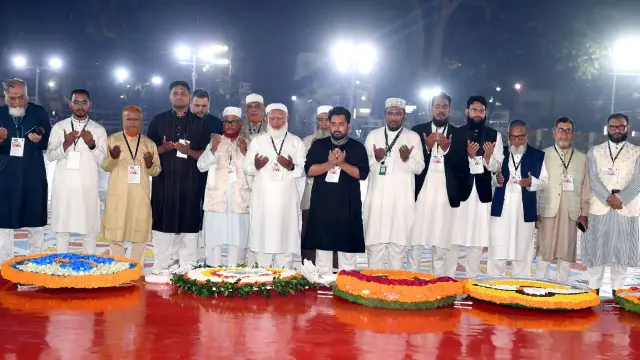
Language is never merely a tool of communication. In Bangladesh, it is memory, legitimacy and power. International Mother Language Day—February 21st, commemorated nationally as Amar Ekushey—is less a ceremony than a civic ritual. At midnight in Dhaka, leaders file barefoot to the Central Shaheed Minar to honour those killed in 1952 while demanding recognition of Bengali. The choreography is familiar. This year, however, the cast raised eyebrows.
President Mohammed Shahabuddin attended. So did the newly elected prime minister, Tarique Rahman Zia of the Bangladesh Nationalist Party (BNP). More strikingly, Dr Shafiqur Rahman, amir of Jamaat-e-Islami and leader of the opposition alliance, laid wreaths alongside representatives of an 11-party coalition. After the official observances, Dr Rahman visited the graves of language martyrs in Azimpur cemetery, accompanied by newly elected MPs and senior party figures.
In Bangladesh’s modern political history, this was not routine. For more than seven decades, Jamaat-e-Islami—rooted in the Islamist thought of Abul Ala Maududi—has maintained an ambiguous, often distant relationship with the symbolic politics of the Language Movement and, later, the Liberation War. This year, the party did more than attend. It organised discussions and commemorations nationwide under its own banner.
Is this contrition, conversion or calculation?
Language of symbolism
Jamaat-e-Islami’s record on the Language Movement and the Liberation War has long shadowed its politics. Critics argue that the party’s historical positions—particularly during 1971—place it at odds with the Bengali nationalist narrative that underpins the republic. Jamaat-e-Islami leaders counter that political contexts evolve and that present commitments should matter more than past controversies.
Yet even as Dr Rahman paid homage at the Shaheed Minar, the party’s communication choices betrayed a certain ambivalence.
At the beginning of Ramadan, his address to supporters was posted on the social-media platform X in Arabic.
نداء إلى صون حرمة شهر رمضان المبارك
— Bangladesh Jamaat-e-Islami (@BJI_Official) February 18, 2026
الدكتور شفيق الرحمن
في بيان صادر عنه بتاريخ 17 فبراير، وجه أمير الجماعة الإسلامية في بنغلاديش، الدكتور شفيق الرحمن نداء إلى أبناء الشعب يحثهم فيه على تعظيم شعائر شهر رمضان وصون حرمته، قائلا:
يهل علينا شهر رمضان المعظم متوشحا بأنوار الرحمة،… pic.twitter.com/1jrsiYYczb
For Language Martyrs’ Day itself, Jamaat-e-Islami released its principal statement in English. Bengali, the language whose defence cost lives, was not always foregrounded.
Jamaat Ameer calls to observe ‘International Mother Language and Historic Martyrs’ Day’
— Bangladesh Jamaat-e-Islami (@BJI_Official) February 19, 2026
Bangladesh Jamaat-e-Islami's Ameer and Leader of the Opposition Dr. Shafiqur Rahman issued a statement today, 19 February calling upon the fellow countrymen to observe 21 February —…
While Dr Rahman said “today” while delivering the speech on February 19th, he carefully evaded mentioning Pakistan in his statement. So, one can find: “In 1952, the students and youth of this country launched a historic movement against the then ruling authorities,” and “To suppress the movement, the then law enforcers opened indiscriminate fire on the demonstrators.”
Not naming Pakistan isn’t merely a carefully calculated step by Dr Rahman; it’s also an act of symbolism.
Symbolism in Bangladesh carries weight. To participate in Ekushey is to claim a share in the republic’s founding myth. That claim invites scrutiny.
Electoral arithmetic and ideological adjustment
Recent elections complicate the picture. Though Jamaat-e-Islami failed to achieve its more ambitious goals, it secured the strongest parliamentary presence in its history. That outcome prompted internal reflection.
A vocal faction of supporters—mostly on social media and heavily influenced by West-based exiled rabble-rousers—alleged irregularities and manipulation. At the grassroots, however, party organisers appear to have drawn a different lesson—religious rhetoric alone does not guarantee a national majority in a complex landscape like Bangladesh.
One episode crystallised this realisation. During campaigning, some Jamaat-e-Islami candidates were accused by rivals of promising voters not merely policy change but heavenly reward. The suggestion that ballots might double as tickets to paradise unsettled even conservative clerics. It underscored a broader truth: most Bangladeshi Muslim voters weigh bread-and-butter issues alongside faith. They do not treat elections as theological referendums.
Equally persistent is the unresolved question of Jamaat-e-Islami’s dark wartime legacy. The absence of an unequivocal reckoning has left scepticism intact. Repeated evasion on issues relating to collaboration with Pakistan and participation in atrocities against Bengalis during 1971 has reinforced the impression—fairly or not—that the party prefers ambiguity to apology.
Against that backdrop, the embrace of Ekushey looks less spontaneous than strategic. National symbols can be powerful solvents. Aligning oneself with them broadens appeal.
Borrowed playbooks
Observers note a resemblance to developments across the border in India. The Hindu-nationalist Bharatiya Janata Party (BJP) and its ideological parent, the Rashtriya Swayamsevak Sangh (RSS), were historically peripheral to India’s anti-colonial movement. In recent decades, however, they have invested heavily in reinterpreting and appropriating nationalist icons once associated with rivals. Historical revisionism has proved electorally useful.
Jamaat-e-Islami’s critics argue that a similar recalibration is under way in Bangladesh: a movement once sceptical of Bengali nationalism now seeks to inhabit it. Publicly, Jamaat-e-Islami remains sharply critical of India. Privately, it appears to have studied aspects of the BJP’s institutional ascent.
The objective is not hard to discern. Jamaat-e-Islami has emerged as the principal opposition force in parliament. Should a more fragmented right-wing landscape develop in future—particularly if the BNP’s dominance wanes—Jamaat-e-Islami would prefer to occupy its centre rather than its fringe.
NCP factor
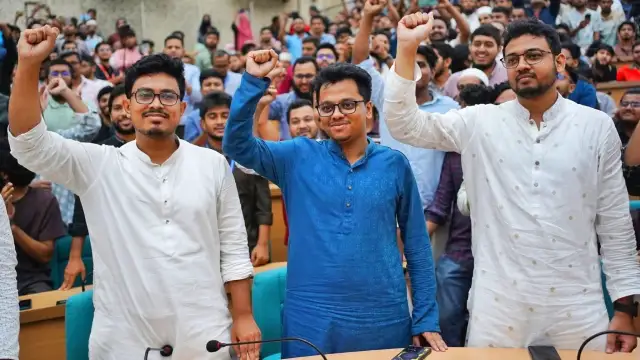
Another variable is the National Citizens’ Party (NCP), a newer formation whose convenor, Nahid Islam, has been seen working closely with Jamaat-e-Islami’s leadership. In a statement marking Language Martyrs’ Day, Mr Islam declared that safeguarding Bengali and other languages spoken in Bangladesh is a collective duty, and that citizens are heirs to those who died for both language and country.
Such language bridges ideological divides. For Jamaat-e-Islami, association with parties that foreground civic rather than theological themes offers reputational insulation. For the NCP, cooperation with an organised Islamist machine yields mobilisation capacity.
Whether this amounts to ideological convergence or tactical coexistence remains uncertain.
Geopolitics and respectability
Bangladeshi politics rarely unfolds in isolation. The US and Western Europe are crucial export markets, particularly for the garment industry. No major party can afford overt estrangement from Western capitals. Jamaat-e-Islami is no exception; nor are the BNP or the Awami League.
At the same time, China, Türkiye and Pakistan maintain lines of communication with various political actors. In such an environment, ideological rigidity gives way to pragmatic calculus. International legitimacy matters. Parties that appear more “national” and less doctrinaire are likelier to be treated as viable interlocutors abroad.
Some analysts argue that Jamaat-e-Islami’s embrace of Ekushey should be read through this lens. Participation in foundational national rituals signals moderation. It suggests that the party seeks to be perceived not as an ideological outlier but as a conventional contender.
Arithmetic of the next contest
In the 13th general election, the BNP secured just under 50% of the vote, while the Jamaat-e-Islami-backed alliance won around 32%. The gap is sizeable. Yet political narratives can narrow distances.
Jamaat-e-Islami believes that a portion of voters historically aligned with the now-banned Awami League abstained or voted tactically for the BNP. Should restrictions on that party ease in future, electoral equations could shift again. A fragmented parliament—particularly under proposals for constitutional reform, proportional representation or the creation of an upper chamber—would enhance the leverage of mid-sized parties.
Under such circumstances, a Jamaat-e-Islami that has successfully re-embedded itself in national symbolism could become indispensable in coalition arithmetic. Symbols are not merely emotive; they are instruments.
Transformation or adaptation?
Does the laying of wreaths signal a genuine transformation? Or is it strategic adaptation to altered incentives?
The distinction turns on candour. True ideological evolution requires public reckoning with contested history. Without that, ceremonial inclusion risks appearing instrumental. Bangladesh’s political past suggests that symbolic gestures rarely substitute for substantive accountability.
Yet politics rewards patience. By participating in Ekushey and organising nationwide commemorations, Jamaat-e-Islami has taken a step that would have been unthinkable a generation ago. Whether it is a bridge to a different future or a carefully measured repositioning will depend on what follows.
For now, the image endures: an Islamist party at the Shaheed Minar, barefoot at midnight, laying flowers beneath the monument to linguistic nationalism. In Bangladesh, that is never a neutral act.
East Post is an independent geopolitical analysis portal covering South Asia and global power dynamics for international audiences. Views expressed are analytical and do not constitute endorsement of any state or non-state actor.
Join our channels on Telegram and WhatsApp to receive geopolitical updates, videos and more.