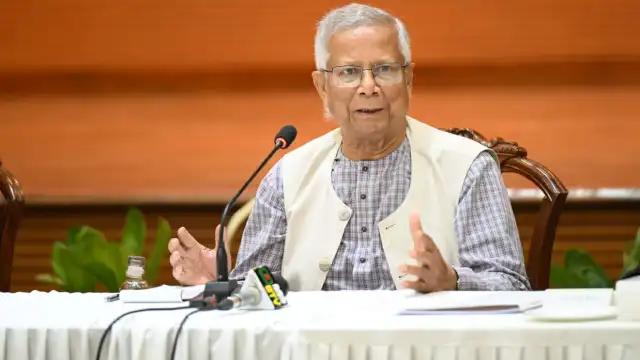
Bangladesh’s Chief Adviser (CA) Muhammad Yunus faces a sophisticated disinformation campaign as Indian deceptive propaganda on Bangladesh undermines Dhaka’s interim government. The assault combines traditional media outlets with social media, exploiting Bangladesh’s volatility during a crucial political transition to advance India’s regional interests.
American pressure on India to drive a wedge between China and Bangladesh has prompted New Delhi to intensify its campaign against the interim government.
India employs a two-pronged strategy—unleashing its unofficial channels, particularly the ruling Bharatiya Janata Party‘s (BJP) Hindutva ecosystem, to depict Bangladesh as a failed state overrun by Islamists, while simultaneously issuing critical official notes.
The timing proves opportune for India.
With Dhaka falling from Washington’s favour after Donald Trump‘s return to the White House in January 2025, following his landslide November 2024 victory, India has seized the moment to corner Bangladesh.
In doing so, India has applied a two-pronged strategy.
Indian propaganda on Bangladesh adopts dual manipulation strategy
India’s approach reveals calculated sophistication.
On one hand, New Delhi relies on the deposed Awami League to propagate narratives of Bangladesh sinking amid Islamist resurgence.
On the other hand, it manipulates different Islamist factions, including Jamat-e-Islami Bangladesh, to create provocations and unrest supporting New Delhi’s narrative, critics argue.
In a nutshell, India’s strategy exploits Bangladesh’s genuine political tensions while amplifying them through coordinated disinformation campaigns.
This complex manipulation forces Mr Yunus’s office into a constant defensive mode, combating narratives peddled by India across multiple fronts.
Wearing the fact-checker’s hat, the CA’s office plunges into the arena to defend itself.
Recent evidence of such acts emerged when Mr Yunus’s office confronted an op-ed by far-right Hindutva-incensed author MD Nalapat in The Sunday Guardian newspaper.
The piece exemplified the author’s confused loyalty to Prime Minister Narendra Modi‘s government, which controls India’s media landscape.
“Bangladesh has in effect become a captive of extremists who use the standing within much of the international community of Yunus to camouflage and to whitewash the atrocities they are doing, not least amongst the shrinking Hindu and Christian minorities of the country,” Mr Nalapat wrote.
This irked Dhaka, which denies any involvement of the ruling clique in communal violence targeting minorities.
Systematically debunking Indian propaganda on Bangladesh
The CA’s office methodically dismantled such propaganda talking points.
Officials called the claims “entirely false and unsubstantiated or based on opinion rather than verified facts.”
“The interim government consists primarily of respected technocrats, legal experts, and civil society leaders, with no evidence indicating Islamist influence or control,” Mr Yunus’s office stated.
“The government has taken steps to prevent communal unrest and reinforce Bangladesh’s longstanding commitment to secularism,” it added.
Mr Nalapat’s article also claimed Bangladesh had become “subservient to the Pakistan army”, which is what the BJP peddles through its ecosystem in India.
The CA’s office countered that Bangladesh maintains sovereign diplomatic relations with Pakistan following international norms and national interests.
A cargo vessel from Karachi arrived at Chittagong Port in November 2024 carrying industrial raw materials and consumer goods, according to Prothom Alo.
Indian Hindutva-incensed mainstream media cited the report to allege that Bangladesh received Pakistani weapons.
Such trade activity does not imply military subservience or sovereignty erosion, the CA’s office asserted, highlighting the issue.
On May 30th, Hindutva-inclined author Omar Ghazi published similar attacks against Bangladesh in Firstpost, owned by Indian tycoon Mukesh Ambani’s Network18 group.
“The columnist went on to claim that the July-August movement in Bangladesh was not a genuine, grassroots uprising demanding justice, but rather a carefully orchestrated operation masterminded by the CIA, with Pakistan’s Inter-Services Intelligence (ISI) acting as a willing collaborator,” the CA’s office paraphrased the allegations.
“However, these allegations are entirely unfounded and appear carefully crafted to propagate the narrative of the fallen Awami League,” the CA’s office claimed.
“The July movement itself was not a CIA-ISI conspiracy but a spontaneous outpouring of anger by students and ordinary citizens against Sheikh Hasina’s brutal, authoritarian rule, which had suppressed democracy and led to widespread violence. Tens of thousands took to the streets demanding her removal after witnessing hundreds of deaths caused by her government’s security forces. According to a UN fact-finding mission, approximately 1,400 protesters were killed during this period,” Mr Yunus’s office further said.
“The narrative of the United States seeking to establish control over Saint Martin’s Island is a baseless fabrication pushed by Sheikh Hasina’s camp,” it added, lambasting Mr Ghazi.
“Ultimately, Omer Ghazi’s article merely echoes the defeated Awami League’s narrative, reflecting a well-coordinated campaign across social and international media to undermine Bangladesh and the interim government. This propaganda effort seeks to delegitimize the current administration while whitewashing the record of the previous regime,” the statement said in conclusion.
The systematic nature of these false narratives becomes clear when examining multiple sources.
Rohingya corridor controversy exploited
Indian propaganda on Bangladesh has intensified around the humanitarian corridor that Mr Yunus’s government agreed to open for UN aid supplies to Rohingyas in Myanmar’s Rakhine state.
This issue faces obstinate resistance domestically from the far-right Bangladesh Nationalist Party to the left-wing Communist Party of Bangladesh, with even Army Chief Waker-Uz-Zaman raising concerns.
Mr Yunus’s office addressed false social media claims about 20,000 Bangladeshi militants joining the Arakan Army through alleged US-backed networks.
“Some social media accounts falsely claim that 20,000 Bangladeshi militants have joined the Arakan Army, recruited through a U.S.-backed network and supplied with weapons and training,” the office wrote on X.
“These claims are entirely false and politically motivated to spread fear and confusion. There are no credible reports, evidence, or official statements supporting the existence of such a large militant recruitment or Dr. Yunus’s involvement (sic).”
The office emphasised that Bangladesh operates no humanitarian corridors with Myanmar, making the arms assistance allegations baseless.
“The coordinated repetition of these narratives across multiple social media accounts indicates a deliberate campaign to discredit Bangladesh, reflecting a broader anti-Bangladesh agenda aligned with the fascist Awami League’s political interests,” the CA’s office.
Global credibility crisis for Indian Media
India’s media credibility suffers globally as these campaigns intensify.
The World Economic Forum’s Global Risks Report 2024 identified India as a hub of misinformation.
This falling credibility undermines the effectiveness of coordinated propaganda campaigns around religious minority persecution in Bangladesh.
The irony deepens when considering India’s own intelligence relationships with the US.
New Delhi’s accusation of Mr Yunus serving as a CIA stooge ignores that India maintains extensive intelligence-sharing frameworks with America that Bangladesh lacks.
India’s Research & Analysis Wing and Intelligence Bureau maintain cordial relations with American intelligence agencies, including the CIA.
The concerted anti-Bangladesh campaign gains momentum when Dhaka strengthens ties with China and cements relationships across the Asia-Pacific region.
This pattern suggests India’s propaganda efforts serve broader strategic objectives beyond simple bilateral tensions.
The propaganda aims at isolating Bangladesh, but the CA’s tours around Asia-Pacific have proved that the strategy isn’t working.
As Indian media reaches new depths in maligning Bangladesh’s image, the global backlash intensifies.
Yet mainstream Indian outlets continue peddling false narratives, aided by some American and European elements whenever Bangladesh grows closer to China or strengthens Asian partnerships.
Mr Yunus’s office has demonstrated remarkable persistence in countering each false narrative systematically.
Amid this, the Chinese have proposed to help the interim government in fighting misinformation.
According to The Business Standard, Chinese Ambassador to Bangladesh Yao Wen had sent a letter on May 21st to Mahfuj Alam, the interim government’s information adviser, stating that Beijing can help Dhaka with the same strategies that it uses to combat misinformation regarding itself across the world.
For India, this will be another major blow.
This defensive posture, while necessary, highlights the resource drain India’s campaign imposes on Bangladesh’s interim government as it attempts to implement democratic reforms and prepare for elections between December 2025 and June 2026.
What India could’ve done?
For India’s BJP, prolonging Bangladesh’s crisis and a rise in violence against the minorities, especially the Hindus, is politically beneficial.
Optics of purported Hindu repression in Bangladesh help the BJP polarise India’s majority Hindu community against its minority Muslims, especially in the provinces bordering Bangladesh like Assam, Tripura and West Bengal.
Keeping this in view, since August 2024, Mr Modi’s government has followed a hostile approach regarding Bangladesh and allowed the vicious campaigns against it.
In a bid to further its political interests, the BJP has jeopardised India’s long-term geopolitical interests in the region.
Although the CA’s office, which follows Bangladesh’s traditional pacifist foreign policy, has extended the olive branch to India several times, the BJP’s myopic interests are preventing the formation of new ties in these new circumstances.
Instead, the BJP and Mr Modi’s government have thrown all their weight behind the deposed Ms Hasina.
It has not just irked Mr Yunus’s government but also the majority of Bangladeshis who accuse India of hegemonic expansionism.
This has caused immense harm to India’s interests.
For India, it’s imperative to discard its disinformation campaigns and seriously review its Bangladesh policy, leaving aside jingoism and Islamophobia.
Without a peaceful and stable Bangladesh and the region, India can’t afford to enjoy security and stability itself.
This makes it imperative for the Indian side to desist from running disinformation propaganda on Bangladesh.
Rather, it must seize the opportunity to strengthen ties with the interim and the post-election governments.
Else, BJP’s Hindutva-laced campaigns cause grave losses to India’s prestige. And with China joining Bangladesh to fight misinformation, India finds itself in a disadvantaged position in the subcontinent.
The battle over Bangladesh’s international image reflects broader regional power dynamics as India seeks to maintain influence over its neighbours while China expands its presence across South Asia.
East Post is an independent geopolitical analysis portal covering South Asia and global power dynamics for international audiences. Views expressed are analytical and do not constitute endorsement of any state or non-state actor.
Join our channels on Telegram and WhatsApp to receive geopolitical updates, videos and more.