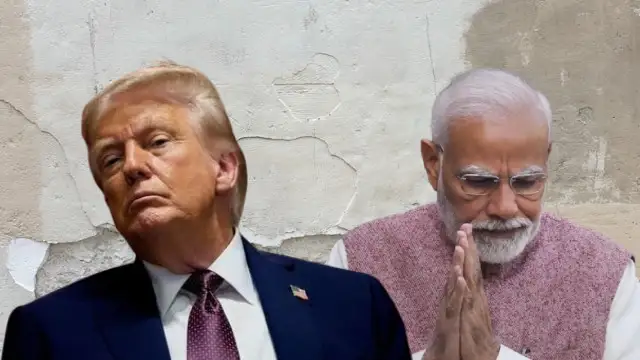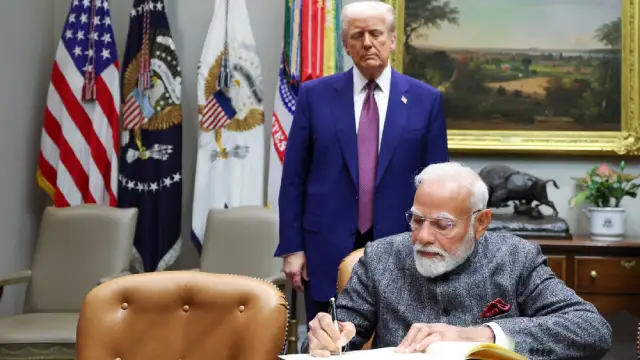
Indian Prime Minister Narendra Modi’s name has surfaced in the newly released Jeffrey Epstein files in Washington—an embarrassment that could scarcely have come at a worse moment. As questions swirl over his alleged efforts to placate Israel at the behest of a former American president, Mr Modi is simultaneously presenting a hastily announced India–United States trade deal as a diplomatic triumph. The timing is awkward. So are the optics.
In early February, Mr Modi found himself squeezed from both sides. Donald Trump, the US president, declared that a long-awaited India–US trade agreement had been concluded. Almost simultaneously, Epstein’s emails—released by the US Department of Justice following a Supreme Court order—dragged the Indian leader into an unsavoury international controversy. Together, the two episodes cast doubt on Mr Modi’s carefully cultivated image as a strong nationalist leader able to stand up to Washington.
Outside India’s mainstream media, much of which has rallied behind him, the broader picture looks less flattering. Mr Modi’s government has spent months trying to persuade Mr Trump to roll back punitive tariffs imposed on Indian exports. Those tariffs—25% on top of an existing 25% levy—were introduced in August last year after Mr Trump accused India of indirectly funding Russia’s war in Ukraine by buying discounted Russian oil.
After months of back-channel liaison, Piyush Goyal, Mr Modi’s commerce minister, succeeded in brokering a deal. Yet unlike India’s negotiations with the European Union over a free-trade agreement, New Delhi has disclosed virtually nothing about the terms. Indians instead learned of the agreement through a post by Mr Trump on his proprietary social-media platform, Truth Social—an asymmetry that underlined who was setting the narrative.
Even India’s External Affairs Minister S Jaishankar has distanced himself from the US trade deal, pushing the ball to Goyal’s court. The fine print of the agreement is yet to reach New Delhi’s policymakers, according to experts.
Although the precise contours of the deal remain opaque, Mr Modi has claimed it will benefit Indian exporters. Available data, as well as Mr Trump’s own words, suggest otherwise.
Trump sets terms for India-US trade deal
Unlike most bilateral trade agreements, the India–US trade deal was not unveiled at a joint press conference or formal signing ceremony. Characteristically, Mr Trump announced its conclusion online.
“Out of friendship and respect for Prime Minister Modi and, as per his request, effective immediately, we agreed to a Trade Deal between the United States and India, whereby the United States will charge a reduced Reciprocal Tariff, lowering it from 25% to 18%. They will likewise move forward to reduce their Tariffs and Non Tariff Barriers against the United States, to ZERO. The Prime Minister also committed to ‘BUY AMERICAN,’ at a much higher level, in addition to over $500 BILLION DOLLARS of U.S. Energy, Technology, Agricultural, Coal, and many other products (sic),” the president wrote.
"It was an Honor to speak with Prime Minister Modi, of India, this morning… He agreed to stop buying Russian Oil, and to buy much more from the United States and, potentially, Venezuela. This will help END THE WAR in Ukraine" – President Donald J. Trump 🇺🇸 pic.twitter.com/RD7PZ8S16z
— The White House (@WhiteHouse) February 2, 2026
Mr Modi responded enthusiastically on X (formerly Twitter). “Delighted that Made in India products will now have a reduced tariff of 18%. Big thanks to President Trump on behalf of the 1.4 billion people of India for this wonderful announcement,” he wrote.
Wonderful to speak with my dear friend President Trump today. Delighted that Made in India products will now have a reduced tariff of 18%. Big thanks to President Trump on behalf of the 1.4 billion people of India for this wonderful announcement.
— Narendra Modi (@narendramodi) February 2, 2026
When two large economies and the…
His government and the far-right Bharatiya Janata Party (BJP), which rules at the federal level, quickly portrayed the announcement as a major diplomatic victory. Mr Goyal remained conspicuously in the background while Mr Modi was showered with praise by supporters for clinching the deal.
Yet while BJP leaders, party apparatchiks and Indian diplomats have repeatedly claimed that the agreement slashes tariffs from 50% to 18%—lower, they note, than those faced by neighbours such as Bangladesh and Pakistan—a look at historical data tells a less celebratory story.
According to World Bank figures for 2022, the first full year after the pandemic, the average tariff applied to more than 5,600 Indian commodities exported to the US was just 3.89%. Under the new arrangement, that average rises to 18%—more than 4.6 times higher than before. What New Delhi is presenting as a victory looks, in relative terms, like a retreat.
In 2022, 54 categories of Indian goods entered the American market duty-free. These included animal and agricultural products, raw materials and minerals, manufactured goods and machinery, metals and pharmaceuticals. Under the new regime, all will face significantly higher price barriers, potentially curbing long-term demand.
That year, only three Indian commodity groups attracted tariffs of 18% or more. Under the new deal, more than 5,600 will do so. For exporters, the relief promised by the government appears largely illusory.
What India stands to lose
Mr Modi has argued that “Made in India” products will now face lower tariffs than the 50% Mr Trump had imposed. But the greater concern lies on the import side. As with India’s proposed free-trade agreement with the European Union, the deal with Washington appears to grant greater market access to the other party.
Mr Trump has said that India agreed to purchase additional American goods beyond $500bn worth of energy, technology, agricultural products, coal and other commodities. “They will likewise move forward to reduce their Tariffs and Non Tariff Barriers against the United States, to ZERO,” he wrote, adding that Mr Modi had committed to “BUY AMERICAN”.
The Indian government has remained silent on whether it has agreed to slash tariffs or substantially increase imports. That silence is telling.
In 2022, American exports to India faced an average tariff of 13.86%, with the top five product categories subject to levies ranging from 100% to 150%.
Only 13 types of US goods entered India duty-free. According to data from the Global Trade Research Initiative, India imported $70bn worth of American goods in 2023 while running a trade surplus of $50.1bn.
If Mr Trump’s claims are accurate, that surplus would evaporate. India would be compelled to import nearly seven times more from the US, draining dollars and putting downward pressure on the rupee.
How such an outcome would benefit India’s economy remains unclear.
Oil and leverage
Mr Trump’s post also claimed that India had agreed to stop buying Russian oil. “We spoke about many things, including Trade, and ending the War with Russia and Ukraine. He agreed to stop buying Russian Oil, and to buy much more from the United States and, potentially, Venezuela,” the president wrote, adding that this would help end the war (sic).
If accurate, the pledge marks a sharp reversal. Mr Modi’s government had previously defended its purchases of discounted Russian crude. Before the Ukraine war, India— which imports more than 88% of its fuel—sourced just 0.2% of its oil from Russia. By 2023-24 and 2024-25, Russian supplies accounted for roughly a third of India’s crude basket, reaching 2m barrels per day.
Following Mr Trump’s tariff measures, those purchases fell. By December 2025, Russian fuel imports had dropped below 1.3m bpd. In the first three weeks of January 2026, they averaged 1.1m bpd. By the end of February, imports are expected to fall below 800,000 bpd.
Cheaper Russian oil, however, has brought little relief to Indian consumers. The gains accrued largely to oil-marketing companies, whose profits surged.
Although New Delhi has said little publicly about the future of Russian imports, recent diplomatic behaviour suggests that Mr Trump’s claims may not be unfounded. India maintained a conspicuous silence after the reported abduction of former Venezuelan president Nicolás Maduro by the Trump administration on January 3rd. The foreign ministry issued only an ambiguous statement, avoiding any direct criticism.
Nor did India join fellow BRICS members—Brazil, China, Iran, Russia and South Africa—in strongly condemning the episode.
Instead, Mr Modi phoned Delcy Rodríguez, Venezuela’s acting president, after her government moved to normalise relations with Washington.
The two reportedly discussed the oil trade. Following reforms in Venezuela’s petroleum sector designed to appease Mr Trump, India is once again free to buy Venezuelan crude—though payments will effectively pass through the US, which controls the country’s oil funds.
The episode completes a cycle that began in 2019, when Mr Modi joined Mr Trump at a rally in Texas branded “Howdy Modi”. During that visit, Mr Modi openly courted the American president’s favour and met US oil executives eager to enter the Indian market. The pandemic, Mr Trump’s electoral defeat and the Ukraine war disrupted those ambitions. They now appear to be back on track.
Russian unease
India’s gradual pivot has unsettled Russia. Since the launch of Vladimir Putin’s “special military operation” in Ukraine, New Delhi has been one of Moscow’s most important economic partners, particularly in energy. Trading in local currencies made the arrangement especially attractive for Russia.
Russian officials and state-aligned media have gone to some lengths to flatter Mr Modi. Mr Putin has publicly suggested that the Indian leader would never act against his country’s national interests, and even claimed that Russia would compensate India for losses stemming from Mr Trump’s tariffs.
During Mr Putin’s visit to India in December 2025, Russian business delegations sought ways to expand bilateral trade. Yet Russia lacks the capacity to offset India’s potential loss of access to the American market. Although neither side has announced an end to Russian oil imports, purchases are expected to decline steadily as India increases imports from the US, Venezuela and the Gulf monarchies—at higher cost and over longer distances.
India’s recent outreach to the United Arab Emirates, cemented at an India–Arab League meeting held amid rising tensions between the UAE and Saudi Arabia, suggests an effort to diversify supplies. Whether that will prevent a widening trade deficit remains uncertain.
Delighted to receive the Foreign Ministers and delegations of the Arab League today. The Arab world is a part of India’s extended neighbourhood, linked by deep civilisational bonds, vibrant people-to-people connections and enduring brotherly ties, as well as a shared commitment… pic.twitter.com/GSqth4nXEN
— Narendra Modi (@narendramodi) January 31, 2026
Epstein’s shadow
The political damage may extend beyond trade and energy. Opposition parties have seized on Mr Modi’s mention in Epstein’s correspondence. In a 2017 email to an associate identified as “Jabor Y”, Epstein claimed that the Indian prime minister had followed instructions from the US president and “appeased the Israelis” during his first visit to the occupied Palestinian territories.
“The Indian Prime minister modi took advice. and danced and sang in israel for the benefit of the US president… IT WORKED. (sic)!” Epstein wrote.
The resurfacing of the email coincided with Mr Trump’s announcement of the trade deal, prompting questions about the extent to which Mr Modi may have compromised India’s autonomy to placate Washington. Similar doubts arose in May 2025 after Mr Trump claimed he had brokered a ceasefire between India and Pakistan. While India’s foreign ministry and the BJP denied the assertion, Mr Modi declined to publicly contradict the US president.
Now, with another visit to Israel scheduled later this month, the Indian leader faces renewed scrutiny. A trade deal widely seen as lopsided, pressure to realign energy policy, and an uncomfortable association with Epstein’s claims have made it harder for Mr Modi to sustain his image as an assertive nationalist.
With key state elections looming in Assam, Kerala, Tamil Nadu and West Bengal, the political costs may yet mount. Whether his party can convincingly defend an agreement in which Washington appears to hold most of the cards remains to be seen.
Join our channels on Telegram and WhatsApp to receive geopolitical updates, videos and more.