Though PM Modi claims that India’s national security has been strengthened under his rule, facts show how it has been suffering, especially due to the excessive use of security agencies for political gimmicks.
Like any far-right party, India’s federally-ruling Bharatiya Janata Party (BJP) emphasises national security. Incumbent Prime Minister Narendra Modi always highlights his ten-year-long government’s purported achievements in strengthening national security and making India militarily assertive.
However, a recent chain of events has contradicted Mr Modi’s narrative and caused severe embarrassment for India’s intelligence services.

At the time of writing this report, the soldiers of the Indian Army’s 37 Rashtriya Rifles (RR) and its special forces are carrying out a search and cordon operation in Jammu’s Poonch district to nab suspected gunmen who attacked a convoy of Indian Air Force (IAF) personnel, killing one and injuring five on the evening of Saturday, May 4th.
The IAF personnel were ambushed near Shahsitar, between Surankote’s Sanai Top and Mendhar’s Gursai area in the district that shares a border with neighbouring Pakistan. The IAF personnel belong to a unit collocated with 37 RR in Mendhar.
The militant attack on the IAF personnel in Poonch has become a shocking incident amid the high-voltage election canvassing. The critics of the government claim that the Poonch incident mocks the BJP’s claim that under Mr Modi’s rule, the incidents of “cross-border terrorism” have considerably fallen to an unprecedented level.
New Delhi accuses its bête noire Pakistan of running a proxy war using non-state actors, trained terrorists, over the control of the United Nations-recognised disputed territory of the former princely state of Jammu & Kashmir.
The Poonch attack on IAF personnel is not a standalone issue. This attack is part of a chain of events in recent years that have raised questions on the credibility of Mr Modi’s claims that India’s national security has been enhanced under his rule.
According to the BJP’s principal opponent, the Indian National Congress, while there were no major incidents of militant attacks in the Poonch area between 2007 and 2014, 25 soldiers and eight civilians have lost their lives in the area since January 31st of this year.

In the last few years, Indian intelligence has suffered setbacks in several parts of the world after some of its overtly ambitious operations, which critics claim are allegedly designed to serve Mr Modi’s overall political goals, were botched up and several of its officials were exposed.
The ‘New Mossad’ aspiration
“What do you think…Indian agencies didn’t have such capability (of covert operations) earlier. Of course, it was there. What has changed now is the emergence of India as a powerful nation and go-ahead from the government in power”, the EuroAsian Times had quoted a former Indian intelligence officer NK Sood saying.
Mr Sood was hailing Mr Modi’s tenure implicitly.
But he isn’t the only one.
Ever since Mr Modi came to power, there has been a bush telegraph that his government has provided leeway to India’s security agencies and the Research and Analysis Wing (R&AW)—India’s external intelligence agency—to launch attacks on anyone who poses a threat to the country. Several high-budget Hindi films were made on this theme.
After Modi’s ascension to power, the Hindu nationalists started propagating that the R&AW would be moulded like the Mossad, the dreaded Israeli secret service agency. They claimed that the R&AW would be able to carry out hit jobs like Mossad in foreign territories and eliminate threats to India.
To spice up this spy game fantasy, Mr Modi appointed Ajit Doval, a former Intelligence Bureau—India’s internal intelligence agency—head, as his National Security Advisor (NSA). Mr Doval, who is projected as a ‘spymaster’ by the BJP sympathisers, has close ties with the Hindu nationalist camp and has an ideological affinity with the Rashtriya Swayamsevak Sangh (RSS), the parental body of the BJP.
After Mr Doval became the NSA, it’s claimed that the R&AW went into a fast-forward mode to emulate the Mossad model. At least 20 killings in Pakistan alone are attributed to the R&AW.
Although neither Mr Modi, who is the minister in-charge of the R&AW, nor Mr Doval made any comments on the allegations of these killings by the external agency, India’s Defence Minister Rajnath Singh claimed in a television interview that the Modi government can go to a foreign country and punish India’s enemies.
“If any terrorist from a neighbouring country tries to disturb India or carry out terrorist activities here, he will be given a fitting reply. If he escapes to Pakistan we will go to Pakistan and kill him there,” Mr Singh told News18.
While it seems, Mr Singh was trying to titillate the ultra-right vote bank of the BJP, his comments can boomerang for India, as the Ministry of External Affairs (MEA) officers are consistently rubbishing the claims made by the western mainstream media in their ‘reports’.
Although the Indian government cracked the whip on the Delhi-based news portal NewsClick after The New York Times launched a scathing attack against it last year, using a dubious ‘investigation’, due to the MEA’s selective approach, it has outright rejected the recent media reports critical of New Delhi.
Apparently, driven by its success in Pakistan, the R&AW has attempted to spread its net further, especially to the West, but suffered setbacks.
The alleged ‘assassination’ in Canada
Last year, Canada accused India of killing Sikh separatist Hardeep Singh Nijjar in June outside a Gurdwara in Surrey, a Vancouver suburb. Canadian Prime Minister Justin Trudeau officially accused Indian intelligence of the murder while addressing the Parliament.
Mr Trudeau’s accusation, backed by the US agencies, ironically came soon after the G20 Summit in New Delhi where he was warmly welcomed by Mr Modi. Mr Trudeau’s allegations sparked an Indo-Canada diplomatic spat, causing a deterioration of bilateral relations and trouble for Indians who sought visas to Canada, especially the students.

While India kept denying Canada’s allegations, the Royal Canadian Mounted Police (RCMP) on Friday, May 3rd, arrested and charged three Indian men with the murder of Mr Nijjar. According to the police, the accused are Karanpreet Singh (28), Kamalpreet Singh (22) and Karan Brar (22).
“We are investigating their ties, if any, with the Indian government,” Mandeep Mooker, a superintendent of the RCMP, told the press.
What’s surprising is that the US government, with which Mr Modi has been flaunting New Delhi’s ties with much fanfare, has been providing support to the RCMP in this case.
The reason behind the US’s support of its neighbour is India’s similar faux pas in its territory.
The botched-up US ‘plan’
Last year, the FBI alleged that the Indian authorities hatched a conspiracy to kill Gurpatwant Singh Pannun, a dual citizen of the US and Canada, who is the general counsel for a Sikh separatist organisation in America called Sikhs for Justice.
On November 29th, the US federal prosecutors charged Indian national Nikhil Gupta with a foiled plot to kill Mr Pannun on US soil. Mr Gupta allegedly worked on behalf of an R&AW official and attempted to hire an assassin to shoot Mr Pannun in New York City.
However, according to the US federal prosecutors, Mr Gupta contacted an undercover FBI informer to carry out the job, while sitting in India. He even conducted video calls with the R&AW official and the undercover FBI agent, exposing the Indian officer to the Americans.
It’s alleged that Mr Gupta was roped in by the R&AW officer with the promise of ending criminal cases lodged against him in India. But that didn’t happen. Mr Gupta found himself in the soup.
Mr Gupta was arrested on June 30th by Czech authorities, soon after Mr Modi’s much-hyped maiden ‘state visit to the US’. The US has been pursuing his extradition. Later, the US government revealed the identity of the R&AW operative handling Mr Gupta as Vikas Yadav.

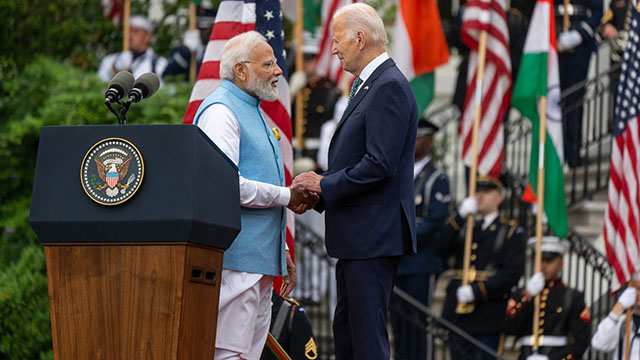
Indian Prime Minister Narendra Modi with US President Joe Biden during a bilateral meeting at the sidelines of the G-20 Summit in New Delhi on September 8th 2023. (Photo: PIB)
The Washington Post claimed in a report that Mr Yadav, an officer of the Central Reserve Police Force (CRPF), an Indian paramilitary force, who was on secondment in the R&AW, lacked the training and skills needed for an operation that meant going up against sophisticated US counter-intelligence capabilities.
The Post’s report also claimed that the US authorities believe that Mr Yadav wasn’t acting as a lone wolf, which New Delhi earlier tried to peddle. Rather, his actions were endorsed by Samant Goel, the former R&AW chief.
“In reports that have been closely held within the American government, U.S. intelligence officials have assessed that the operation targeting Pannun was approved by the RAW chief at the time, Samant Goel (sic),” the report said.
The Post claimed that the operations had sanction from the senior R&AW authorities who allegedly have “ties to” Mr Modi’s inner circle, indicating Mr Doval, the self-styled ‘intelligence Tsar’.
“U.S. spy agencies have more tentatively assessed that Mr. Modi’s National Security Adviser, Ajit Doval, was probably aware of RAW’s plans to kill Sikh activists (sic),” it highlighted.

Though New Delhi has denied any role in the botched-up operation to kill Mr Pannun using a hitman, the evidence collected by the US authorities could cause further embarrassment to Mr Modi’s government. And the US isn’t relenting.
Even though the US, which hysterically shoots weather research balloons suspecting them of being aerial reconnaissance vehicles, approached New Delhi without much fanfare, on a far serious case of sovereignty violation like Mr Pannun’s alleged assassination plot.
Considering India’s crucial role in the anti-China military alliance QUAD, the US isn’t amplifying its concern. However, even though the US remains passive, more such incidents of the R&AW’s blunders in Canada and Australia have come to light.
The Australian gaffe
While Australia has been a partner of India and the US in the QUAD, and an American ally, new details emerging from the country have shocked many.
According to the Post, New Delhi was behind the “nest of spies” that Australian secret service agency ASIO’s chief Mike Burgess had disclosed in his 2021 speech. The latest revelations by Australian broadcaster ABC, followed by the Sydney Morning Herald, show that two R&AW operatives were expelled from Australia in 2020 for their alleged attempt to steal defence secrets, attempts to poach politicians and illegally monitor the Indian diaspora.
Australian Foreign Minister Penny Wong claimed that the government will push back against any foreign interference in the country. Although Australia is keen to increase its bilateral engagements with India in the backdrop of their shared hostility towards China’s aggrandisement, Wong said Canberra has acted “consistent to our interests and to our values in all of our engagements”.
The road doesn’t end here
The Post claimed in a separate press release that several other R&AW officials, known as ‘Research Officers’, faced “arrest, expulsion and reprimand” in the recent months. It based these findings on interviews with “more than three dozen current and former senior officials in the United States, India, Canada, Britain, Germany and Australia”.
One of the biggest allegations against the R&AW is that it’s mostly targeting the Indian diaspora in the western countries, especially the communities that are critical to New Delhi, like several Sikhs based there.
As these lapses cause embarrassment, the MEA has been evading questions related to them. It didn’t comment when the Post asked it for its opinion on the allegations. The MEA spokesperson only said that a “high-level committee is looking into information” shared by the US and that to prevent these incidents from embarrassing the government, it has imposed a ban on Australian broadcaster ABC and Canadian CBC in India.
While banning television channels, blocking the internet and boasting extra-territorial killings to earn brownies, Mr Modi’s government overlooked the need for enhancing the security cover for India’s troops, especially in crucial areas like Jammu & Kashmir.
Despite the tall talks on national security, botched-up operations, over-exhausting the R&AW’s striking rather than enhancing its intelligence collection, analysis and preventive machinations, led to several disastrous incidents like the Poonch attack that not only caused embarrassment to India’s security establishments but also exposed its vulnerabilities to the world, providing ample opportunities of exploiting them to the hostile forces.
East Post is an independent geopolitical analysis portal covering South Asia and global power dynamics for international audiences. Views expressed are analytical and do not constitute endorsement of any state or non-state actor.
Join our channels on Telegram and WhatsApp to receive geopolitical updates, videos and more.