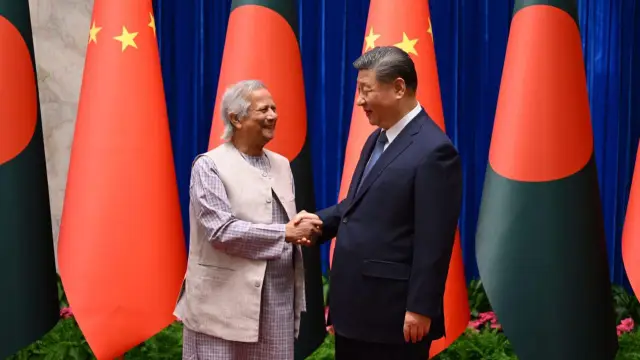
When Muhammad Yunus became chief adviser of Bangladesh’s interim government last August, few expected the Nobel Prize-winning economist to tilt away from his western allies. Yet on March 28th 2025, as Professor Yunus concluded a four-day visit to China, the shift in Bangladesh’s geopolitical compass became unmistakable. Standing alongside Chinese officials in Beijing, the man once celebrated in Washington’s corridors of power signed a dozen cooperation agreements with the world’s second-largest economy—a pointed rebuke to America’s diminishing influence and India’s overbearing presence in South Asia.
The timing is significant. This year marks the 50th anniversary of diplomatic relations between Bangladesh and China, a milestone that offers convenient cover for what appears to be a strategic pivot. “The relationship between the two countries remains strong,” wrote Zhang Xiaoyu, director of the Centre for South Asian Communication Studies at China’s Communication University, in the state-run Global Times. What Mr Zhang diplomatically omitted is that this strengthening comes as Bangladesh’s relationships with both America and India have noticeably deteriorated.
From Washington’s darling to Beijing’s embrace
Before his current role, Professor Yunus personified the archetypal globalist hero—founder of microfinance pioneer Grameen Bank, Nobel Peace Prize laureate, and a figure warmly embraced by America’s Democratic establishment. When student-led protests toppled Sheikh Hasina‘s increasingly authoritarian government last summer, Mr Yunus emerged as Washington’s preferred steward for Bangladesh’s transition.
But geopolitical winds change quickly. November 2024 saw Donald Trump return to the White House, bringing his “America First” doctrine and deep scepticism of Mr Yunus’s globalist credentials. The new administration promptly slashed USAID projects in Bangladesh, maintaining funding only for Rohingya refugee programmes that serve America’s broader anti-China messaging.
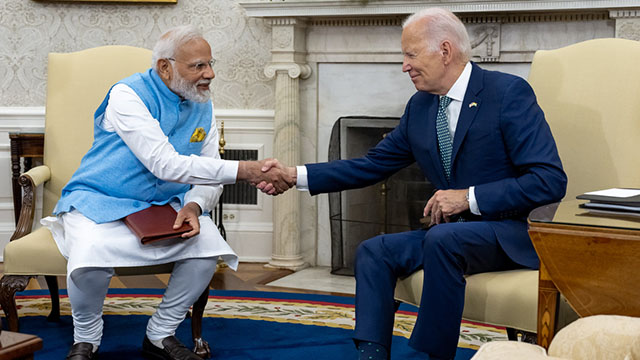
More alarming for Dhaka was Mr Trump’s February meeting with Indian Prime Minister Narendra Modi, during which the American president effectively delegated Bangladesh policy to New Delhi. “There was no role for our deep state. This is something that the Prime Minister has been working on for a long time, for hundreds of years, frankly, I have been reading about it. I will leave Bangladesh to the Prime Minister,” Mr Trump told reporters, displaying what many Bangladeshis viewed as colonial-era disregard for their sovereignty.
This strategic outsourcing coincided with the growing anti-India sentiment within Bangladesh. The interim government’s request for India to repatriate Ms Hasina, who fled to Delhi after her government collapsed, was rebuffed. Dhaka has also proposed reviewing several memorandums of understanding signed with India during Ms Hasina’s tenure, which many Bangladeshis perceive as unfairly favouring Indian interests.
Xi offers concrete support as Delhi dithers
The contrast between China’s substantive offers and India’s reticence was starkly evident during Yunus’s meetings with President Xi Jinping in Beijing. Unlike Ms Hasina, who returned empty-handed from China just months before her government’s collapse, Professor Yunus secured tangible commitments that directly address Bangladesh’s economic challenges.
“China would continue to grant zero-tariff facilities to Bangladeshi goods and extend the status until the end of 2028,” Mr Xi announced—a crucial two-year extension beyond Bangladesh’s scheduled graduation from least-developed country status. The Chinese leader proposed starting negotiations for a Free Trade Agreement and Investment Agreement, measures that would significantly boost bilateral commerce currently tilted in Beijing’s favour.
Most significantly, Mr Xi pledged to “encourage more Chinese private investment and relocation of Chinese manufacturing plants to Bangladesh”—precisely the economic shot in the arm that Dhaka has long sought. This promised industrial migration could transform Bangladesh’s manufacturing sector, creating jobs for its burgeoning youth population while diversifying away from the garment industry’s low margins.
The offerings extend beyond trade. President Xi promised support for an “exclusive Chinese industrial economic zone” in Bangladesh and welcomed “high-quality” Belt and Road cooperation—a stark contrast to the stalled infrastructure projects under India’s watch. China also addressed Bangladesh’s healthcare needs, pledging to build a specialised hospital and continue welcoming Bangladeshi patients to medical facilities in Yunnan province.
“Today, we witnessed history in the making. This is a transformational visit,” declared Khalilur Rahman, High Representative of the Chief Adviser, with unmistakable enthusiasm. The meeting’s agenda even covered potential defence cooperation, with discussions about “the purchase of multiple-role combat aircraft” and “multimodal transport connectivity” linking southern China with Bangladeshi ports.
For a country struggling with both economic challenges and regional muscle-flexing from India, China’s comprehensive support package represents a diplomatic triumph for the interim government. Mr Xi’s personal touches—recalling his previous visits to Bangladesh and mentioning his study of Yunus’s microfinance models while governor of Fujian province—added warmth to what might otherwise have been seen as purely transactional diplomacy.
China’s calculated welcome
Beijing, sensing an opportunity in this diplomatic tension, has moved deliberately to strengthen ties. “China strictly follows the principle of non-interference in other countries’ internal affairs,” declared Foreign Minister Wang Yi when meeting Professor Yunus on the sidelines of the UN General Assembly last September. This stance resonates powerfully in Dhaka, where both the Trump administration and India are viewed as meddling in Bangladesh’s sovereignty.
The fruits of this approach were evident in the joint statement released after Mr Yunus met with the Chinese president. China pledged support for multiple infrastructure projects, including the modernisation of Mongla Port and the development of the Chinese Economic and Industrial Zone in Chattogram. Both sides agreed to initiate negotiations on a free trade agreement and optimise their investment treaty.
“The Chinese side welcomed the interim government of Bangladesh led by Professor Muhammad Yunus and noted the reform and progress made by the interim government since August 2024,” the statement read—diplomatic language that directly legitimises a government still viewed warily by Washington and Delhi.
Perhaps most significantly, the Chinese affirmed Bangladesh’s independence to choose its own development path—a subtle but unmistakable critique of Indo-American pressure tactics. “China consistently adheres to the principle of non-interference in the internal affairs of other countries, respects Bangladesh’s independence, sovereignty and territorial integrity,” the statement declared, language certain to resonate with a Bangladeshi populace increasingly resentful of foreign dictates.
India’s proxy role challenges regional stability
India’s approach to its eastern neighbour has grown increasingly problematic since the fall of Ms Hasina, a reliable Delhi ally. The Modi government’s Hindu-nationalist orientation has led to exaggerated claims of “Hindu persecution” in Bangladesh—claims eagerly amplified by Mr Trump and his director of national intelligence, Tulsi Gabbard, despite scant evidence.
During her recent India tour, where she left no stone unturned to exhibit her strong bondings with Mr Modi’s far-right Hindutva camp, Ms Gabbard had highlighted “longtime unfortunate persecution, killing, and abuse of religious minorities like Hindus, Buddhists, Christians, and others has been a major area of concern for the US government and President Trump and his administration.”
Speaking to the Indian media, Ms Gabbard accused Bangladesh of “persecution and killing” of religious minorities and claimed that “the threat of Islamic terrorists” in the South Asian country was “rooted” in the “ideology and objective” to “rule and govern with an Islamist caliphate”.
Her statements echoed the Hindutva camp’s narratives. She also claimed that this narrative will remain the core area of focus during Mr Trump’s dealings with Bangladesh. “The talks are just beginning between President Trump’s new cabinet coming in and the Government of Bangladesh, but this continues to remain a central focus area of concern,” she underscored.
Mr Yunus’s office strongly objected to the statement linking Bangladesh’s upheaval with an “Islamist caliphate” stating, “Political leaders and public figures should base their statements, especially about the most sensitive issues, on actual knowledge and take care not to reinforce harmful stereotypes, to fan fears and potentially even stoke sectarian tensions.”
Ms Gabbard’s statements, which are mostly recycling of Hindutva talking points, further drove a wedge between Washington and Dhaka.
The strategic alignment between Washington and Delhi has created what many analysts describe as a proxy relationship, with India executing America’s containment strategy against China in South Asia. “For the interim government of Bangladesh, a major task is to rebuild diplomatic independence, which means reducing dependence on India’s influence,” noted Mr Zhang in Global Times.
This influence extends beyond politics to resources vital for Bangladesh’s development. “Bangladesh and India share 54 rivers. Most of the rivers originate in India, giving New Delhi some leverage in negotiations,” Mr Zhang observed. The Teesta River management project featured prominently in the China-Bangladesh talks, offering Dhaka a potential counterbalance to India’s water hegemony.
India’s reaction to Bangladesh’s growing Chinese ties has been predictably alarmist. The Hindustan Times characterised Mr Yunus’s visit as underscoring “growing ties between the two nations as diplomatic tensions simmer with neighbouring India.” Qian Feng, director of the research department at Tsinghua University’s National Strategy Institute, told Global Times this perspective is unsurprising: “Indian media [is] highly vigilant about Bangladeshi cooperation with other major powers, leading them to view China-Bangladesh relations through a geopolitical lens and with a biased perspective.”
Economic pragmatism trumps ideological alignment
Despite its fraught political circumstances, Bangladesh’s interim government has demonstrated surprising pragmatism in its economic diplomacy. With nearly 40% youth unemployment and pressing infrastructure needs, the country can ill afford ideological purity.
Professor Yunus seems to recognise this reality. He has previously called on China to relocate solar panel factories to Bangladesh and requested increased imports of Bangladeshi goods to the Chinese market. During his recent visit, agreements were signed covering economic and technical assistance, disaster mitigation, and human resource development.
“This is a reflection of the interim government’s diplomatic policy of balanced pragmatism and prioritising the economy,” Mr Qian told Global Times, “since to revive the economy and improve employment, cooperation with China is essential.”
This approach represents a sharp contrast with Ms Hasina’s final months in power. In July 2024, she visited Beijing seeking a $7bn credit line but returned empty-handed after refusing to offer Chinese businesses greater market access in Bangladesh. Her commitment to alignment with India prevailed over economic necessity—a luxury her successor evidently feels Bangladesh cannot afford.
America’s strategic contraction creates opportunity
The American retreat from global leadership under Mr Trump has created an opportunity for China in Bangladesh and beyond. “With America’s strategic contraction, Bangladesh is uncertain about the extent of assistance the West can provide,” Mr Zhang observed in Global Times. “China remains a viable option for enhancing cooperation in various fields,” he added.
This uncertainty has been compounded by provocative statements from American security experts. Michael Rubin, a prominent US analyst, recently suggested that “Bangladesh either has to follow Egypt’s path [military coup] or it will need a Grenada Solution [Indian military intervention] to avoid becoming a Pakistan and China-backed Taliban nightmare”—rhetoric that many in Dhaka view as thinly veiled threats.
China has moved deftly to counter such pressure. When India tightened visa policies for Bangladeshi medical tourists—a vital service for many citizens—China promptly hosted the first group of Bangladeshi patients in Yunnan Province. The joint statement noted that “Bangladesh expressed appreciation for the convenience provided by China for Bangladeshi patients to seek medical treatment in Yunnan Province.”
A balancing act with uncertain outcomes
Despite the warming China-Bangladesh relationship, significant challenges remain. As Mr Zhang noted, “protecting the safety and interests of Chinese investments in Bangladesh is a crucial task for the interim government.” Political instability continues to complicate the country’s development trajectory.
Bangladesh’s geopolitical reorientation, while notable, should not be overstated. Mr Yunus’s interim government maintains diplomatic engagement with western powers and faces the difficult task of navigating between competing blocs. The joint statement’s reference to “high-quality Belt and Road cooperation” suggests Bangladesh remains open to China’s signature foreign policy initiative without abandoning other partnerships.
Yet the broader strategic implications are unmistakable. As America retreats into isolationism and delegates regional influence to an increasingly assertive India, countries like Bangladesh are seeking alternatives. China’s non-interference stance and economic pragmatism offer an attractive counterweight to Washington’s ideological demands and Delhi’s regional hegemony.
For Bangladesh, the 50th anniversary of its relationship with China marks not just a commemoration of past ties but potentially a new chapter in its foreign policy. As Mr Modi somewhat ironically noted in his Bangladesh Independence Day message: “The spirit of the Liberation War of Bangladesh continues to remain a guiding light for our relationship.” That spirit—of sovereignty and self-determination—may now be leading Bangladesh in directions neither Washington nor Delhi anticipated.
East Post is an independent geopolitical analysis portal covering South Asia and global power dynamics for international audiences. Views expressed are analytical and do not constitute endorsement of any state or non-state actor.
Join our channels on Telegram and WhatsApp to receive geopolitical updates, videos and more.