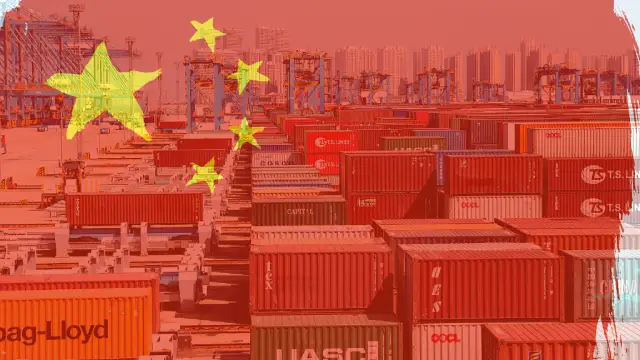
After months of bombastic rhetoric and punitive measures, the United States has abruptly changed course. The China-US trade deal announced this weekend represents a significant retreat from President Donald Trump‘s aggressive trade stance. The 47th American president, who took office in January after winning the November 2024 election, appears to have accepted economic reality.
The Geneva breakthrough: China-US trade deal final
The White House announced on Sunday, May 11th, that negotiators had struck a China-US trade deal following two days of intensive talks in Geneva.
This development comes barely three months after Mr Trump ignited a global trade war by slapping 145% tariffs on Chinese imports in February 2025.
After the meeting, American Treasury Secretary Scott Bessent told reporters that his team had made “substantial progress” with the Chinese delegation led by Vice-Premier He Lifeng.
The breakthrough represents the first face-to-face interaction between senior officials since both economic giants imposed punitive tariffs well above 100% on each other’s goods.
“I’m happy to report that we’ve made substantial progress between the United States and China in the very important trade talks,” Mr Bessent said in televised remarks posted on social media by the White House.
He promised more details on Monday but declined to answer questions about specific tariff reductions.
China’s measured response
For their part, Chinese officials offered a more measured assessment. Vice-Premier He, Beijing’s top trade official, described the talks as “candid” and noted that the two sides had reached an “important consensus”, according to Chinese state media. He announced plans for a joint statement to detail the agreement.
The Chinese position reflects a growing confidence.
While Mr Trump boasts about his superior leadership qualities vis-a-vis Joe Biden, his predecessor-cum-successor, his government has effectively capitulated to Chinese economic power whilst maintaining diplomatic rhetoric.
This raises serious questions about America’s unipolar hegemony in the world.
China, meanwhile, has demonstrated its ability to dominate both diplomacy and trade, proving indispensable even to its supposed adversaries.
America’s premature victory lap
Trump officials wasted no time in claiming victory. US Trade Representative Jamieson Greer suggested the speed of the agreement reflected smaller differences than initially portrayed.
“It’s important to understand how quickly we were able to come to an agreement, which reflects that perhaps the differences were not so large as maybe thought,” Mr Greer said. He added, “Just remember why we’re here in the first place. The United States has a massive $1.2 trillion trade deficit, so the president declared a national emergency and imposed tariffs, and we’re confident that the deal we struck with our Chinese partners will help us to resolve, work toward resolving that national emergency.”
Mr Trump himself took to his social media platform on Saturday night to trumpet progress on what he characterised as a “total reset” in relations. “Many things discussed, much agreed to,” he wrote. “We want to see, for the good of both China and the U.S., an opening up of China to American business. GREAT PROGRESS MADE!!!”
This rhetoric about “opening” China to American business conveniently ignores half a century of trade between the two nations—dating back to when one of Mr Trump’s political heroes, Richard Nixon, visited China in 1972.
The retreat from maximalism
Despite the triumphalist tone, careful observers note a significant American climbdown.
While Mr Trump started by imposing tariffs on Chinese imports of over 145%, he quickly scaled back to just 10% tariffs on electronics and computer-related goods—products that constitute the lion’s share of Chinese exports to the US. China, meanwhile, has maintained its proportional tariff increases on American imports across all categories.
US Commerce Secretary Howard Lutnick confirmed to CNN that America will maintain “a 10% baseline tariff to be in place for the foreseeable future” even on imports from nations with which the US strikes new trade deals.
This represents a dramatic retreat from Mr Trump’s initial maximalist position.
Kevin Hassett, director of the National Economic Council, further revealed the shift, saying: “What’s going to happen in all likelihood is that relationships are going to be rebooted. It looks like the Chinese are very very eager to play ball and renormalise things … they really want to rebuild a relationship that’s great for both of us.”
Behind the China-US trade deal
The China-US trade deal comes after the White House insisted it would not lower tariffs unilaterally. Press Secretary Karoline Leavitt declared on Friday that China would need to make its own concessions. Yet the evidence suggests American officials began backtracking almost immediately after imposing their most punitive measures.
Chinese state media reported that Beijing decided to engage with the US after considering global expectations, the country’s interests and appeals from American businesses.
The latter point appears particularly important, as American companies have pressured the Trump administration to resolve the dispute.
The China-US trade deal exemplifies the Trump administration’s lack of a concrete plan to reduce American economic dependence on China. Even if the US and Western allies attempt to build their own industrial capacity from scratch—after decades of relying on offshore manufacturing for cheap labour—or shift production to countries like India, they will struggle to counter China’s economic dominance.
The strategic reality
Mr Trump agreed to finalise a China-US trade deal within the same 90-day period he granted to all countries except China to rectify their trade relations with America. This timeline exposes the fundamental weakness in his trade strategy.
The United States economy remains deeply entwined with Chinese manufacturing and supply chains. Neither Mr Trump’s bluster nor his tariffs could change this basic economic reality. The China-US trade deal represents an acknowledgement—however grudging—that America cannot simply dictate terms to the world’s second-largest economy.
Whether the US and Western powers accept this reality and work in a cooperative spirit or continue their confrontational approach remains uncertain. What is clear, however, is that the China-US trade deal marks a significant retreat from Mr Trump’s aggressive opening gambit in this latest episode of great power competition.
East Post is an independent geopolitical analysis portal covering South Asia and global power dynamics for international audiences. Views expressed are analytical and do not constitute endorsement of any state or non-state actor.
Join our channels on Telegram and WhatsApp to receive geopolitical updates, videos and more.