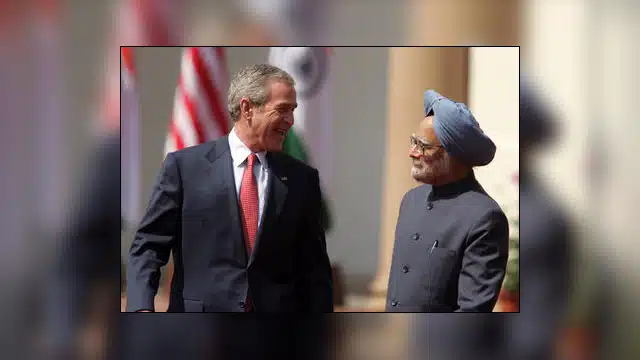
Former prime minister Manmohan Singh’s death has cast a gloomy cloud over India, as politicians from all hues pay their last respects to the maverick economist-turned-politician, who is often called “the accidental prime minister” due to his public image of being a shy and soft-spoken man. Mr Singh’s death ended a chapter in Indian politics that played a crucial role in taking the country where it is now.
Long ago, in mid-1991, when as the finance minister of the Congress party’s government, Mr Singh tabled his neo-liberal economic policies, it shook the country worse than what the Glasnost and Perestroika did to the Soviet Union. Soon, liberalisation, privatisation and globalisation (acronym as LPG) fuelled India’s economic growth and created a hyper-active middle class. Several decades later, the latter became Mr Singh’s and his party’s nemesis.
As the mainstream media and politicians hail Mr Singh for his contributions towards India’s economic liberalisation, whose results have been a matter of an intense debate between the right and left of the country’s polity, it’s crucial to also see how he had been intrinsically tied with India’s tectonic foreign policy shift.
India’s right-turn, Manmohan Singh’s U-turn
It’d be quite normal for one to find a former World Bank official like Mr Singh, who was also a senior economist bureaucrat in Indira Gandhi’s tenure, to advocate for LPG unapologetically, overlooking the threats like wealth inequality, agrarian crisis, end of state-sponsored welfares and the inevitable rise of ultra-right and fascist political trends.
However, if one looks at Mr Singh’s stint as the secretary-general in the South Commission, Geneva, from 1987 to 1990, which was then led by Julius Nyerere, a Tanzanian anti-colonial activist, then it’d be difficult to match both personalities and the ideas they promoted.
During his tenure, the South Commission’s report critically examined the trend of globalisation and inequality in the world, especially between what’s now known as the Global North and the Global South. Surprisingly, someone like Mr Singh led the Commission that then claimed, “The fact that transnational corporations exercise a dominant influence both on the generation of new technologies and on the flows of international trade makes such co-operation even more vital. The hold of these corporations on the world economy would further tighten if the type of rules contained in the General Agreement on Tariffs and Trade (GATT) were extended to services, investment, and intellectual property rights (sic).”
The South Commission worked as a platform for the Global South countries, sans China, mostly the Non-Aligned Movement (NAM) members, to negotiate their share of the fruits of development with the colonial Western powers. The South Commission’s report had warned of the vicious impacts of the Global North’s neo-colonial practices and how they hamper the economic development prospects of the Global South.
However, Mr Singh later turned 180 degrees against what he fought for at the South Commission when he had to face the depleting foreign reserves in India.
When India accepted the International Monetary Fund’s (IMF) conditions in Bangkok to receive a bailout and Mr Singh was inducted into PV Narasimha Rao’s government as the finance minister, he ended the commanding role of the public sector in the economy to provide unrestricted access to transnational corporations. The very corporations that the South Commission was critical of.
Mr Singh was hailed by Indian and foreign corporates and urban elites for being a harbinger of change, something that went against what the South Commission aimed at preventing.
While many on India’s left blame Mr Singh for shifting India’s economy rightwards from what the first prime minister, Jawaharlal Nehru, had envisioned, many on the right commend him for ending India’s catastrophic tryst with socialism.
However, the facts show that he didn’t end the Nehruvian era, but took Mr Nehru’s agenda to its logical conclusion.
Before India gained independence, the Congress party under Mr Nehru accepted the Bombay Plan prepared by capitalists like JRD Tata and GD Birla that suggested that the government create a conducive environment for Indian industries by protecting them from foreign competition and by taking a commanding role in the economy.
Mr Nehru’s first two Five-Year Plans (1952-1962) followed the Bombay Plan and emphasised developing key industries under public ownership to help in the growth of the private sector, which was quite weak when the British colonial rulers transferred power to Indians.
India under Mr Nehru was a founding member of the GATT, the precursor to the World Trade Organization (WTO). It was only under Ms Gandhi that the Union government took the drastic steps of nationalisation of industries like banking, mining, insurance, etc. Ms Gandhi’s reliance on the Soviet Union for unbridled support and her alliance with the communists, who were also leading mass movements demanding public ownership of key industries, played a crucial role in these steps.
Mr Singh took India away from Ms Gandhi’s ‘left’ shift towards the right side that Mr Nehru, Ms Gandhi’s father, had wanted.
However, in doing so, Mr Singh’s LPG not only aggravated inequality but also brought massive changes to Indian foreign policy.
How Manmohan Singh’s ‘reforms’ changed India’s foreign policy
Until 1991, Indian foreign policy remained closely embedded within the socialist and progressive framework that Mr Nehru had envisioned.
While Ms Gandhi took the foreign policy further left by aligning closely with the Soviet Union due to the pressure exerted by her communist allies, from the tenure of her son Rajiv Gandhi, the country saw a rightward shift in its political economy and foreign policy.
Mr Singh opened the door ajar that Mr Gandhi had unlocked during his tenure by drifting India away from the ailing, crisis-ridden Soviet Union to the US-led West’s side.
Former prime minister Rao’s government not just widely embraced the West but also took steps that contradicted Mr Nehru’s and Ms Gandhi’s stances.
Strengthening India-Israel ties
Mr Rao’s Congress government established diplomatic ties with Israel in 1992, paving the way for a nexus that grew stronger in the next three decades. In the next thirty years, diplomatic ties have been upgraded gradually, especially when Mr Singh became the prime minister.
Before Mr Singh became the prime minister in 2004, under the far-right Bharatiya Janata Party (BJP)-led National Democratic Alliance (NDA) government, with former prime minister Atal Bihari Vajpayee at the helm, India started strengthening ties with Israel, especially on agriculture, defence, horticulture, water resource management, etc, since 1999.
Following a pro-US foreign policy, which was an obvious byproduct of Mr Singh’s LPG ‘reforms’, Mr Vajpayee’s government initiated large-scale defence collaborations with Israel. In 2000, India’s then home minister Lal Krishna Advani and external affairs minister Jaswant Singh visited Israel.
In July same year, the former communist chief minister of West Bengal, Jyoti Basu, visited Israel with a 25-member delegation. Mr Basu met former Israeli prime minister Ehud Barak and Labour leader Shimon Peres during his Israel visit. Mr Basu’s visit was followed by his Communist Party of India (Marxist) [CPI(M)] comrade Somnath Chatterjee, who went there to seek investment from Israel for West Bengal.
Ironically, the CPI(M) remained a vocal critic of Mr Vajpayee-led BJP government’s ties with Israel. Following the Al-Aqsa Intifada of September 2000, the CPI(M) grew extremely critical of Israel and India’s bonhomie with the Zionist state, although West Bengal’s left government didn’t sever ties with Tel Aviv over the bloodshed.
In September 2003, the then Israeli prime minister Ariel Sharon visited India on his first state visit, which was protested by the left. Though Mr Singh’s Congress party, which earlier had opposed Israel vehemently, remained critical of India-Israel ties under Mr Vajpayee-led NDA, it didn’t oppose Mr Sharon’s visit.
After the BJP-led NDA lost the 2004 general elections and the Congress-led United Progressive Alliance (UPA), backed by the CPI(M)-led left forces came to power and Mr Singh became the prime minister, India ironically started developing its ties with Israel and the US with greater enthusiasm than the Hindutva-driven BJP.
The UPA government refused to take a U-turn from the BJP-led NDA’s Israel policy, despite the left’s pressure. As a balancing act, it acknowledged that the Palestinian struggle for an independent state following the Oslo Accord was justified. In December 2004, the UPA government hosted the then-deputy prime minister of Israel, Ehud Olmert, to show it was not reversing the stance of the NDA.
When in July 2006, Israel unleashed attacks on Lebanese citizens following the abduction of two of its occupation soldiers by the Hezbollah guerillas, India condemned both sides at the beginning, but Mr Singh had to backtrack later when the Parliament adopted a resolution unanimously condemning the Israeli aggression.
Despite the left’s continued pressure, which included a major conference against Zionist aggression in New Delhi in 2006, attended by a Hezbollah representative, Mr Singh didn’t change the course of his government’s engagement with Israel, which brought India closer to the US.
In May 2007, the UPA government disclosed that between 2002 and 2007, India had spent $5bn on defence procurements from Israel. In July 2007, the Cabinet Committee on Security Affairs, chaired by Mr Singh, held a crucial meeting where it endorsed a joint missile research and development project with Israel worth $2.5bn.
It was a watershed moment in India-Israel ties. From here on, Mr Singh’s government developed India-Israel defence ties from cash-and-carry to joint research and development of missile systems, which paved the way for greater India-Israel defence ties under Prime Minister Narendra Modi.
India-US ties
Though India-US ties started improving since the time of Mr Gandhi’s rule, especially when he allowed the accused American executive of an American chemical firm, involved in the Bhopal Gas tragedy of 1984, to flee the country, they started developing since Mr Singh unleashed the LPG.
Although Mr Vajpayee-led NDA government’s nuclear test in May 1998 brought American sanctions on India, which continued even after then-president Bill Clinton’s visit in 2001, the situation improved under George W Bush’s presidency. Mr Bush lifted the sanctions in 2001, paving the way to greater cooperation between India and the US under the neo-liberal economic order.
Under Mr Singh, India-US ties strengthened manifold, despite the CPI(M)-led left’s vehement opposition. The India visit of former Mr Bush on March 1st 2006, amid protests from the left, opened a new chapter of India-US defence cooperation, following the template set by Mr Vajpayee’s government.
Although Mr Singh’s government distanced India from the US military aggressions in Iraq and Afghanistan, following Mr Vajpayee’s similar stance, it didn’t stop it from enhancing India’s defence and security cooperation, including intelligence exchange with the US.
Under Mr Singh, the government emphasised the US-India civil nuclear cooperation to seek energy security. This created a fissure within the UPA, with the left under the CPI(M) sternly opposing the deal. Despite the left’s threat of withdrawing support, Mr Singh went ahead with the India-US civil nuclear deal, which didn’t fetch India any energy security even in 2024.
Even though Mr Singh risked his government to sign a nuclear deal with the US, it brought no major American investment or technology to set up nuclear power plants in India even after one and a half decades. However, the withdrawal of the left’s support enabled his government to invigorate India-US ties, including the creation of what’s now the biggest anti-China entente in the “Indo-Pacific” war theatre—the Quad.
Mr Singh’s government fanned the anti-China xenophobia in India over the long-term border dispute between the two countries and sought American support on this, especially after the Barack Obama-led Democrat establishment started its hawkish anti-China moves from 2008 onwards.
India-US trade and commerce grew manifold under Mr Singh, with large-scale investments in India’s mining and service sectors by western corporations. India’s banking and insurance sectors were also opened to foreign corporations, especially Americans, and greater defence exchanges between the two countries, along with those of the collective West continued under Mr Singh’s watch.
While Mr Singh remained loyal to the West, he also realised the changing dynamics of global power equations and tried shifting gears, albeit with utmost caution.
Towards multipolarity
While Mr Singh batted for the US, ironically it was Russia that helped India with nuclear power plants. Considering the growing influence of Russia and China in world affairs following the colossal damage to the US economy by the subprime crisis of 2008, Mr Singh’s government ensured it tied up with these two to safeguard India’s long-term interests in a volatile world.
It was under Mr Singh that India played a pivotal role in founding the BRIC—a global bloc consisting of Brazil, Russia, India, and China—in 2009, which included South Africa in 2010 and became BRICS, one of the fastest-growing and most popular multi-lateral body in the world.
Anticipating major changes in world affairs, Mr Singh ensured despite strong ties with the US, India follows multilateralism to retain balanced relations in a world transitioning towards multipolarity with the weakening of the collective West. Although the Congress party largely remain wedded to the idea of the West’s supremacy, Singh’s legacy in promoting multilateralism at the fag end of his rule has also ensured that Mr Modi’s government follows the same route. This has helped India dodge shocks and isolation even though Mr Modi’s government has been showing signs of moving closer towards the US-led collective West.
While Mr Singh showed signs of pragmatism by putting India on the trajectory of multilateralism at an early stage and enhancing ties with the Global South, his pro-US leanings, visible in policy affairs, never let him return to his South Commission days, where he led the bandwagon against the neo-colonial powers.
East Post is an independent geopolitical analysis portal covering South Asia and global power dynamics for international audiences. Views expressed are analytical and do not constitute endorsement of any state or non-state actor.
Join our channels on Telegram and WhatsApp to receive geopolitical updates, videos and more.