What can become a catalyst for India’s imminent involvement in the West Asia conflict involving Israel and Yemen is the Yemeni Armed Forces’ recent announcement of a naval blockade on the Israeli port of Haifa.
India has so far remained critical of the Yemeni naval blockade across the Red Sea region, but has not engaged in any direct conflict with Sana’a.
However, the maritime blockade on Haifa Port has thrown a major challenge before Prime Minister Narendra Modi’s federal government, which has shown solidarity with the Israelis since the beginning of the conflict.
Since 2023, Haifa Port has become extremely important for Mr Modi’s government for two reasons.
The Adani involvement
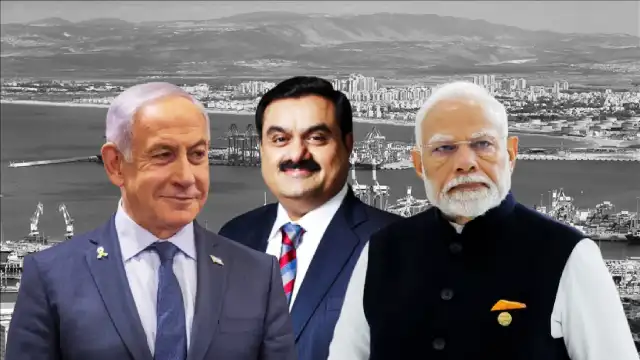
Gautam Adani, the owner of the port-to-power conglomerate Adani Enterprises, had bought 70% stakes in the Haifa Port in January 2023 in collaboration with the Gadot group, which owns 30% in the 92-year-old port.
Mr Adani buying stakes in the Haifa Port, which, according to its statement following Operation Al-Aqsa Flood, contributed only 6% of the total business volume of Adani Ports and Logistics, the subsidiary company run by Mr Adani’s son, raised a lot of eyebrows but later it appeared to be a well-planned move.
The reason behind its higher business potential is what can compel Mr Modi’s government to get involved in the Yemen-Israel conflict over Gaza.
India’s stake in Haifa Port
When the US-backed India-Middle East-Europe Economic Corridor (IMEC) project was officially discussed at the G-20 Summit, the Haifa Port became a crucial linkage point.
It’s considered to be a gateway to Europe for cargo from India through the sea route from Mundra Port, owned by Adani Ports and SEZ Ltd in Gujarat, to the UAE.
The cargo is supposed to be transferred through railways from the UAE to Israel via Saudi Arabia and Jordan.
Therefore, for the IMEC project to work, India needs security of the Haifa Port, while Saudi Arabia and the UAE need Israel’s cooperation.
This makes an India-Israel-Saudi Arabia-UAE axis led by the US depend highly on Adani Ports, which has also been trying to get control over Greek and Italian ports, which will be entry points of IMEC in Europe.
Mr Modi’s critics allege close ties between the controversial tycoon and India’s federally ruling Bharatiya Janata Party (BJP).
Whenever the Adani conglomerate has been accused of wrongdoings, especially by the now-defunct US-based shortseller firm Hindenburg Research, the BJP has come to its rescue, equating any allegation against it as a conspiracy against India.
In these circumstances, when the Hezbollah guerrillas had launched rocket attacks on Haifa last year, India became worried.
Later, to mitigate the risks posed by Hezbollah, Benjamin Netanyahu’s government launched a large-scale attack on the Lebanese resistance organisation, assassinated thousands of its members, including its top leadership, before signing a ceasefire in November, which Tel Aviv has been violating nonstop by continuously attacking Lebanon, including the outskirts of capital Beirut.
India, despite having good bilateral relations with Lebanon, didn’t oppose the bombing of Beirut and the violation of the country’s sovereignty by Israel during these attacks to ensure the safety of Haifa Port.
India’s silence on Israeli aggression on Lebanon and the celebration of the assassination of Hezbollah leader Hassan Nasrallah in September 2024 by the BJP-aligned social media army have further isolated India in West Asia, where it already faced criticism over Mr Modi’s pro-Israel stance following Operation Al-Aqsa Flood.
Moreover, during the aggression on Lebanon, Mr Netanyahu had shown a map at the United Nations General Assembly in September 2024, where he had hailed the IMEC project and emphasised a better relationship with partners like Saudi Arabia and the UAE.
To end the Yemeni Armed Forces’ naval blockade in the Red Sea region, leading to attacks on ships related to Israel, the US and the UK had launched a series of attacks on the country from December 2023 onwards.
Despite US President Donald Trump intensifying the attacks on Yemen since assuming office in January 2025, the Americans failed to defeat the Yemeni forces.
To avoid an ignominious situation, especially after losing over 23 drones and its carrier USS Harry Truman suffering multiple hits from the Yemenis, Mr Trump had announced a unilateral ceasefire.
Now, as the US has retreated and Israel faces a naval and air blockade from Yemen, India has more reasons to worry about Mr Adani’s interests in the Haifa Port, especially as it pushes for the implementation of the IMEC, which remains stalled due to Saudi Arabia’s reluctance to openly cooperate with Israel until the two-state solution is implemented.
It’s impossible to draw the US back into the conflict with Yemen again. For New Delhi, entering the conflict isn’t possible either.
As India remains nonchalant about the plight of the Palestinians, whom it had supported in the initial four decades since gaining independence, it has lost much public support in not just the Arab world but has become even a pariah for those vouching for a multipolar world order like China, Iran, Russia and other countries.
In this scenario, India can’t openly join any military action against the Yemeni Armed Forces, despite not recognising the Houthi rule in the country, to ensure it maintains its neutrality in the conflict.
However, due to the close ties between Mr Adani’s defence and other businesses with Israel, Mr Modi’s government will try to mitigate the risks posed to the Haifa Port.
It has opportunities to do so by collaborating with Israel to ensure the normal functioning of the Haifa Port.
India can also try to use its influence on Iran, a country with which it shares strong bilateral ties despite some hiccups, to ensure that Tehran can help it resolve the impasse.
As India has helped build Iran’s Chabahar Port, which New Delhi has a right to operate, it’s unlikely that Iran will turn down its requests.
Mr Modi’s government can also use the Indian Navy’s anti-piracy operations to secure the route to the Haifa Port, without directly involving itself in the conflict. However, it has the potential to harm India’s long-term interests in the region.
As India’s recent conflict with Pakistan, a Muslim-majority country, has stirred public sentiment against it in the Arab world as well as turned many Arab governments sceptical about New Delhi, Mr Modi’s government will take careful steps to resolve the crisis.
In any case, Mr Modi’s government won’t allow Mr Adani’s interests to suffer. Mr Adani is a key link for India in its attempts to strengthen bilateral and defence ties with Israel.
His interests prevent India from supporting the Palestinian cause any more, except for reiterating its official stance on a two-state policy.
What India could’ve done?
India had the advantage of ensuring that the situation didn’t aggravate from the very beginning.
With Mr Modi’s strong and unique ties with both Mr Netanyahu’s far-right Zionist camp and Iran’s ruling bloc, including its former president Ebrahim Raisi, India could’ve used its diplomatic prowess to ensure an early ceasefire in 2023 itself.
On the one hand, India could’ve worked as a neutral force to ensure that Israel stopped its attacks on Gaza and, on the other, secured the release of the prisoners held by the Palestinian resistance Hamas by liaising with Iran.
Instead, Mr Modi, who had in September 2023, a month before Israel launched its renewed Gaza aggression, claimed that India is going to be a leading force of the Global South, cocooned and took a pro-Israel, pro-West stance, which very few Asian countries have taken.
As it lost the scope of mediating peace in West Asia, India now has no qualms being seen as an Israeli and American ally, especially after the conflict with Pakistan.
In this situation, it’s not merely the future of Mr Adani but also India’s long-term interests in West Asia remain jeopardised.
Unless Mr Modi’s government changes its approach towards the issue, it’s unlikely that India can secure its interests and regain its lost prestige in the Global South.
East Post is an independent geopolitical analysis portal covering South Asia and global power dynamics for international audiences. Views expressed are analytical and do not constitute endorsement of any state or non-state actor.
Join our channels on Telegram and WhatsApp to receive geopolitical updates, videos and more.