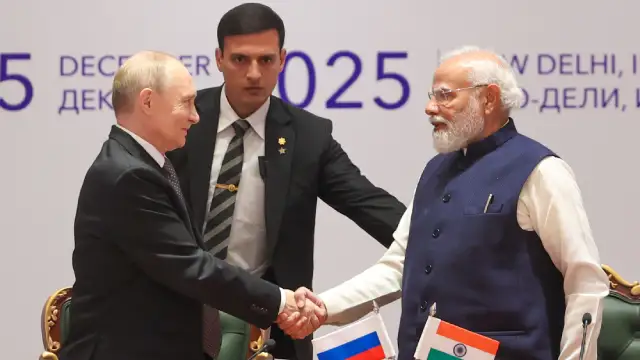
Russian President Vladimir Putin‘s first visit to India since launching his special military operations in Ukraine produced warm embraces, commemorative rhetoric and a 70-point joint statement. What it didn’t produce was much that was genuinely new.
Apart from reiterating old commitments, packaging ongoing endeavours as new and launching the Indian version of Russia’s state-sponsored propaganda outlet RT, there has been nothing new in Mr Putin’s visit to India.
The December 4th-5th summit showcased Indian Prime Minister Narendra Modi‘s increasingly precarious balancing act.
He had to do the heavy lifting. Mr Modi must appease Russia while courting the West. This is a unique diplomatic endeavour in the modern world.
The result is a document heavy on aspiration but light on concrete deliverables.
The timing was pointed.
Mr Putin arrived in New Delhi not just amid its worsening air quality, but also months after the US imposed punitive 50% tariffs on India. The penalty targets India’s Russian oil purchases directly.
Yet, still, Mr Modi has welcomed the Russian president with open arms.
The two leaders posed for photographs.
Glimpses from the ceremonial welcome for President Putin at Rashtrapati Bhavan. President Putin has been unwavering in his commitment to strong India-Russia ties and has contributed immensely to taking this relationship to new heights. Though the world has seen many changes over… pic.twitter.com/iQQNzq168n
— Narendra Modi (@narendramodi) December 5, 2025
Soon after landing in New Delhi on Thursday evening, Mr Putin visited Mr Modi’s residence for an unofficial dinner where the duo, sources say, spoke at length about insulating India-Russia relations from the West’s pressures.
Welcomed my friend, President Putin to 7, Lok Kalyan Marg.@KremlinRussia_E pic.twitter.com/2L7AZ1WIph
— Narendra Modi (@narendramodi) December 4, 2025
Officially, on Friday, the duo invoked 25 years of strategic partnership. They spoke of “mutual trust” and “equal and indivisible security”.
Behind the diplomatic theatre and media hullabaloo, however, the joint statement revealed uncomfortable truths.
There has been nothing new on the table during Mr Putin’s India visit.
Most flagship commitments are mere reiterations of previous summits. Some even date back a decade!
The much-touted bilateral trade target of $100bn by 2030 is not new.
India and Russia had announced it at their July 2024 Moscow summit, 18 months earlier. The promise to pursue a free trade agreement with the Eurasian Economic Union had appeared in joint statements since 2021. Defence cooperation language was recycled nearly verbatim from earlier years.
My remarks during meeting with President Putin. https://t.co/VCcSpgZmWx
— Narendra Modi (@narendramodi) December 5, 2025
Russia’s construction of a second nuclear power plant site in India—still described as pending “formal allotment”—has been aspirational since 2013.
No major weapons contracts have been signed, despite pre-summit speculation about Su-57 fighters and S-500 air defence systems.
Though the Kremlin spokesman, Dmitry Peskov, during a press meet on December 2nd, mentioned Russia may consider joint production of Sukhoi jets without passing the technology, nothing concrete has been discussed between the two leaders.
Cross-referencing the December 2025 statement against summit documents from 2014 to 2024 reveals a pattern. The language is strikingly similar. The ambitions are familiar. The timelines remain elastic. What has changed is the context, not the content.
Trump’s tariffs force India’s hand on Russian oil dependency
The geopolitical backdrop transformed what might have been routine diplomatic pageantry into a high-stakes signal. President Donald Trump’s second administration has done what previous US governments would not. It directly penalised India’s relationship with Russia’s economic weapons.
The tariff escalation followed a clear timeline. Mr Trump’s April 2nd “Liberation Day” tariffs initially imposed 25% reciprocal duties on India. On July 30, he announced an additional 25% specifically as a penalty for India’s Russian oil and military equipment purchases.
Trade adviser Peter Navarro called India a “laundromat for the Kremlin”.
The full 50% took effect on August 27th 2025.
India’s Ministry of External Affairs responded that the tariffs were unfair and unreasonable. Officials defended purchases as ensuring energy security for 1.4bn people.
The numbers explain Washington’s frustration.
India-Russia bilateral trade reached $68.7bn in the 2024-25 financial year. That represents nearly sevenfold growth from $10.1bn before the pandemic. Yet the structure of this commerce reveals its lopsided nature.
Russia accounts for 88% of India’s imports as crude oil and petroleum products—approximately $57bn. India’s exports to Russia total just $4.9bn. The trade deficit approaches $59bn annually.
Russia has risen from supplying 2% of India’s crude imports in 2021 to 36-40% today. Volumes reach 1.7m barrels daily.
External Affairs Minister Subrahmanyam Jaishankar acknowledged in August 2025 that India needed to address the imbalance urgently.
Yet the December joint statement offered no concrete mechanisms for doing so. It merely reiterated the need to increase Indian exports and promote joint manufacturing.
Despite a business delegation visiting New Delhi and inviting Indian businesses to Russia, it’s clear that India’s corporates, with high exposure to the US market, won’t risk irking the West.
The payment mechanisms in national currencies face their own challenges.
Russia accumulates $40bn-60bn annually in rupees that it cannot easily use. India accounts for only 2% of global exports. The rupee represents just 1.6% of global foreign exchange turnover. Russian oil exporters increasingly request yuan payments instead. It’s hard for Mr Modi to comply. His government considers Beijing as a foe and uses Sino-India hostilities to bargain with the US-led collective West. Switching to yuan will impact that equation.
Western trade deals advance as Putin visits New Delhi
While Mr Modi hosted Mr Putin, India has been simultaneously deepening economic integration with the West. The apparent contradiction reveals the substance of India’s strategic autonomy. It is neither anti-Western alignment nor unconditional Russia loyalty.
It is calculated self-interest under extraordinary pressure.
The UK and India signed their Comprehensive Economic and Trade Agreement on July 24th 2025. It was the largest bilateral free trade agreement Britain had concluded since Brexit. The deal provides duty-free access for 99% of Indian exports. It includes labour mobility provisions for 1,800 annual visas for Indian professionals. Britain projects a £4.8bn GDP boost and a £25.5bn increase in annual bilateral trade.
The European Union-India free trade agreement is on track for signing at the January 27th, 2026, summit. EU leadership will attend as guests at India’s Republic Day parade on January 26th. Eleven of 23 chapters are closed following intensive negotiations. EU Commission President Ursula von der Leyen’s February 2025 visit brought 22 of 27 Commissioners to India. It was the first European Commission College visit outside Europe. EU officials stated that India and the EU could set the agenda for global governance in the absence of the US.
Yet tensions persist beneath the diplomatic courtesies. EU foreign policy chief Kaja Kallas warned that India’s participation in Russia’s military exercises and oil purchases “stand in the way of closer ties”. The EU’s Carbon Border Adjustment Mechanism remains a major sticking point. European officials have made clear that while they understand India’s position reluctantly, patience has limits.
The Modi government’s simultaneous pursuit of free trade agreements with the West and Russian energy deals creates cognitive dissonance for observers. For Mr Modi, it demonstrates that India will not accept external vetoes on its relationships.
For Western governments, it represents a frustrating but accepted reality. India’s value as a counterweight to China exceeds its costs as a sanctions spoiler.
Democracy concerns take back seat to strategic calculations
The Putin-Modi embrace highlighted an uncomfortable paradox for Western governments. Both leaders face significant criticism for democratic backsliding. Both governments dismiss these criticisms as Western interference. Yet their treatment by the West differs dramatically.
India’s democratic downgrades are substantial.
Freedom House reclassified India from “Free” to “Partly Free” in 2021. It was the first such downgrade since the 1975-77 Emergency.
The V-Dem Institute classified India as an “electoral autocracy” since 2018.
India’s Liberal Democracy Index fell from 0.58 in 2000 to 0.29 in 2024. India ranks 161st of 180 countries in press freedom.
Mr Jaishankar dismissed these assessments. He described the institutions producing them as “self-appointed custodians of the world” who “invent their rules”.
Russia’s classifications are far more severe. Freedom House rates Russia “Not Free”. It scores 12 out of 100 compared with India’s 66. Russia’s electoral process scores zero out of ten.
Western governments have compartmentalised their responses.
The reason is China.
In the context of growing polarisation and potential bifurcation of the international system marked by strategic rivalry between the US and China, India’s “democratic credentials” continue to trump backsliding on its liberal credentials.
India’s 2024 general election and the following assembly elections have raised questions about its electoral malpractices. India’s Leader of the Opposition Rahul Gandhi accuses Mr Modi’s Bharatiya Janata Party (BJP) of rigging India’s elections using the poll body, the Election Commission, as a partisan weapon.
Moreover, Mr Gandhi’s Indian National Congress has been alleging that Mr Modi’s BJP and the Election Commission have been altering voter lists to help the prime minister’s party retain power.
The West ignores these concerns.
It ignores the allegations against Mr Modi’s BJP regarding electoral malpractices, persecution of minority Muslims and Christians, as well as India’s massive military operations against the tribal populations in its central and south-eastern parts under the garb of fighting left-wing extremism.
The US had earlier waived sanctions on India’s $5.43bn S-400 air defence purchase from Russia. It imposed those same sanctions on Turkey and China for identical purchases.
A bipartisan Congressional amendment passed with more than 300 votes approving an India-specific waiver. It explicitly cited the need to deter aggressors like China. Joe Biden’s administration ruled out secondary sanctions on Indian oil imports.
There are allegations that the Rashtriya Swayamsevak Sangh (RSS), the BJP’s ideological parent, has been spending a huge amount of money to lobby in the US.
Strategic autonomy faces stress test as partnerships narrow
The December summit’s modest, genuine deliverables tell their own story.
India will open consulates in Yekaterinburg and Kazan.
The countries signed a labour mobility agreement.
They concluded a memorandum of understanding on polar seafarer training.
They established a shipbuilding cooperation framework.
However, all these are incremental additions, not transformative achievements.
There have been talks on allowing tourist groups from India to enter Russia without a need for visa for 30 days. No decision has been taken on this.
The discussion of small modular reactors and floating nuclear power plants represents genuinely new territory at the summit level.
It aligns with India’s 2025 budget announcement of a Rs 200bn Nuclear Energy Mission. Yet even here, concrete timelines and investment commitments were absent.
The free trade agreement with the Eurasian Economic Union showed measurable progress. Terms of Reference were formally signed in August 2025. They establish an 18-month negotiation timeline and quarterly regulator-to-regulator engagement. Yet the agreement itself remains aspirational.
Previous negotiations collapsed in 2016.
Defence cooperation, traditionally the pillar of the relationship, is in structural decline.
Russia’s share of India’s arms imports fell from 76% during 2009-13 to 34% during 2019-23 to 28% in 2023. The relationship provides immediate value through discounted oil and maintenance for Russian-origin equipment comprising over 55% of India’s arsenal. But India’s strategic trajectory points toward Western technology, capital and partnerships.
The Chatham House characterisation captures the reality most accurately. India holds a “non-Western, not anti-Western, worldview”.
India simultaneously participates in Western-led security architecture—the Quad with the US, Japan and Australia; I2U2 with the US, Israel and the UAE; the India-Middle East-Europe Economic Corridor.
It maintains Russia ties and BRICS membership.
Mr Jaishankar’s formulation is — India must engage the US, manage China, cultivate Europe, reassure Russia and bring Japan into play.
The objective is to ensure no other nation has a veto on its policy options.
The Putin visit was a statement of principle rather than a fundamental reorientation.
Mr Modi signalled that 50% US tariffs would not dictate India’s partnerships. Yet the joint statement’s heavy reliance on recycled commitments suggests the relationship’s limits.
The $100bn trade target appears technically achievable. India is already at 69% of that figure.
But experts note it requires addressing the massive imbalance and diversifying beyond oil.
Mr Putin realises that India risks losing over $45bn in trade surplus if it loses the US
While Mr Putin told Indian television anchors that he has directed officials to see how to increase imports from India, and although Russian businesses met Indian businesses, there are a lot of issues in realising such goals.
Recent US sanctions on Russian energy entities may actually reduce near-term trade volumes. Mr Putin realised it well before landing in New Delhi.
Mr Putin left New Delhi with warm words and familiar promises. He did not leave with transformative agreements or substantial new commitments. His visit’s significance lay in its symbolism. It demonstrates that the India-Russia relationship, while narrowing and costly, will not be abandoned under external pressure.
Whether this represents principled multipolarity or expedient opportunism depends on one’s vantage point.
What is clear is that the joint statement offered more continuity than change.
The underlying goal of India’s foreign policy increasingly lies not in Moscow but in its deepening engagement with the West’s economic and security architecture.
Mr Putin’s visit has been a reminder that India charts its own course. Although the course doesn’t lead New Delhi towards Moscow.
Join our channels on Telegram and WhatsApp to receive geopolitical updates, videos and more.