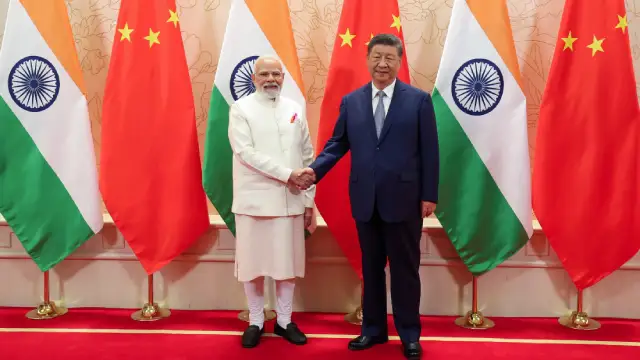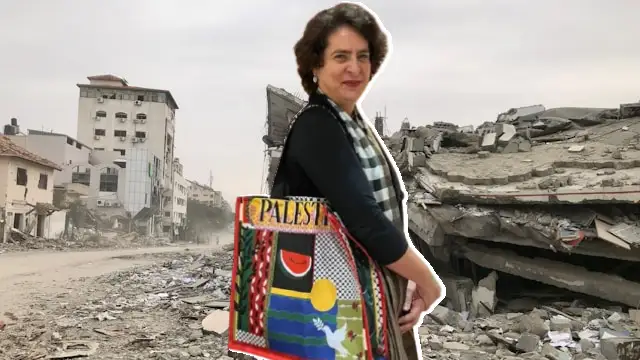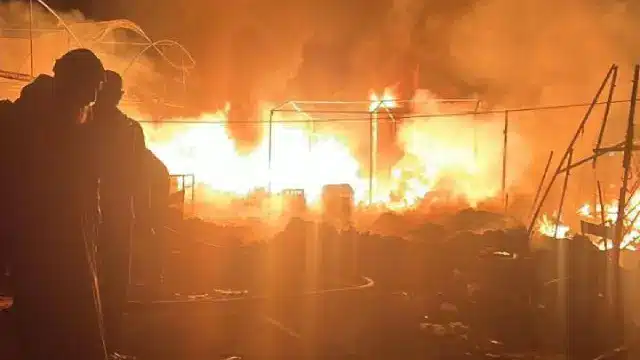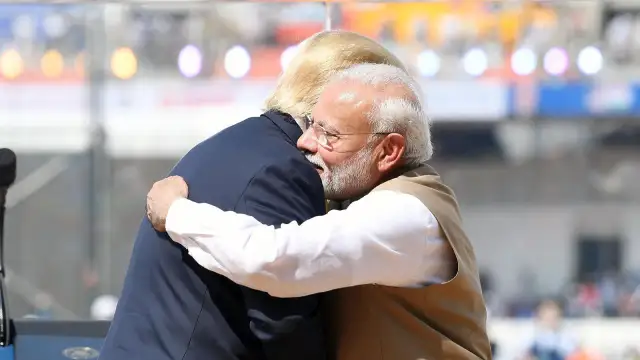
Indian Prime Minister Narendra Modi has continued a series of missteps in the weeks following the US-Israeli attack on Iran. His government says it has secured energy and fertiliser supplies through diplomacy, even as New Delhi maintains close ties with Washington and Tel Aviv, largely ignoring Tehran’s concerns. Iran, notably, has exempted India and a few others from its Strait of Hormuz blockade.
Yet this balancing act of Mr Modi is becoming harder for India to sustain. India stands at the verge of losing the leverages it has gained through its decades-long warm ties with Iran, which deteriorated in the last few months under Mr Modi’s watch.
India presents itself as strategically autonomous. Instead, its defence posture is tightening around a US-led war that threatens its own energy security and regional standing.
Colby tries to entangle India in Iran war
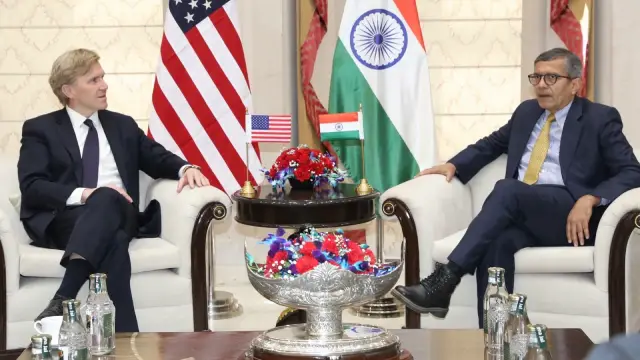
As India’s Ministry of External Affairs spoke of safe passage through the Strait of Hormuz, America’s Under Secretary of War for Policy, Elbridge Colby, concluded a visit to India on Thursday March 26th, emphasising deeper defence ties.
According to the US Department of War (formerly the Department of Defense), Mr Colby aimed “to advance key elements of the 2026 National Defense Strategy and the President’s Peace through Strength agenda (sic)”. He met India’s external affairs minister, Subrahmanyam Jaishankar, foreign secretary Vikram Misri, and co-chaired the US-India Defence Policy Group with defence secretary Rajesh Kumar Singh.
American officials said the talks advanced the “Framework for the US-India Major Defence Partnership”, signed in October 2025 by Secretary of War Pete Hegseth and India’s defence minister Rajnath Singh.
The Framework calls for expanded operational coordination, intelligence sharing, and military-industrial cooperation. Its timing, amid an ongoing US-Israeli war with Iran, underscores continuity in defence alignment rather than caution.
Mr Colby’s speech at the Ananta Centre reinforced this direction. He argued that American and Indian interests are largely aligned, despite differences, and stressed the importance of the “Indo-Pacific theatre”.
He called for “strategic clarity” and deeper cooperation. The implication of his message has been clear: Washington sees India as a partner whose logistical, diplomatic and intelligence support would be valuable in a widening conflict.
Mr Colby invoked Mr Jaishankar’s ideas of “Bharat First” and the “India Way”, citing his 2020 book. Though framed as respect for Indian autonomy, the argument recasts that autonomy as compatible with American priorities.
In effect, India’s self-interest has been presented as naturally converging with Washington’s.
Mr Colby also introduced “flexible realism”, suggesting that strategic autonomy requires distancing from long-standing partners such as Iran and Russia. In practice, this reframes non-alignment as conditional alignment with the United States.
China remained the unspoken reference point. Mr Colby repeatedly stressed the need for a “stable balance of power in Asia”, linking cooperation in West Asia to competition in the Indo-Pacific.
The logic is circular. India is encouraged to support American operations in the Persian Gulf in anticipation of future American support against China.
Security and economic risks: Energy, diaspora, and entanglement
The immediate risks lie closer to home. The conflict’s centre is West Asia—the Persian Gulf and the Strait of Hormuz—through which much of India’s oil flows and where over nine million Indian citizens live.
Expanded “information sharing” between the two militaries has practical consequences. If Indian intelligence supports US operations, even indirectly, Tehran is unlikely to distinguish between passive and active involvement.
That would expose India’s energy lifelines and diaspora to retaliation.
The emphasis on interoperability erodes the separation India has traditionally maintained between its partnerships. Routine intelligence flows make neutrality harder to sustain in practice.
The same applies to defence manufacturing. Mr Colby praised India’s push for indigenous production, while highlighting America’s own wartime industrial mobilisation under Donald Trump and Mr Hegseth.
In such conditions, co-production risks becoming integration into American supply chains rather than genuine self-reliance. Indian facilities would serve priorities set in Washington, not New Delhi.
This is not theoretical. Previous collaborations have already tied Indian production to foreign military use, raising questions about autonomy and accountability.
India has spent years reducing defence import dependence. A deeper shift towards American systems would reverse that effort, binding Indian logistics and planning to US timelines.
Geopolitics: Iran, China, and BRICS contradictions
For India, the war offers little strategic gain. Early assumptions in New Delhi that Iran would collapse quickly have been challenged by its sustained retaliation and asymmetric response.
Claims of damage to US positions in the region and the dispersal of American personnel—though requiring careful attribution—underscore a broader point. American security guarantees in West Asia appear less certain under pressure.
Washington has struggled to shield its own bases and long-standing partners from Iranian strikes. In moments of escalation, evacuation and withdrawal have taken precedence over defence.
That raises an obvious question for India. What assurances, if any, would hold in a crisis affecting it?
Mr Colby’s remarks did not address this. Nor did they engage with Indian public opinion, which remains wary of entanglement in another US-led war or the risk of retaliation against Indian interests.
Instead, the relationship was framed in abstract strategic terms, with India cast as a resource within a wider American design.
This sits uneasily with India’s position in groupings such as BRICS+ and the Shanghai Cooperation Organization. As New Delhi prepares to host BRICS foreign ministers in May and a summit in October—both including Iran—its current posture risks contradiction.
Despite parliamentary statements in the Lok Sabha and the Rajya Sabha, and consultations with state chief ministers regarding the West Asia scenario, Mr Modi’s government has avoided condemning the US-Israeli attacks on Iran. That silence narrows diplomatic space and invites external pressure.
India’s challenge is not rhetorical but structural. Aligning too closely with Washington in a volatile conflict risks weakening its energy security, complicating its regional ties, and limiting its room for manoeuvre in an increasingly multipolar order.
India must realise that strategic autonomy is not declared; it is exercised. In a war reshaping West Asia, India’s choices are beginning to suggest alignment by default rather than independence by design.
East Post is an independent geopolitical analysis portal covering South Asia and global power dynamics for international audiences. Views expressed are analytical and do not constitute endorsement of any state or non-state actor.
Join our channels on Telegram and WhatsApp to receive geopolitical updates, videos and more.