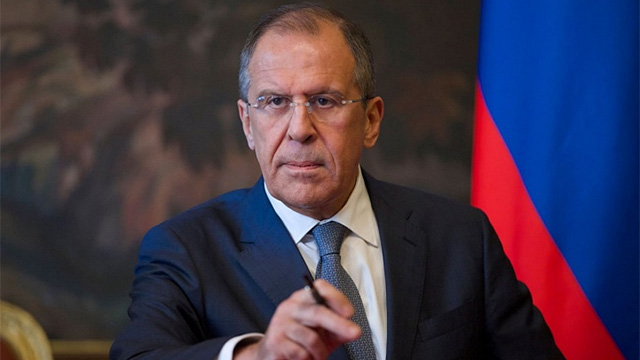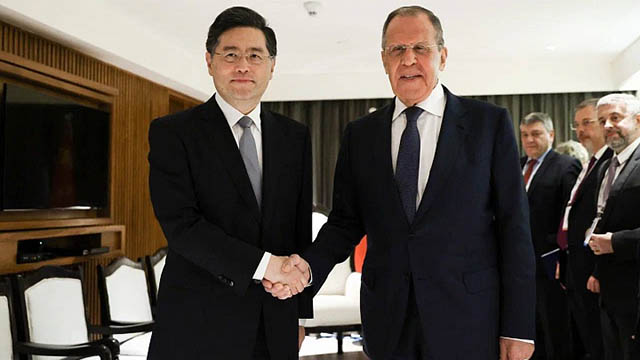
Russia and China have discussed in detail their bilateral relationship on the sidelines of the Shanghai Cooperation Organisation’s (SCO) Foreign Ministers’ Meeting held in India’s Goa on May 4th and May 5th 2023. Russian Foreign Minister Sergey Lavrov and Chinese Foreign Minister Qin Gang discussed several aspects of Russia and China’s bilateral relations.
The two ministers praised Russia and China’s bilateral relations for the momentum gained against the backdrop of growing geopolitical instability. They discussed in detail the matters relating to the talks held between Chinese President Xi Jinping and Russian President Vladimir Putin in March this year.
Lavrov and Qin also discussed the prospects of developing the SCO’s scope and its current state. They welcomed the collective efforts by the member states to ensure peace and stability in the Eurasian region. The two ministers also discussed how the SCO has been playing a key role in international affairs and the regional security infrastructure.
Russia and China have been collectively facing the wrath of the West for their pursuit of a truly multipolar world order, which is a vision shared by other key member states of the SCO, including India. While Russia has been facing western sanctions over its special military operations in Ukraine, the US has been keen to isolate China and encircle it militarily to curb its economic growth and global influence.
Although China has been advocating for dialogue between Russia and Ukraine to end the conflict, the US has been accusing Beijing of providing Moscow with weapons, an allegation that the Chinese have vehemently rejected. Moreover, under the pretext of enhancing its “Indo-Pacific” security infrastructure, the US isn’t only building newer military entente against China in South and Far-East Asia, it’s also inciting tensions in the Taiwan Strait by violating the “One China Policy” that it agreed to abide by in the 1970s.
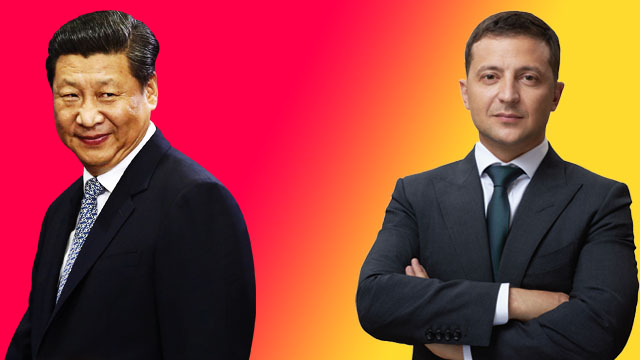
The Russian Ministry of Foreign Affairs has exhibited scepticism regarding Chinese President Xi’s call for dialogue with the Kiev regime led by Volodymyr Zelenskyy, calling the latter an unreliable entity and puppet of the West. Moscow has repeatedly underscored the Ukrainian regime’s anti-communist credentials to desist China from considering Kiev as a party serious regarding the scope for peace in the region.
Against the backdrop of this global scenario, the foreign ministers of Russia and China discussed how to enhance their bilateral cooperation in the United Nations, the SCO, the Brazil-Russia-India-China-South Africa (BRICS) forum, the G-20 and other international organisations.
Qin reportedly had a confidential discussion with Lavrov regarding the US’s growing activities in the so-called “Indo-Pacific” war theatre, where it’s forming military blocs with SCO member India to counter China. The Chinese consider the US actions in the “Indo-Pacific” as disruptive activities that undermine the ASEAN-centric security and stability framework in the region.
Although Russia is a close ally of both China and India and has always promoted peace between these two neighbours undergoing a phase of renewed hostility since the Galwan Valley clash in mid-2020, it has not commented publicly on India’s involvement in the anti-China military bloc named QUAD. However, in several instances, Moscow has criticised the US attempts to stoke tension in the South China Sea and Asia-Pacific region.
As part of its new foreign policy, Russia opposes military blocs formed by the West that undermine regional security in different parts of the world and considers it as a part of the West’s neo-colonial aggression.
The foreign ministers of Russia and China shared the view that neo-colonialist practices—an integral part of the US-led West’s foreign policy—are not acceptable in the present era. They consider that such a neo-colonialist approach by the West has a destructive effect on most countries of the world and international relations in general.
East Post is an independent geopolitical analysis portal covering South Asia and global power dynamics for international audiences. Views expressed are analytical and do not constitute endorsement of any state or non-state actor.
Join our channels on Telegram and WhatsApp to receive geopolitical updates, videos and more.