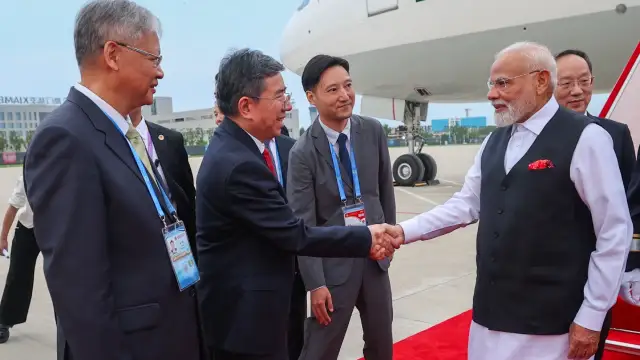
Indian Prime Minister Narendra Modi arrived in Mauritius Tuesday for a two-day visit, ostensibly to participate in the island nation’s 57th National Day celebrations. In a statement ahead of his visit, he noted that “Mauritius is India’s close maritime neighbour, a key partner in the Indian Ocean, and a gateway to the African Continent.”
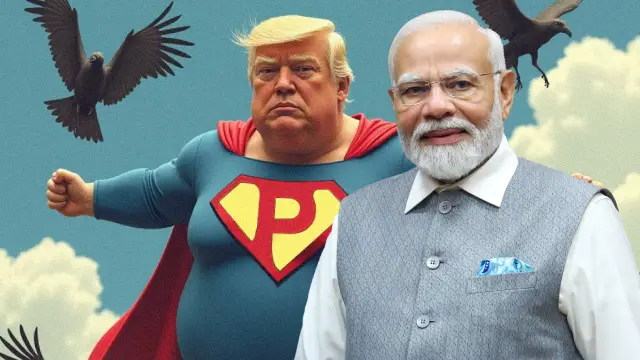
The diplomatic language, however, obscures a more strategic purpose. Mr Modi’s journey forms part of a broader effort to strengthen India’s position in the Indian Ocean region—a move aligned with Washington’s Indo-Pacific strategy, where India serves as an increasingly willing lieutenant to American interests.
“We are connected by history, geography and culture. Deep mutual trust, a shared belief in the values of democracy, and a celebration of our diversity are our strengths,” Mr Modi said in his official statement. Yet behind these platitudes lies a more calculating geopolitical agenda, which may not be in India’s interests in the long run.
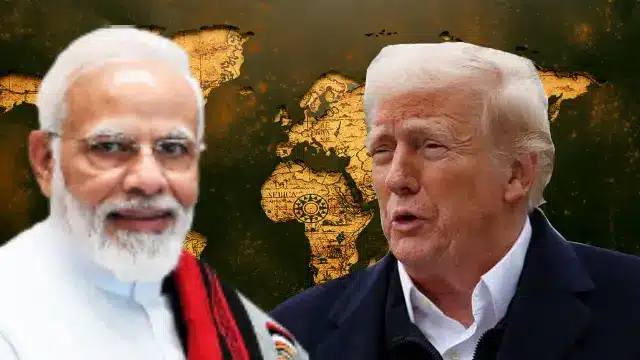
While portraying this visit as strengthening traditional ties, the underlying motivation appears to be India’s continued commitment to America’s containment policy toward China. This comes at a particularly inopportune moment, as President Donald Trump‘s economic policies send tremours through global markets and cast doubt on America’s economic stability.
The American ‘house of cards’
As Mr Modi courts small island nations in service of American strategy, the US economy itself shows troubling signs of vulnerability.
Mr Trump’s tariff policies have triggered a significant market sell-off, with the S&P 500 falling 8.6% from its February peak—shedding over $4 trillion in market value. The tech-heavy Nasdaq tumbled 4% in a single day, its largest one-day decline since September 2022, according to Reuters.
The market downturn deepened as investors grappled with Mr Trump’s seemingly chaotic approach to trade policy. “The Trump administration seems a little more accepting of the idea that they’re OK with the market falling, and they’re potentially even OK with a recession in order to exact their broader goals,” Ross Mayfield, investment strategist at Baird, was quoted by Reuters.
This economic turbulence has begun to manifest in social unrest. In a particularly telling sign of distress, theft of truckloads of green coffee beans is surging in the United States. Each truckload, worth approximately $180,000 at current market prices, has become a target for organised criminal gangs disguising themselves as transportation companies.
Kevin Hassett, who heads the National Economic Council, attempted to dispel concerns in an interview with CNBC: “There are a lot of reasons to be extremely bullish about the economy going forward. But for sure, this quarter, there are some blips in the data.”
The unconvincing reassurance comes as the Atlanta Federal Reserve’s GDPNow tracker suggests the US economy, despite Mr Trump’s rhetoric, could contract in the first quarter of 2025.
The ‘Dragon’ ascendant
Contrast America’s economic jitters with China’s steady progress. While the Modi government courts a declining superpower, neighbouring China continues to strengthen its position both economically and diplomatically.
China has targeted an economic growth rate of around 5% in 2025, according to the Government Work Report submitted to the National People’s Congress. “These figures send a more positive and clear policy signal, boosting confidence among consumers, entrepreneurs, foreign enterprises, investors, and the whole market,” Ji Mo, chief China economist of Singapore-based DBS Bank, told the Global Times.
China’s GDP grew by 5% year-on-year in 2024, ranking among the world’s fastest-growing major economies and continuing to contribute about 30% to global economic growth, according to official data.
“In the past 40-plus years, China did everything right,” Scott Rozelle, co-director of Stanford Center on China’s Economy and Institutions, was quoted by Global Times. “The Chinese market is very competitive and made things very efficient. There’s only one way to grow. That’s by productivity, growth, new technologies,” Mr Rozelle has said.
The Chinese government has also announced a 7.2% increase in its 2025 national defence budget, bringing the planned expenditure to 1.78 trillion yuan ($249bn). This marks the tenth consecutive year of single-digit growth for China’s defence spending.
Meanwhile, in India, where the ruling far-right Bharatiya Janata Party’s (BJP) supporters claim they want to fight a war with China, the total defence allocation has been Rs 6.81 trillion ($77.94bn), which is one-third of China’s curtailed defence budget.
Yet, the spirit of confrontation drives Indian polity, where Sinophobia soars and pragmatism sinks into an abyss. This gives rise to a disastrous foreign policy, which puts India into a zero-sum game.
A strategic triple alliance emerges
While India plays second fiddle to American interests, a formidable alliance is taking shape among China, Russia, and Iran—three powers that India might have cultivated more constructive relationships with.
In a development that should give New Delhi pause, the Chinese Defence Ministry announced joint naval exercises with Iran and Russia near Iran’s Chabahar Port, which is leased by India, starting today.
The Security Belt-2025 joint exercise will feature “maritime target strike, VBSS (visit, board, search, and seizure), damage control as well as joint search and rescue operations,” according to a statement from the ministry.
“Joint exercises among China, Iran and Russia have become routine,” Song Zhongping, a Chinese military affairs expert, was quoted by the Global Times. The exercise will take place in the Gulf of Oman, “a crucial gateway between the Strait of Hormuz and the Indian Ocean, making it a strategic pathway crucial to energy shipping,” Song noted.
China has dispatched the destroyer Baotou and the replenishment ship Gaoyouhu from the People’s Liberation Army Navy’s 47th escort task group for these exercises. Zhang Junshe, another Chinese military affairs expert, told China’s Global Times, “The trilateral exercise is not targeted at any third party,” before adding pointedly that “the drill among the three countries, which are key forces to peace in the world, yields key significance to peace and stability in the world.”
And guess who missed the train?
India’s strategic misstep
By aligning so closely with the United States, India has potentially missed an opportunity to defuse tensions with China and strengthen its regional influence. Rather than pursuing a more balanced approach, Mr Modi’s government appears content to follow Washington’s lead, even as America’s global standing becomes increasingly precarious.
Sena Yao Voncujovi, an Africa-China policy analyst at Development Reimagined, told the Global Times that “China’s emphasis on sharing the fruits of its innovation with the world, and the Global South in particular, is very important.” This represents exactly the sort of soft power approach India might have employed to bolster its own standing among developing nations.
Denis Depoux, global managing director at Germany’s strategy consulting firm Roland Berger, highlighted China’s focus on “new quality productive forces” as a key driver of its economic growth. “This reflects China’s determination to modernise its industries and shift toward value-added economic leadership,” the Global Times quoted him saying.
Meanwhile, India continues its trade negotiations with the US from a position of weakness, with Commerce Minister Piyush Goyal’s recent visit to Washington reportedly failing to resolve tensions over tariffs and market access.
The road not taken
In this rapidly changing world order, India had options. It could have played a pivotal role in promoting multipolarity in the Global South. It might have sought to neutralise the perceived Chinese threat through engagement rather than containment. Instead, it appears to have handed China the initiative to build relationships with India’s traditional allies like Russia, while extending Beijing’s influence within multilateral forums such as BRICS and the Shanghai Cooperation Organisation.
Under Mr Modi’s pro-US foreign policy, India risks finding itself on the wrong side of history—backing a declining power while alienating the rising forces that will shape its region for decades to come. The irony is palpable: in its effort to counter Chinese influence, India may have simply accelerated China’s ascendance as the premier power in Asia.
For a nation that prides itself on strategic autonomy and diplomatic dexterity, the current course represents not bold leadership but a failure of imagination. As the American empire shows signs of strain, India’s decision to hitch its wagon so firmly to the Washington consensus looks increasingly like a strategic blunder of historic proportions.
East Post is an independent geopolitical analysis portal covering South Asia and global power dynamics for international audiences. Views expressed are analytical and do not constitute endorsement of any state or non-state actor.
Join our channels on Telegram and WhatsApp to receive geopolitical updates, videos and more.